Astrobotics
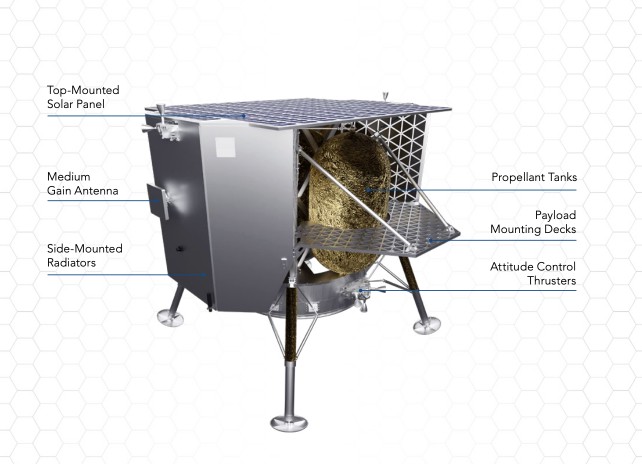
The Peregrine Lander configuration.
Get news, papers, media and research delivered. Sign up for our free newsletters.
Stay up-to-date with news and resources you need to do your job. Research industry trends, compare companies and get weekly market intelligence with Robotics 24/7.

Astrobotics
The Peregrine Lander configuration.
Moon delivery service company Astrobotic and Lunar Logistics Services are teaming up for the European Space Agency’s first commercial delivery on the moon in 2024. The companies have been selected by the European Agency to carry a landing sensor called the LandCam-X on Astrobotic’s Griffin Mission One, GM1.
The announcement was made during the 73rd International Astronautical Congress in Paris.
“Innovative technologies are a must to open the dawning new era of lunar exploration, with more sustainable and global access to the lunar surface as a focus,” Astrobotic said in a statement on Thursday. “ESA has been developing a landing camera called LandCam-X: similar to a camera on a car used for smart parking but at much higher speeds. LandCam-X, developed by a Belgian company, will take pictures during landing that are suitable for image processing algorithms improving precision and safety.”
Pittsburgh-based Astrobotic noted that the cameras will be used to “test and refine” Europe’s autonomous navigation systems.
“LandCam-X is part of ESA’s wider-ranging lunar exploration campaign that includes science, technology and services which will expand Europe’s economy to the Earth’s eighth continent, the Moon,” said David Parker, ESA’s director of Human and Robotic Exploration, in a statement.
“Astrobotic is humbled to be selected by ESA for its first-ever commercial payload delivery contract to the Moon. This is the fourth space agency to choose Astrobotic’s lunar delivery service, and another milestone toward our goal of making the Moon accessible to the world,” said Astrobotic CEO, John Thornton.
As part of Griffin Mission One, Astrobotic will deliver NASA’s Volatitles Investigating Polar Exploration Rover (VIPER) to the South Pole of the Moon. VIPER’s job will be to map the moon to check for the presence of ice.
Earlier in the week in Paris, Astrobotics announced it was launching a commercial power service to the moon called Luna Grid.
It also recently announced it had acquired Masten Space Systems, which provides “suborbital payload testing services,” according to Astrobotic.
The company, as part of NASA’s Small Business Innovation Research Sequential Phase II program, will “develop, test, and fly lunar night survival and communication technologies onboard its CubeRover platform.
“The effort will culminate in a commercial flight to the Moon for CubeRover on an upcoming Astrobotic lander mission, where it will demonstrate the platform’s ability to survive the harsh environment of lunar night and utilize satellite relays to traverse long distances,” the company said.
NASA’s VIPER team practiced driving the rover down Griffin’s sizeable ramps to mimic safely egressing onto the lunar surface.
GENISOM AI makes ICRA debut at conference in Vienna

World's first omni-modal evaluation including tactile sensing for…

Ultrasonic sensing enhances robotics perception

Cybernetix Ventures’ event kicks off Robotics Tech Week 2026 slate of events