Luxonis
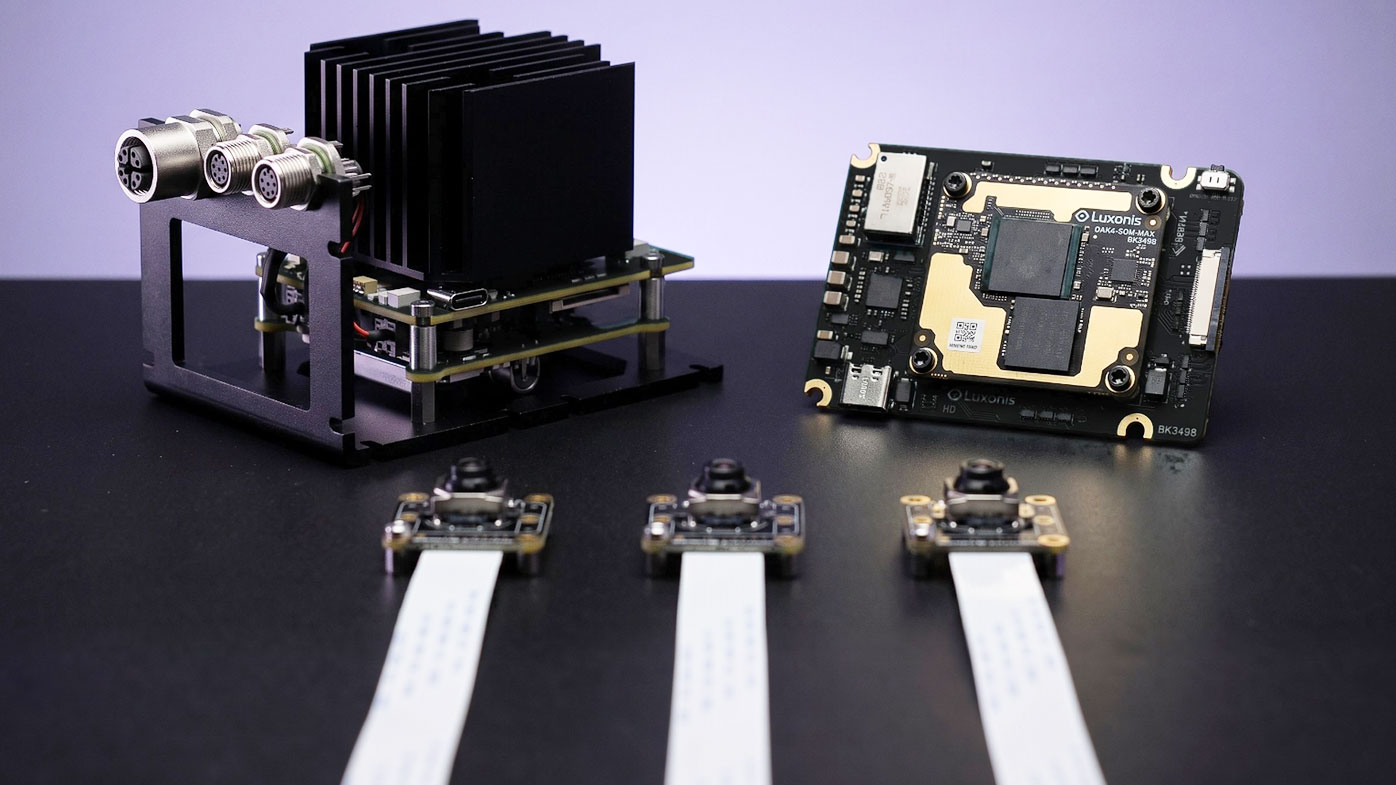
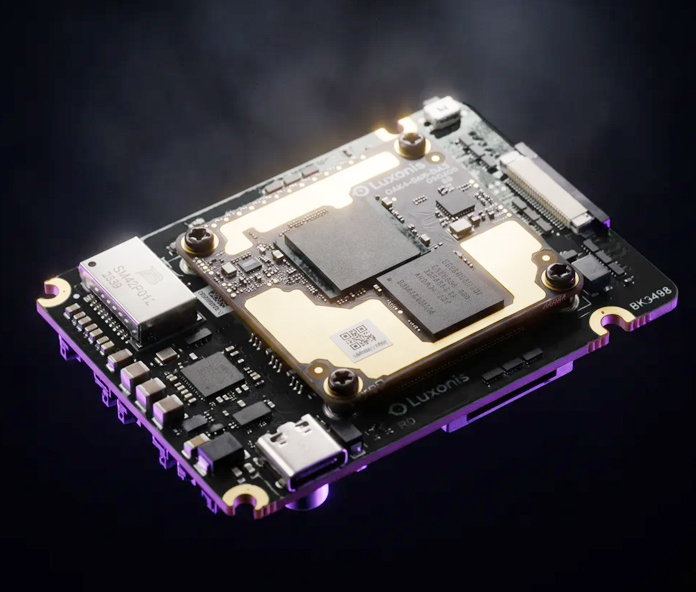
Luxonis launched the modular OAK 4 FFC, a board-level vision computer for humanoids, drones and other machines that won’t fit a standard camera.
Get news, papers, media and research delivered. Sign up for our free newsletters.
Stay up-to-date with news and resources you need to do your job. Research industry trends, compare companies and get weekly market intelligence with Robotics 24/7.

Luxonis
Luxonis launched the modular OAK 4 FFC, a board-level vision computer for humanoids, drones and other machines that won’t fit a standard camera.
Luxonis, the company behind the OAK camera and DepthAI software, announced the release of OAK 4 FFC, a modular addition to its OAK 4 family.
The company said OAK 4 FFC is a board-level vision computer for humanoids, drones and other machines that a standard camera can't fit.
Luxonis said builders can connect up to five of its camera modules in the positions and spacing their design calls for. The board then handles synchronization, calibration, stereo depth and AI on its 6-core RVC4 processor, with 52 total TOPS of compute.
The company said that currently, a custom multi-camera rig usually means sourcing compute, a carrier board, cameras and drivers from different vendors. Teams then write their own synchronization and calibration tools before the real application work starts.
With OAK 4 FFC, Luxonis said that the camera modules, compute, firmware, DepthAI SDK, and OAK Viewer come from one platform and are built to work together.
Teams choose from nine modules across three sensors: the 48 MP IMX586 color sensor, and 1 MP OV9282 and 5 MP OG05 global shutter sensors, in standard and wide fields of view. Builders set their own stereo baselines and viewpoints.
The company said, for example, that a humanoid head can carry a forward stereo pair at human eye spacing plus side and rear cameras, all on a single board. Luxonis said that thermal, time-of-flight (ToF) and additional global-shutter camera modules are coming soon.
Luxonis said that each module ships with factory-calibrated intrinsics stored on the module. The company said that users enter camera positions in OAK Viewer, and Luxonis Dynamic Calibration refines the alignment of cameras with overlapping views using ordinary scene texture. Luxonis said that this lets builders create calibrated stereo pairs with custom baselines for depth perception, or align camera views for stitching into panoramic and bird’s-eye scenes.
On a stationary system or a simpler robot, the company said that OAK 4 FFC can be the main computer. It runs the Linux-based Luxonis OS, so the camera pipeline, AI models and application logic all live on the board.
On a more complex robot, Luxonis said that it becomes the dedicated perception system. It processes everything the cameras see on the device and sends results such as depth, detections and tracked objects to the robot's main computer. The company said that the computer keeps its capacity for planning, manipulation and large AI models. For either role, Luxonis said that the board provides 2.5 Gigabit Ethernet, PoE+ through the PoE module included in the Developer Kit, 6-32 V DC input, USB-C, CAN FD and hardware frame sync.
"The machines our customers are building, from humanoids and drones to surgical and mobile robots, don't have room for a camera designed for someone else's machine,” said Bradley Dillon, CEO of Luxonis. “They kept asking for the same thing: let us choose the sensors and where they go, and you handle the hard parts underneath. With OAK Module now on RVC4, a team can design its vision system around its robot, instead of its robot around a camera."
Enjoyed this article? Add Robotics 24/7 as a preferred source in Google Search.
Edge computing gives AI agents the processing power to turn instructions into…
Daimon-TWM world model debuts for the public
Platform helps robots adapt to complex tasks
Look beyond the headlines for the latest in humanoid robots