Sensory Robotics
At Automate 2026 in Chicago, Sensory Robotics is debuting SR-1, a UL-certified, fenceless, 3D virtual robot safety system.
Get news, papers, media and research delivered. Sign up for our free newsletters.
Stay up-to-date with news and resources you need to do your job. Research industry trends, compare companies and get weekly market intelligence with Robotics 24/7.
Sensory Robotics
At Automate 2026 in Chicago, Sensory Robotics is debuting SR-1, a UL-certified, fenceless, 3D virtual robot safety system.

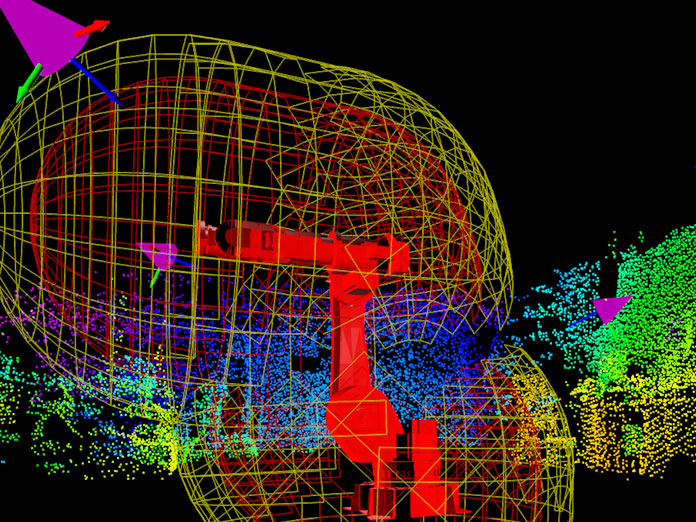
Industrial safety company Sensory Robotics will introduce the SR-1 system, which uses 3D time-of-flight sensing to create a live, invisible safety zone around an existing industrial robot, at Automate 2026 in Chicago.
The company, which said it is modernizing how people and robots work together, will offer live, unfenced robot demonstrations at Automate, allowing attendees to see SR-1 in action via large projector screen.
Sensory Robotics said that the system watches the space continuously, letting the robot run at full speed when the area is clear, slowing it down as a person approaches and stopping it instantly if someone or something gets too close.
The company said that the result is that people and fast, heavy robots can work in the same space without the cages and fences that have defined factory floors for decades.
“Industrial robots were never designed to work next to people. They were powerful machines built to be isolated,” said Chris Edwards, CEO of Sensory Robotics. “What has changed is that the industry now has both the technology and, just as importantly, the certified proof that people and robots can share a space safely.”
Physical safety fencing consumes valuable floor space and forces a choice between speed and proximity. Slow-moving collaborative robots designed to be safe near people solved the proximity problem but gave up the speed and payload that production lines depend on.
Sensory Robotics said that the harder barrier was never just engineering - it was approval. Regulated manufacturers cannot deploy a fenceless system without independent certification, no matter how well the technology performs, because insurance guidelines and regulatory compliance hinge on worker safety. Safety requirements are a large part of why the fence line has stayed in place.
“This kind of certification is one of the hardest things to achieve in our industry, and that is the point,” said Mark Gagas, chief operating officer of Sensory Robotics. “It is what lets a regulated manufacturer trust a fenceless system enough to put it on a real production line. The milestone is not the paperwork. It is the confidence it gives the people who work next to these machines every day.”
The company said that after years of effectively demonstrating its worth, the SR-1 system has been certified under UL 1740 (cULus) and validated to Performance Level d, Category 3 under ISO 13849, with a PFHd of 1.73 × 10⁻⁷, a level of safety certification that Sensors Robotics said is is notoriously difficult to achieve and that regulated manufacturers require before deploying any fenceless system.
GENISOM AI makes ICRA debut at conference in Vienna
World's first omni-modal evaluation including tactile sensing for…
Ultrasonic sensing enhances robotics perception

North America’s largest automation and robotics event takes place June 22-25