AMD
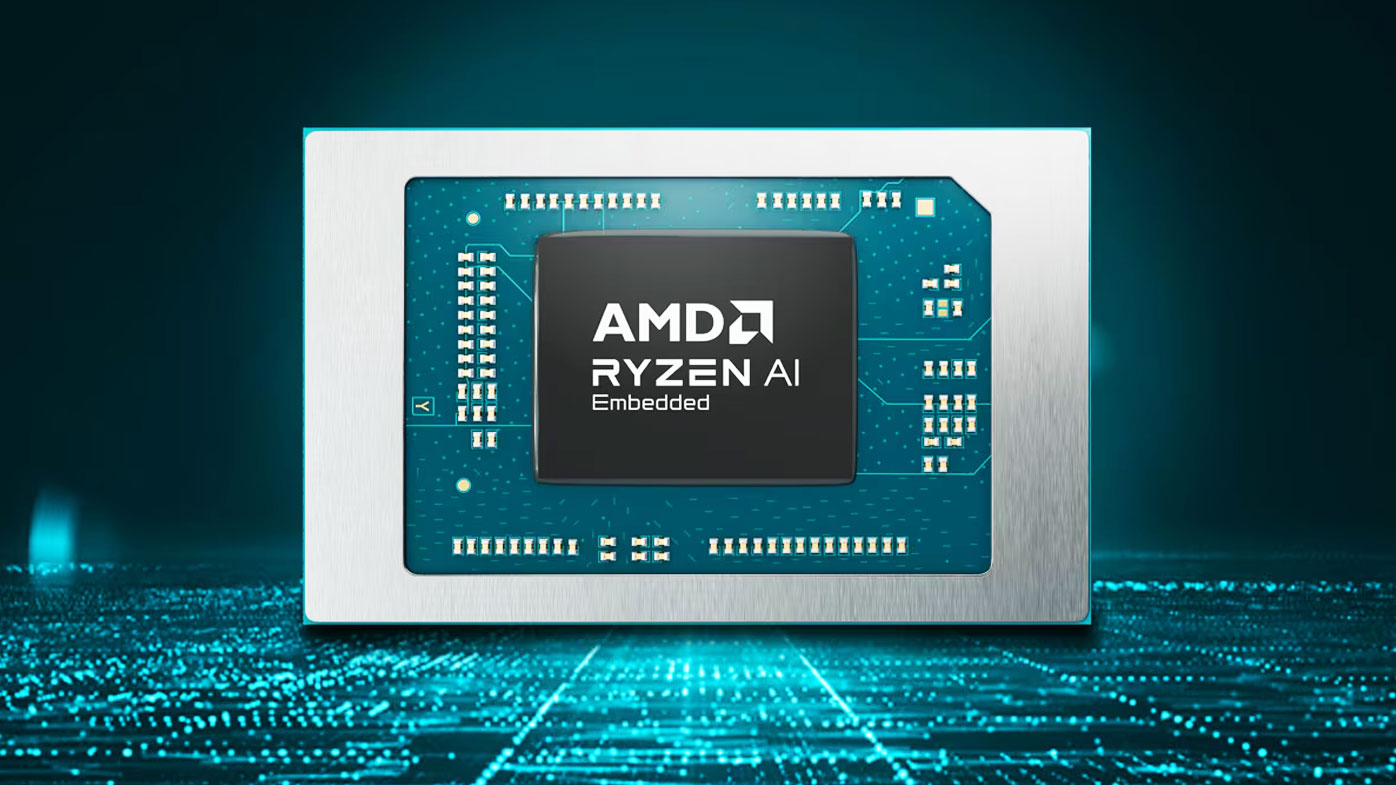
AMD released the Ryzen AI Embedded Processor Series at CES 2026 in Las Vegas.
Get news, papers, media and research delivered. Sign up for our free newsletters.
Stay up-to-date with news and resources you need to do your job. Research industry trends, compare companies and get weekly market intelligence with Robotics 24/7.

AMD
AMD released the Ryzen AI Embedded Processor Series at CES 2026 in Las Vegas.
At CES 2026, Advanced Micro Devices (AMD) introduced the AMD Ryzen AI Embedded processors, a new portfolio of embedded x86 processors designed to power AI-driven applications at the edge.
The company said the new P100 and X100 Series processors provide OEMs, tier-1 suppliers and system and software developers in automotive and industrial markets with high-performance, efficient AI compute in a compact BGA (ball grid array) package for the most constrained embedded systems.
AMD said the processors integrate the high-performance “Zen 5” core architecture for scalable x86 performance and deterministic control, an RDNA 3.5 GPU for real-time visualization and graphics, and an XDNA 2 NPU for low-latency, low-power AI acceleration - all in a single chip.
“As industries push for more immersive AI experiences and faster on-device intelligence, they need high performance without added system complexity,” said Salil Raje, senior vice president and general manager, AMD Embedded. “The Ryzen AI Embedded portfolio brings leadership CPU, GPU and NPU capabilities together in a single device, enabling smarter, more responsive automotive, industrial, and autonomous systems.”
The portfolio includes the P100 Series processors, targeting in-vehicle experiences and industrial automation, and the X100 Series processors featuring higher CPU core counts and AI TOPS performance for more demanding physical AI and autonomous systems.
AMD said the P100 Series processors feature 4-6 cores that are optimized for next-generation digital cockpits and HMI (human-machine interfaces), enabling real-time graphics for in-vehicle infotainment displays, AI-driven interactions and multi-domain responsiveness.
The company said the P100 Series delivers up to a 2.2X multi-thread and single-thread performance boost over the previous generation, ensuring deterministic control in a compact 25×40 mm BGA package. With a 15-54-watt operating range and support for -40°C to +105°C environments, it is built for harsh, power- and space-constrained edge systems and 10-year lifecycles.
The P100 Series processors integrate an RDNA 3.5 GPU, which the company said delivers an estimated 35% faster rendering to power up to four 4K (or two 8K) digital displays simultaneously at 120 frames per second. The AMD video codec engine enables high-fidelity, low-latency streaming and responsive playback without burdening the CPU.
The next-generation AMD XDNA 2 NPU delivers up to 50 TOPS, for up to 3x higher AI inference performance, according to AMD. XDNA 2 architecture combines an understanding of voice, gestures and environmental cues using supported AI models, including vision transformers, compact LLMs and CNNs.
AMD said the Ryzen AI Embedded processors provide a consistent development environment with a unified software stack that spans the CPU, GPU and NPU. At the runtime layer, the company said that developers can benefit from optimized CPU libraries, open-standard GPU APIs and a native XDNA architecture AI runtime enabled through Ryzen AI Software.
The entire software stack is built on the open-source, Xen hypervisor-based virtualization framework that securely isolates multiple operating system domains. This enables Yocto or Ubuntu to power the HMI, FreeRTOS to manage real-time control, and Android or Windows to support richer applications, all running safely in parallel.
With an open-source foundation, long-term OS support and an ASIL-B capable architecture, AMD said the processors can help customers reduce costs, simplify customization and accelerate the path to production for automotive and industrial systems.
GENISOM AI makes ICRA debut at conference in Vienna
World's first omni-modal evaluation including tactile sensing for…
North America’s largest robotics and automation event winds down

Automate’s largest day ever draws huge crowds to McCormick Place