By
Josh Bond
August 3, 2017
Get news, papers, media and research delivered. Sign up for our free newsletters.
Stay up-to-date with news and resources you need to do your job. Research industry trends, compare companies and get weekly market intelligence with Robotics 24/7.

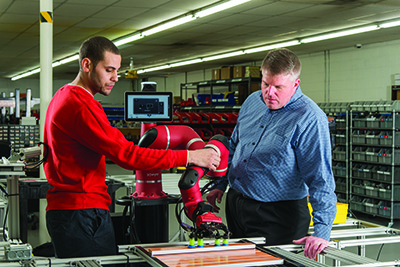
Family-owned and operated for three generations, Acorn Sales Company in Richmond, Va., is a specialist in customized, handmade rubber stamps and embossing seals. To maintain throughput, improve quality and reduce its reliance on outside suppliers, the company now uses a collaborative robot to support manufacturing. As a result, the company has significantly shortened its supply chain.
Before the new collaborative robot (Rethink Robotics), Acorn purchased pre-cut stamp mounts with handles from a third-party supplier, which led to variable pricing, shipping delays and inconsistent stamp mount quality. The company had long sought an option for bringing this process in house, but doing so was too expensive to automate and too tedious for human workers.
The robot operates a band saw and transfers, aligns and cuts pieces of wood to be used as mounts for rubber stamps. The robot cuts, drills and inserts the wooden handles for the stamp mounts, effectively automating a complicated, multi-step process.
“As a family-owned business, one of our main concerns is creating a business that can be sustained through future generations,” says Holly Raidabaugh, vice president. “Since deploying, we have drastically reduced the length of our supply chain, which has saved us money and given us more control over the quality of our products. The market has changed significantly, and customers have more expectations for customization than ever before. The ability to ensure quality without sacrificing flexibility or affordability has been a huge win for us.”
Moving forward, Acorn hopes to deploy robots on a variety of tasks, including a potential overnight shift.

Josh Bond was Senior Editor for Modern through July 2020, and was formerly Modern’s lift truck columnist and associate editor. He has a degree in Journalism from Keene State College and has studied business management at Franklin Pierce University.
Enjoyed this article? Add Robotics 24/7 as a preferred source in Google Search.
Edge computing gives AI agents the processing power to turn instructions into…
Daimon-TWM world model debuts for the public
Platform helps robots adapt to complex tasks

Look beyond the headlines for the latest in humanoid robots