NVIDIA
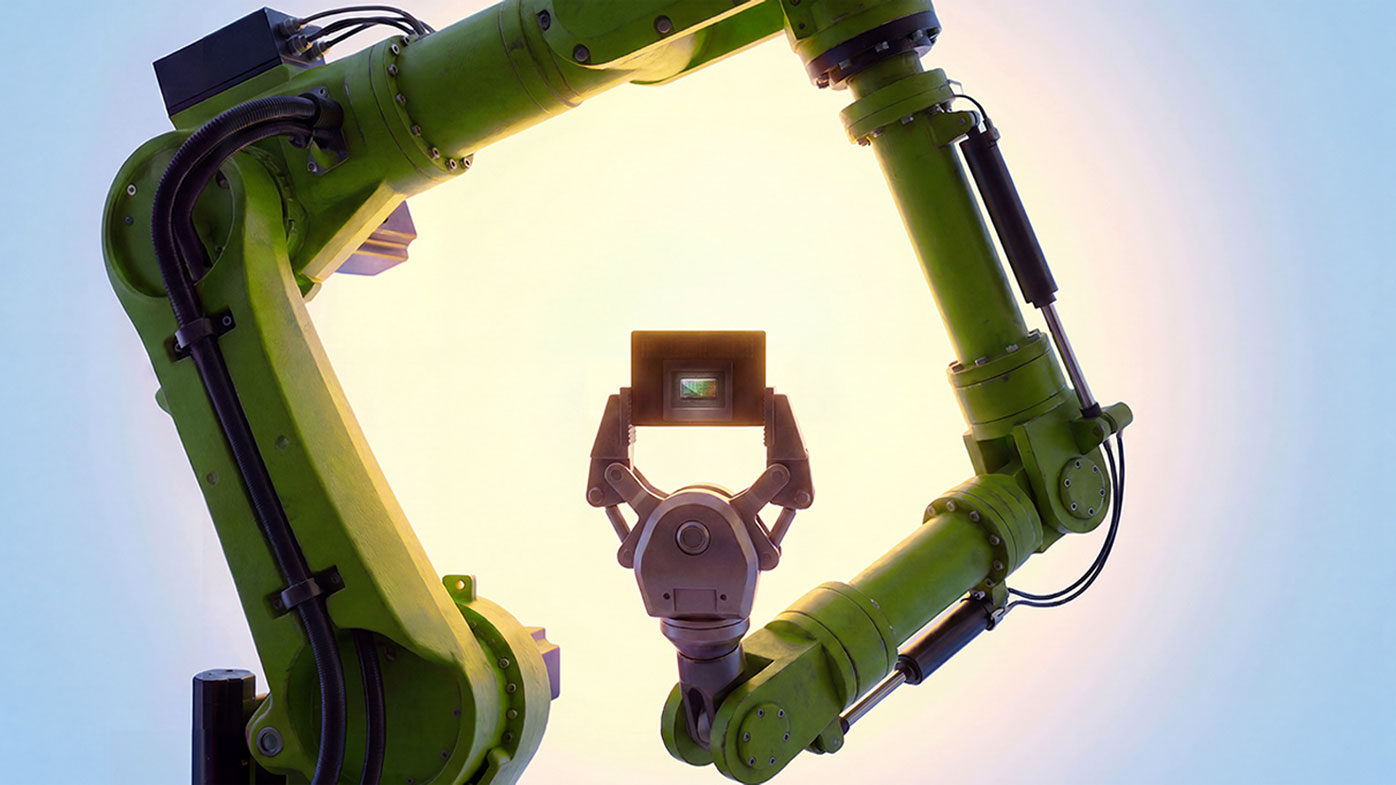
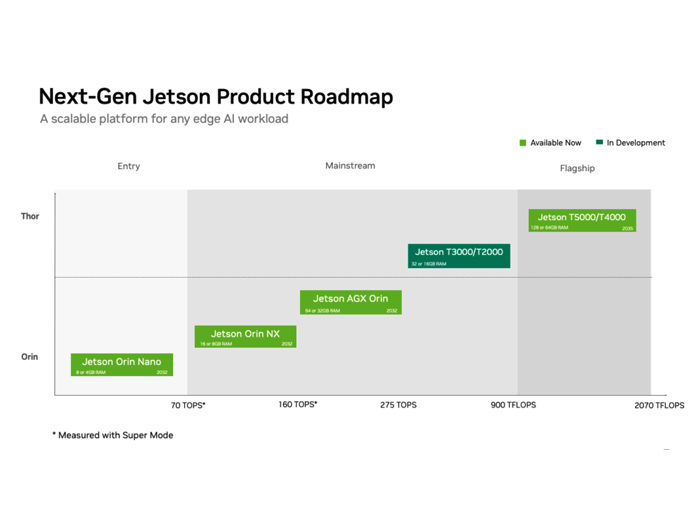
NVIDIA's next-gen roadmap for Jetson includes the newest releases, the Jetson T2000 and T3000.
Get news, papers, media and research delivered. Sign up for our free newsletters.
Stay up-to-date with news and resources you need to do your job. Research industry trends, compare companies and get weekly market intelligence with Robotics 24/7.
NVIDIA
NVIDIA's next-gen roadmap for Jetson includes the newest releases, the Jetson T2000 and T3000.
NVIDIA announced the introduction of the T3000 and T2000, new modules based on the NVIDIA Thor architecture, which the company said enables mass-market robotics and edge AI applications at scale.
The company said that general-purpose robots and autonomous machines are moving from research labs to real-world mass-market deployment, creating demand for compact, power-efficient AI supercomputers capable of running foundation models at the edge.
NVIDIA said that its Jetson AGX Thor is powering this next generation of humanoid and robotic systems, with growing adoption across industries. NVIDIA added that companies - including 1X, Agile Robots, Amazon Robotics, Boston Dynamics, FANUC, Hitachi and Techman Robot - are building on the platform.
NVIDIA said that the hardware underpinning those aforementioned capabilities starts with the Jetson and IGX T3000 modules, which deliver 865 FP4 teraflops of AI compute in a compact form factor roughly half the size and power of the T5000. Jetson T3000 combines an NVIDIA Blackwell GPU, an eight-core Neoverse Arm CPU, 32GB of LPDDR5X memory and 273GB/s of memory bandwidth, along with 25 GbE connectivity.
The company said that the IGX T3000 delivers the same performance with integrated functional safety while running the NVIDIA Halos for Robotics full-stack safety system for robots operating alongside humans.
Despite its smaller footprint, NVIDIA said that the T3000 achieves similar inference performance of the T5000 for multimodal workloads, including large language models, vision language models, vision language action models and world foundation models. The company said that migrating to T3000 helps reduce costs amid high memory prices.
NVIDIA said that the Jetson T2000 brings the Thor architecture to a broader range of edge AI systems. With 400 FP4 teraflops of compute and 16GB of memory, the company said that it provides an entry point for developers building visual AI agents, autonomous mobile robots, industrial manipulators and other intelligent machines.
With the introduction of the new NVIDIA Jetson modules, NVIDIA said that it now offers a scalable edge AI platform spanning performance from 70 TOPS to 2,000 teraflops, enabling developers to address virtually any edge AI workload.
Click here to learn more about the new Jetson Thor computers and skills for robotics and edge AI development.
Enjoyed this article? Add Robotics 24/7 as a preferred source in Google Search.
Edge computing gives AI agents the processing power to turn instructions into…
Daimon-TWM world model debuts for the public
Platform helps robots adapt to complex tasks
Look beyond the headlines for the latest in humanoid robots