Cadence
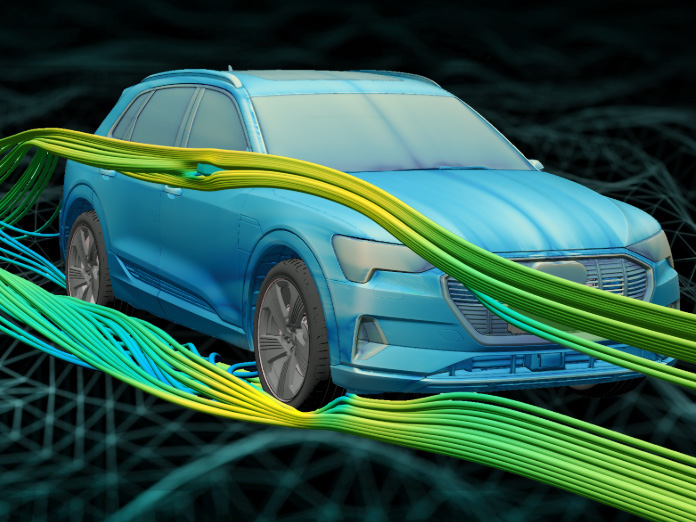
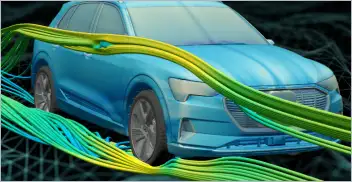
CFD simulation of vehicle aerodynamic performance
Get news, papers, media and research delivered. Sign up for our free newsletters.
Stay up-to-date with news and resources you need to do your job. Research industry trends, compare companies and get weekly market intelligence with Robotics 24/7.
Cadence
CFD simulation of vehicle aerodynamic performance
Automotive, aerospace, and other engineering-driven industries are working within shorter development cycles while performance targets continue to rise. Electric vehicle (EV) programs must translate aerodynamic gains into measurable range improvements. Aircraft programs must assess performance in cruise and off-cruise conditions such as takeoff, landing, and other demanding operating scenarios. Engineering teams also need reliable insight before physical prototypes are available or affordable. As a result, simulation is moving closer to the point where design choices are made.
As computational fluid dynamics (CFD) moves earlier in the design cycle, workflows must handle larger models, more complex physics, and shorter review cycles. A unified, AI-enabled CFD workflow allows teams to run simulations faster, explore more designs, and make better decisions earlier.
In the automotive industry, aerodynamics has a direct impact on vehicle range, energy efficiency, and fuel economy. For EVs in particular, reducing drag can translate into meaningful improvements in driving range, while for internal combustion vehicles, it can improve fuel consumption. At highway speeds, roughly half of vehicle propulsion energy can be spent overcoming aerodynamic drag, making small design improvements highly valuable when they are accurately quantified.
The challenge is that vehicle aerodynamics is rarely about one large design change. Teams often work through an “aero walk,” evaluating many small enablers such as grille shutters, belly pans, tire covers, ride-height changes, and exterior shape refinements. Each option may offer a modest gain, but each also carries cost, packaging, styling, and manufacturing implications. Engineers, therefore, need high-confidence CFD results that can assess the full vehicle holistically and support quantified recommendations.
That need for confidence raises a common CFD tradeoff: when is Reynolds-averaged Navier-Stokes (RANS) sufficient, and when is large eddy simulation (LES) required? RANS can provide efficient answers for many design studies, while LES may be needed when transient flow structures, separation, wake behavior, or higher-fidelity accuracy become critical. The difficulty is balancing accuracy with practical turnaround time. At the same time, model complexity makes geometry cleanup and mesh preparation difficult at scale, especially when CAD contains gaps, overlaps, leaks, or other imperfections. Isolated tools further slow the process because data must move between preprocessing, solving, and post-processing environments.
Aerospace engineering faces a parallel but even more physics-intensive challenge. Aircraft must be understood in both cruise and off-cruise conditions where high-lift configurations, flaps, slats, separation, transition, and stall-adjacent behavior become critical. Wind tunnel and flight testing remain essential, but they are expensive, time-consuming, and not always able to reproduce the full range of real-world operating conditions. For edge-case phenomena near stall, lower-fidelity approaches can miss important aerodynamic behavior.
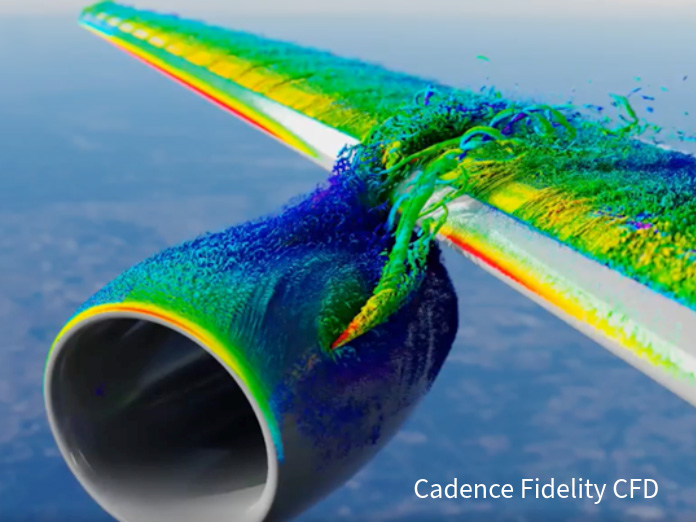
High-fidelity CFD can reduce dependence on physical testing and improve risk assessment, but only if it can run within engineering timelines. Aerospace applications often require multidisciplinary simulation across aerodynamics, aeroacoustics, heat transfer, multiphase flow, and fluid–structure interaction. They also involve large assemblies with many interacting parts, where full-system simulation can quickly become limited by model size, compute resources, and disconnected workflows. To make simulation a practical design driver, aerospace teams need a unified flow that can handle complex physics, large-scale models, and design space exploration without forcing engineers through repeated manual handoffs.
AI is most effective when applied across the full CFD decision cycle, from design change to engineering insight. It can automate repetitive setup tasks, accelerate high-fidelity dataset generation, predict aerodynamic quantities in near real time, and help engineers learn from previous simulations. In a mature workflow, AI strengthens engineering judgment by directing attention to the design questions with the greatest impact.
For example, AI-based prediction can screen trained design scenarios in seconds or less, enabling teams to explore broader design spaces before committing compute resources to full-order simulations. Recommendation-driven workflows can point engineers toward promising changes, while analytics and knowledge systems can turn past simulation data into a reusable asset. This is especially important in fast-moving programs where near-instant feedback can determine whether simulation informs a design decision or arrives too late to matter.
A unified, AI-enabled CFD workflow allows teams to run simulations faster, explore more designs, and make better decisions earlier. The value comes from connecting automation, high-fidelity simulation, data intelligence, and post-processing into one continuous engineering process.
Cadence brings these capabilities together through an integrated workflow spanning ANSA, AutoSeal, Fidelity, META, and AI intelligence. ANSA supports geometry preparation, cleanup, meshing, morphing, and automation, helping teams manage increasingly complex models while maintaining simulation-ready quality. Fidelity AutoSeal accelerates one of the most persistent CFD pain points by automatically repairing dirty CAD, closing gaps, and filling holes, reducing manual cleanup effort and improving consistency.
Fidelity then provides the high-fidelity solver foundation for demanding CFD applications, supporting efficient use of RANS and LES depending on the accuracy required. GPU-resident solver technology and accelerated computing make it possible to bring advanced physics earlier into the design cycle, rather than reserving them for late-stage validation. META completes the workflow by enabling high-performance visualization, quantitative analysis, multi-run comparison, and automated reporting so that large datasets can be converted into actionable insight faster.
The impact is measurable. In a benchmark workflow using a 213-million-cell Audi e-tron 55 Quattro model, automation and morphing reduced updated-design turnaround from approximately 22 hours to as little as 4 hours, enabling two or more design variants per day while maintaining consistent mesh quality and solver setup. With AI-based prediction, trained scenarios can move toward near-real-time exploration, further compressing the path from simulation to decision.
Learn how the ANSA–AutoSeal–Fidelity–META workflow helps engineering teams move from raw CAD to actionable insight faster.
Interested in learning more?
From geometry preparation to AI-assisted analysis, integrated CFD workflows…
GENISOM AI makes ICRA debut at conference in Vienna
North America’s largest robotics and automation event winds down
Automate’s largest day ever draws huge crowds to McCormick Place