Festo
By
Phil Britt
July 14, 2026
Festo
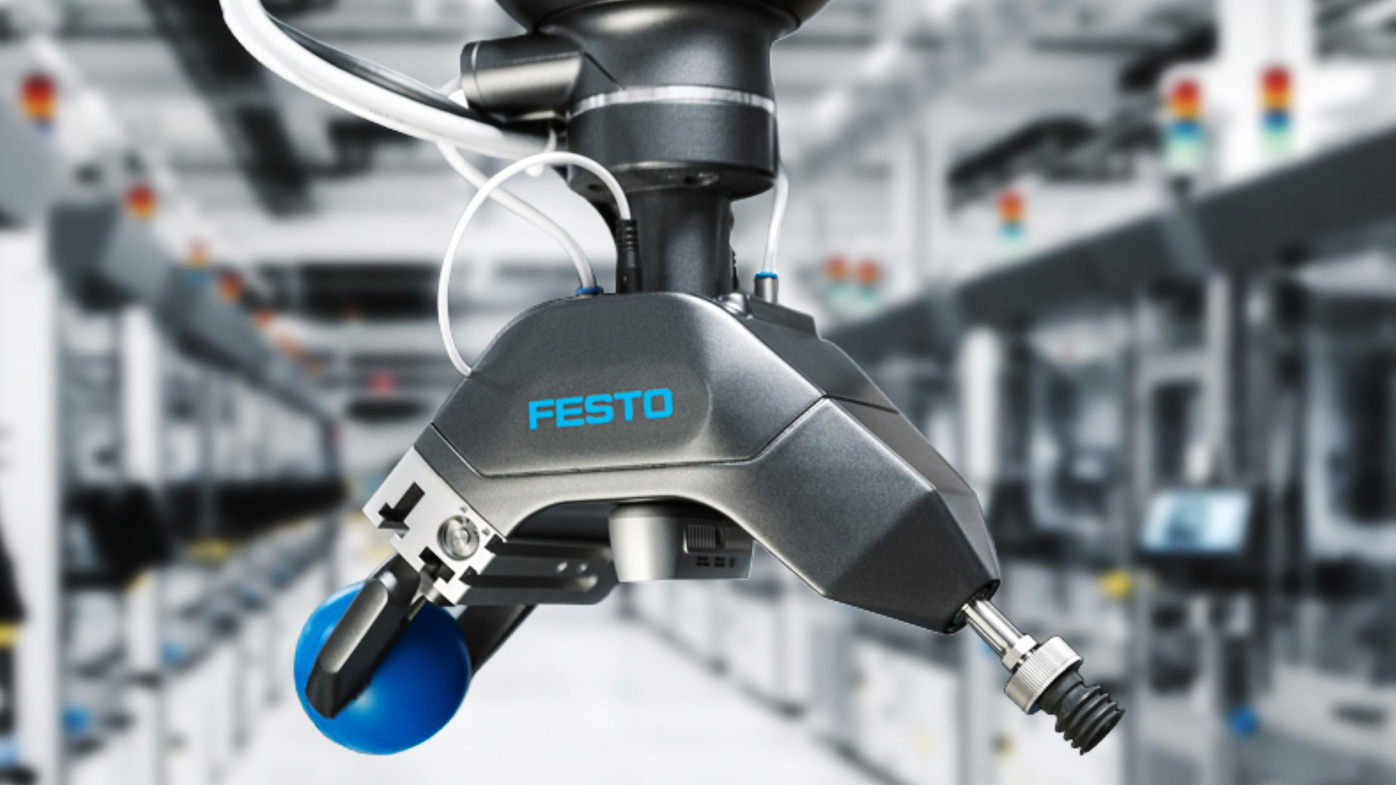
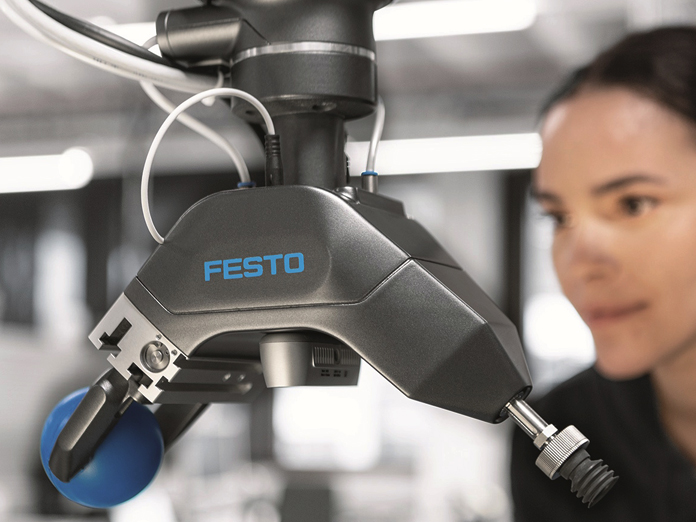
Festo's Gripper AI platform harnesses the power of hardware and software to enable precise picking with various end-of-arm tools.
Get news, papers, media and research delivered. Sign up for our free newsletters.
Stay up-to-date with news and resources you need to do your job. Research industry trends, compare companies and get weekly market intelligence with Robotics 24/7.

Festo
Festo's Gripper AI platform harnesses the power of hardware and software to enable precise picking with various end-of-arm tools.
Germany-based Festo prides itself on seamless automation for all of its products, whether it’s software or hardware, which was the basis for its GripperAI technology.
Though other providers are offering AI-based software for robotic grippers, their approach involves more training and becomes increasingly complex as the number of items to be gripped grows, according to Eberhard Klotz, Festo's head of marketing products and technologies.
Other AI-based gripper software is designed to be trained on different types of items. For example, first the user or developer would train it to pick up a hammer, then a saw, then an item of a different shape and size, and so on and so on.
Some offerings use CAD files of objects to train the gripper. Klotz said such a technology is fine for gripping a handful of objects, but once that number goes much higher, scalability becomes an issue, particularly in a fast-moving operation where the projects change quickly.
Festo saw an opportunity for a gripper software package designed to fit all types of robots, cobots and Cartesian handling systems, and to work with various kinds of cameras and different types of grippers.
In designing GripperAI, Festo wanted to be as generic as possible, focusing on basic geometries such as squares, rectangles, balls and circles, Klotz explained. This synthetic data is then used to simulate any type of potential object that could be gripped. There were more detailed elements as well, though the company didn’t want to divulge them at this time, citing its pending patent.
By using AI designed for generic picking, Festo users avoid the need to train the software on how to grab individual items.
Though GripperAI technology was officially launched in May 2026, the seeds of the technology were planted many years ago.
The company itself is 100 years old, and has worked with pneumatic and servo drive technologies for decades, Klotz said. “Our company is well-experienced with mechanical tasks of moving objects from point A to point B and with motion control. That mechanical knowledge gave us a great competitive advantage because we aren’t a startup company starting from zero.”
The move to develop AI is much more recent, getting a jumpstart when Festo acquired AI company Resolto in 2018. This acquisition provided Festo with the underlying technology, as well as a host of AI experts.
The company’s strong R&D environment was the basis for the initial development of the software platform, Klotz explained. “You need to test whether your development and ideas fit practical needs and uses.”
GripperAI is more than just an engineer’s idea, added Andreas Schoch, product manager for strategic customer business at Festo. “It's a real solution. We’re getting feedback [from pilots] so we can make it better in the future.”
Festo gives a lot of freedom for employees to think outside of the box in developing and improving offerings. Management encourages R&D staff to continue to experiment with new technologies, Klotz added. “This approach is a big accelerator in our company’s innovation.”
GripperAI is currently being used in a pair of pilots, one undisclosed and the other at Würth Group, a global provider of fastening and assembly offerings for industrial, construction and automotive applications. Festo said that its Festo Customer Service Center, an internal logistics company, is also utilizing GripperAI.
Würth uses GripperAI in combination with a robot cell that is equipped with a tool station. The robot can use a variety of suction cups and grippers. GripperAI determines which tool is most suitable depending on the type of object, shape and surface finish. Using an integrated camera in the robot recognizes the various objects, enabling precise selection.
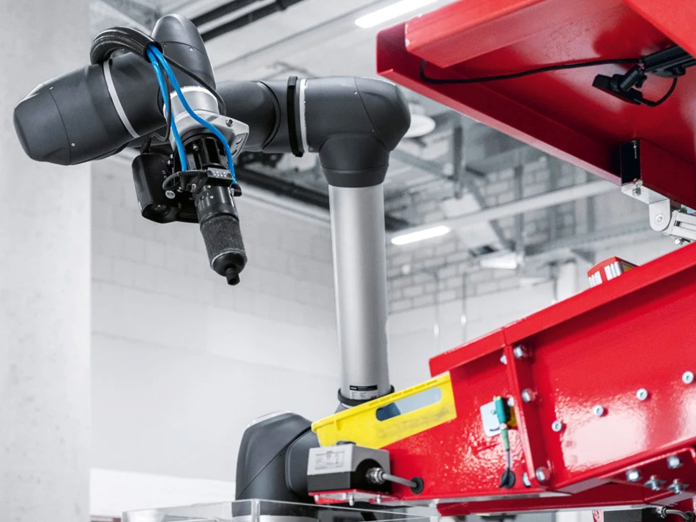
By running on the cell and an edge computer rather than in the cloud, the operator receives real-time performance, which in many applications is a bigger need than the centralization of the software, according to Klotz.
Würth, which has over 1 million parts in its stores, had been looking for a generic picking technology like the one that Festo was developing. The companies collaborated to develop a cobot picking offering for many of the items, such as the generic packages, bags, etc. However, there are still some items that the GripperAI technology doesn’t work with due to a variety of gripping issues, Klotz said. Some items are too fragile or complicated to be handled by existing grippers. Packaging and unpackaging pose other challenges for today’s gripping technology, though Klotz sees those as large opportunities for GripperAI’s future growth.
Another complication is that the underlying gripping technology needs to be correct for the task. For example, if the robot and gripper are designed to work with two-kilogram loads such as a heavy jacket or two hardcover textbooks, it won’t work with 20-kilogram cement bags, regardless of the software in use.
Before GripperAI moves into wider production, Festo wants to ensure that the pilots are meeting their full expectations. There isn’t a definitive timeline for moving beyond the pilots, according to Klotz.
The company said that it is continuing to evolve its AI offering. Earlier this year, Festo held an AI month in which employees throughout the company could use, test and experiment with the technology to determine how it might help them with their daily tasks, whether in R&D or some other area of the company.
Festo is looking to expand Gripper AI’s functionality beyond today’s uses and to further develop the underlying technology so that AI-based gripping knowledge can be shared between robots.
Klotz sees future expansion of GripperAI usage, particularly if some of the complications of packing and unpacking are solved. Amazon and other fulfillment companies, all of which have large warehouse operations, need technology that automates at least part of the packing and unpacking, according to Klotz, citing the shortage of labor to fill such positions, particularly in times of high demand, like the holiday shopping season.
GripperAI’s ease of use makes it ideal to help in those and other picking applications, Klotz added. “It is very flexible, you do not need any training, you can just get started.”
Phil Britt is the owner of S&P Enterprises, and a veteran technology writer who lives in the greater Chicago area. His work has appeared in several national technology, financial services and business publications, including magazines, newsletters, conference dailies and online sites. He is a graduate of Purdue University.

Britt owns S&P Enterprises and is a technology writer who lives in the greater Chicago area. In addition to Robotics 24/7, he has written for financial services and business publications, including magazines, newsletters, conference dailies, and Web sites.
Artificial Intelligence Machine Vision Machine Learning Industrial Automation Collaborative Robots Robot Arm Components Grippers Sensors Cameras Software Cloud and Edge Simulation News Features Editors Pick Assembly CAD Cobots Deployment Festo Corporation Fulfillment Grippers Labor Shortage Picking Research & Development

From geometry preparation to AI-assisted analysis, integrated CFD workflows…
Software-based GripperAI manages mixed picking through basic geometry
Safety, communication and motion control components enable smooth operation

North America’s largest robotics and automation event winds down