Beckhoff Automation
By
Tim Culverhouse
July 13, 2026
Beckhoff Automation
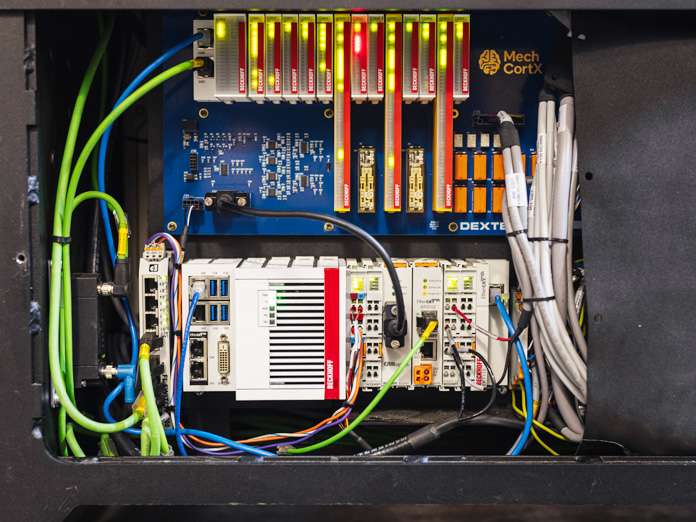
Dexterity uses PCB-mounted EJ series EtherCAT I/O terminals in place of traditional wired I/O terminals to minimize Mech’s wiring requirements and maximize mass production efficiency.
Get news, papers, media and research delivered. Sign up for our free newsletters.
Stay up-to-date with news and resources you need to do your job. Research industry trends, compare companies and get weekly market intelligence with Robotics 24/7.
Beckhoff Automation
Dexterity uses PCB-mounted EJ series EtherCAT I/O terminals in place of traditional wired I/O terminals to minimize Mech’s wiring requirements and maximize mass production efficiency.
As warehouses become increasingly automated, robotics developers are discovering that artificial intelligence alone isn't enough. Physical AI - the ability for robots to perceive, reason and safely interact with dynamic environments - depends just as much on the automation architecture beneath the surface as it does on advanced algorithms.
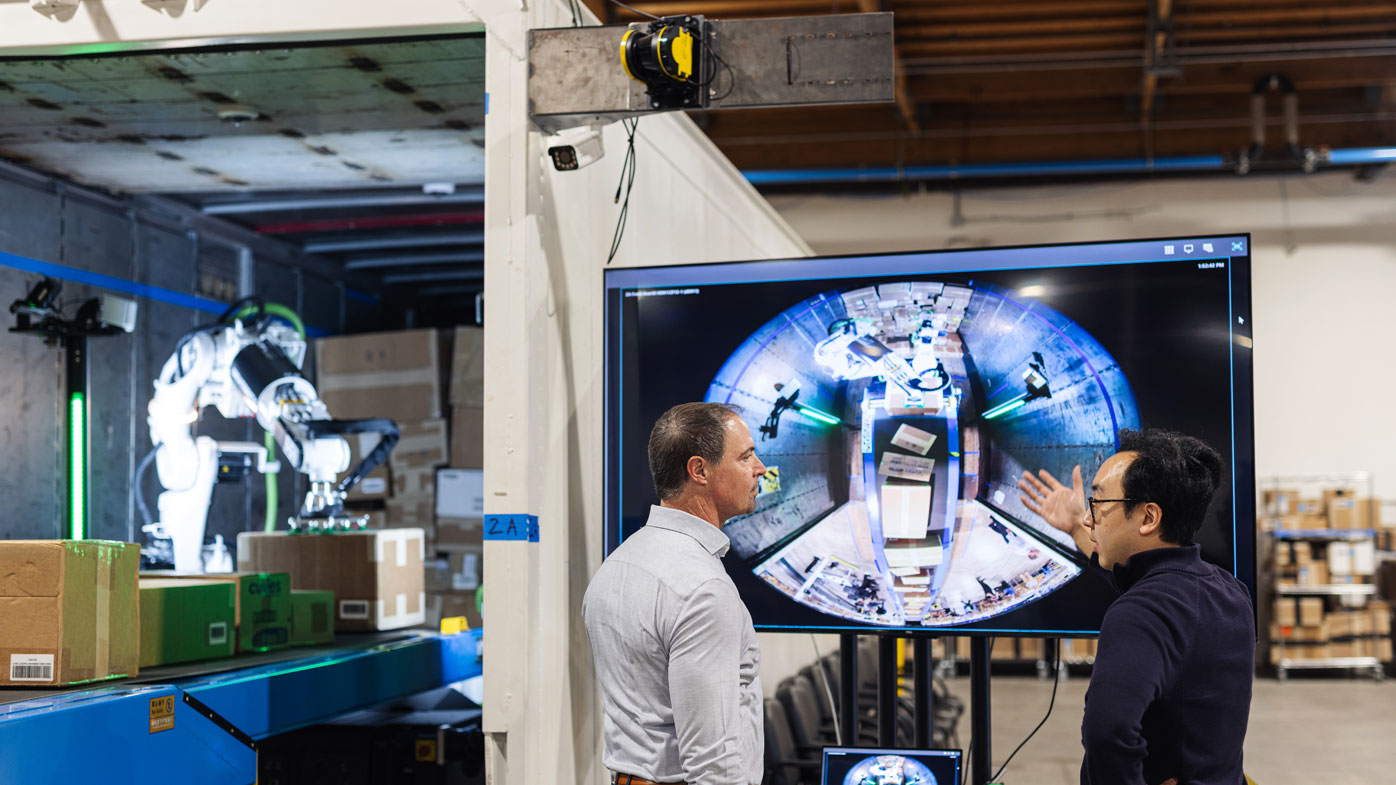
Dexterity, a provider of physical AI and robotics, selected Beckhoff Automation's PC-based control platform, EtherCAT communication technology and integrated automation ecosystem to power Mech, its industrial "superhumanoid" robot.
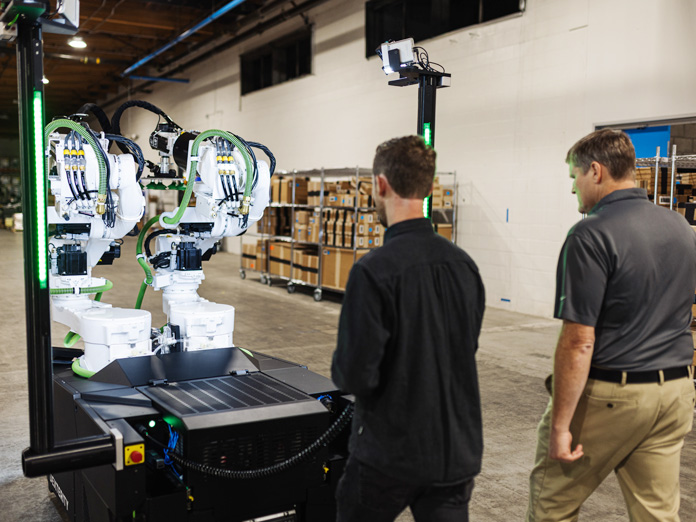
Designed for physically demanding warehouse tasks such as truck loading, unloading, palletizing and depalletizing, Mech combines dual robotic arms with an autonomous mobile base, requiring real-time communication between motion control, safety systems and AI-driven decision making.
The result is a tightly integrated and versatile robotic platform that demonstrates how modern PLC technology and deterministic networking are becoming foundational components of next-generation physical AI.
Dexterity's engineering team wasn't searching for individual automation products - they wanted a unified architecture capable of scaling alongside the company's physical AI platform. Rather than assembling multiple controllers and communication networks, Dexterity adopted Beckhoff's integrated ecosystem built around PC-based control, EtherCAT networking, TwinCAT automation software and TwinSAFE safety technology.
“We had two major problems we needed to solve,” said David Turney, engineering technical lead at Dexterity. “One, we needed to unify both safety and controls in the same system. And two, we needed to create a scalable product. Part of that is getting rid of terminal blocks and discrete wires by using PCBs. Beckhoff has a portfolio of devices, specifically their EJ modules, which allow us to design a custom PCB using their I/O and safety modules with our custom electronics and cable connectors for the full system harnessing.”
That decision aligned with Dexterity's long-term product strategy.
"Our focus is to create a hardware platform," said Keshav Prasad, SVP of Hardware at Dexterity. "A hardware platform doesn't necessarily mean a single product that does everything. It's a set of modular components that can be put together like Lego blocks.”
At the center of Mech's architecture is EtherCAT, Beckhoff's industrial Ethernet communication protocol.
EtherCAT enables deterministic communication between controllers, servo drives, I/O modules and safety devices with low latency and virtually no communication jitter. Those characteristics become especially important when coordinating an autonomous mobile robot carrying two independent robot arms operating around people.
"Some of the Dexterity team, including the founders, had worked with EtherCAT at Stanford," said Doug Schuchart, global intralogistics industry manager at Beckhoff. "EtherCAT was one of the main elements of my conversation with the Dexterity team.”
Schuchart noted that EtherCAT's openness, communication speed and integrated safety capabilities eliminated many of the limitations associated with traditional fieldbus architectures.
"It's the most open and fastest fieldbus protocol in the market," Schuchart said. "Companies like Dexterity don't have to worry about throughput limitations, and it offers incredible bandwidth, which is important for transmitting the sensor data necessary for physical AI.”
While Dexterity's AI software determines how Mech interacts with its environment, Beckhoff's embedded control platform executes the real-time machine control required to safely perform those decisions.
Mech uses the compact CX5240 Embedded PC to manage lower-level motion control and safety logic while complementing Dexterity's AI-driven decision-making layer.
That separation allows AI to focus on perception and task planning while Beckhoff's PLC platform delivers deterministic execution of motion commands.
"We're able to combine the PLC, the motion control, the safety, the navigation for the autonomous vehicle and, in the case of Dexterity, even combine the physical AI analytics into one Beckhoff controller," Schuchart said. "Everything can be executed synchronously instead of having separate controllers with asynchronous communication."
That synchronization, according to the companies, improves diagnostics, simplifies lifecycle management and increases overall system performance. It also reduces the physical size of the control components and lowers overall cost.
Warehouse environments introduce unique safety challenges. Mech must safely navigate around people while simultaneously controlling two robotic arms capable of lifting heavy packages inside confined trailers.
Rather than separating safety and control networks, Dexterity integrated both over EtherCAT using Functional Safety over EtherCAT (FSoE).
"Safety is the core of our system," Turney said. "We made the decision to put safety and controls all in the same network using EtherCAT. That allowed us to have a very flexible system that creates safety from a base layer while allowing much more innovation in the controls."
The architecture also simplifies the robot's internal wiring. Because Mech uses safety-rated servo drives connected over EtherCAT, each drive requires only power and network communication instead of additional discrete safety wiring.
“Our focus has always been working from the customer's needs,” Prasad said. “It's not working in forward motion from technology. We always wanted to do full stack, and we always wanted to make sure that it's a product, not a hard-won experiment or a product that only works in prototypes. But when it came to real production, we didn’t have to do a whole redesign. Our strategy was to really think of a full stack, including safety. That's why when you get into the details, you realize how integrated all of these elements are.”
Rather than simply supplying hardware, Beckhoff's Special Project Team worked alongside Dexterity engineers during implementation, training and commissioning.
"We worked directly with Beckhoff's Special Project Team, and they have world-class support and documentation," Turney said. "There weren't a whole lot of surprises when it came to our development process."
Perhaps the most notable aspect of this collaboration is how closely Beckhoff and Dexterity worked throughout development.
"The Dexterity team came to us with previous knowledge of EtherCAT and tremendous knowledge of robotics," Schuchart added. "Combined with Beckhoff's knowledge of control systems, mobile robotics and safety, it really brought together a great respect and partnership between the two companies very quickly."
As physical AI continues moving beyond warehouses and into broader industrial applications, that combination of deterministic control, integrated safety and scalable automation architecture may prove just as important as the AI models themselves.

Tim is the Editorial Director of Robotics247.com. His mission is to provide valuable information and insights to robotics professionals and decision-makers, and to help them solve business challenges. He is a creative, deadline-driven, and detail-oriented storyteller. In addition, he is a sports broadcaster and public address announcer.
Artificial Intelligence Machine Learning Autonomy Mobile Robots Industrial Automation Robot Arm Components Controllers Motion Control Motors and Drives News Features Editors Pick Autonomous Mobile Robots Beckhoff Automation Depalletization Dexterity Motion Control Palletizing Perception PLCs Safety
From geometry preparation to AI-assisted analysis, integrated CFD workflows…
Safety, communication and motion control components enable smooth operation
North America’s largest robotics and automation event winds down
Automate’s largest day ever draws huge crowds to McCormick Place