By
Eugene Demaitre
August 29, 2023
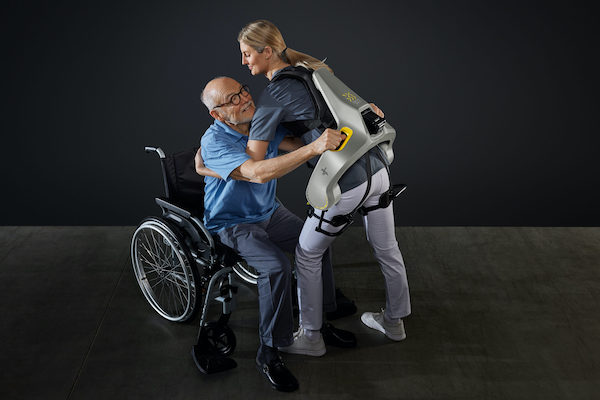
German Bionic
The Apogee+ exoskeleton is designed to help with tasks such as lifting patients.
Get news, papers, media and research delivered. Sign up for our free newsletters.
Stay up-to-date with news and resources you need to do your job. Research industry trends, compare companies and get weekly market intelligence with Robotics 24/7.
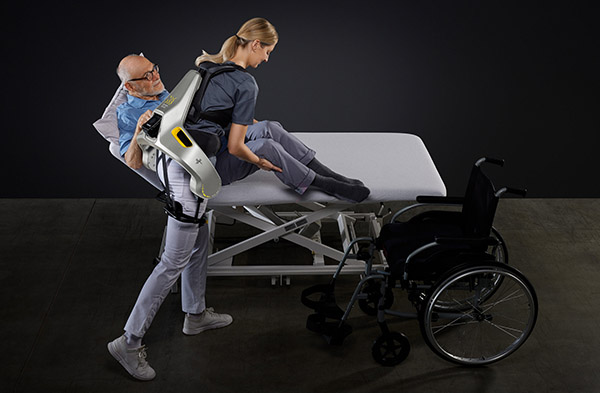
German Bionic
The Apogee+ exoskeleton is designed to help with tasks such as lifting patients.
Nurses and other care staffers have come under tremendous stress, particularly during the COVID-19 pandemic. German Bionic today officially introduced its Apogee+ powered exoskeleton to the North American healthcare market. The company said it designed the technology as a "personal lift assist."
“With its full range of features, our new Apogee+ power suit is designed to help ease the extremely demanding working conditions in these system-critical professions, making the jobs safer and more sustainable,” said Armin G. Schmidt, founder and CEO of German Bionic, in a release. “Based on our early success in the European market, we firmly believe that our smart companions will soon become an indispensable part of everyday practice at health clinics and nursing homes here in the U.S.''
German Bionic develops and manufactures smart power suits and other wearable technologies. It claimed that it was the world’s first company to deliver connected exoskeletons for the workplace. German Bionic said it applies artificial intelligence to support lifting movements and prevent poor posture.
Numerous studies have examined how strain from physical exertion poses health risks ot nurses and care professionals, noted German Bionic. In combination with a lack of appreciation for their roles during the pandemic, many have sought early retirement.
The user-friendly Apogee+ addresses these worker-safety and job-satisfaction concerns, said the company. It listed the following product features:
Because German Bionic worked closely with hospitals during the devlopment of Apogee+, it followed all applicable U.S. Occupational Safety and Health Administration (OSHA) standards from the beginning, Schmidt told Robotics 24/7.
"We can proudly say that the Apogee+ is the only device in the market in this category," he said.
"Our exosuit can be used by people of virtually any size," added Schmidt. "A single device can be shared among workers -- we recommend each has their own set of chest and leg pads. Usage varies among worker – some simply grab it when they specifically need it, while others prefer to wear it for longer periods of time."
The battery for Apogee+ will typically last for four to six hours, he explained. Its batteries are "hot-swappable," so there is no need to take off the wearable device, and batteries can be replaced on the fly, according to Schmidt.
In addition to delivering numerous practical benefits and improved quality of care, cutting-edge wearable equipment can help with emplyee retention, asserted German Bionic.
“State-of-the-art equipment significantly contributes to making nursing and care professions more appealing,” said Norma Steller, chief product officer of German Bionic. “And therefore, it aids hospitals and care facilities in their pursuit of attracting and retaining a qualified and motivated workforce.”
The company said that recent data indicates that active or powered exoskeletons offer flexible and reliable support to nursing staff, effectively alleviating their daily workload on the ward. It contrasted this with the limited use of existing devices such as lifting cranes or fully automated approaches like nursing robots.
"The feedback we have received from the field confirms that the device is very well accepted and being used on a daily basis to support frontline healthcare workers," Schmidt told Robotics 24/7.
By providing an intelligent link between humans and machines, German Bionic said it "puts people back at the center of Industry 4.0." The company, which offices in Boston, Berlin, Augsburg, and Tokyo, said it is moving into healthcare after finding success in manufacturing and logistics.
Merging cutting-edge robotics with research-backed, data-driven insights, German Bionic said its wearable technology will improve working conditions for nurses and healthcare pros. It has received numerous accolades, including the CES 2023 “Best of Innovation” award, the Fast Company “Innovation by Design Award,” the German Entrepreneur Award, and a nomination for the Hermes Award at Hannover Messe.
German Bionic will have a booth at the MEDICA global medical trade show, which will be from Nov. 13 to 15, 2023, in Dusseldorf, Germany.
Join German Bionic experts David Mack and Meghan Kennelly at its U.S. headquarters, as they introduce the game-changing Apogee Exoskeleton.

Eugene Demaitre was editorial director of Robotics 24/7. Prior to joining Peerless Media, he was a senior editor at Robotics Business Review and The Robot Report. Demaitre has also worked for BNA (now part of Bloomberg), Computerworld, and TechTarget. He has participated in numerous robotics-related webinars, podcasts, and events worldwide.
Enjoyed this article? Add Robotics 24/7 as a preferred source in Google Search.

Edge computing gives AI agents the processing power to turn instructions into…
Daimon-TWM world model debuts for the public
Platform helps robots adapt to complex tasks
Look beyond the headlines for the latest in humanoid robots