Harmonic Bionics
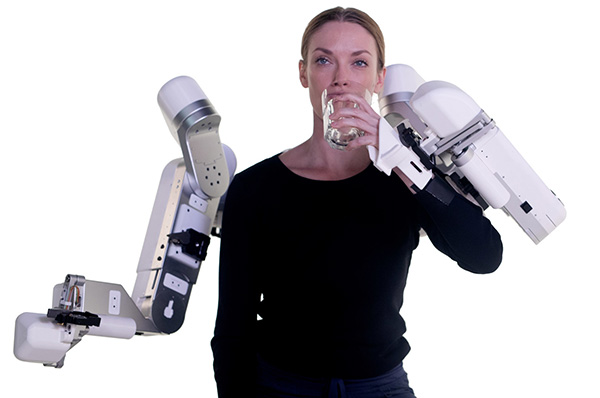
Harmony SHR upper-body exoskeleton.
Get news, papers, media and research delivered. Sign up for our free newsletters.
Stay up-to-date with news and resources you need to do your job. Research industry trends, compare companies and get weekly market intelligence with Robotics 24/7.
Harmonic Bionics
Harmony SHR upper-body exoskeleton.
Harmonic Bionics Inc., which is developing robotics technology for augmenting upper-body movement, today said it has secured $7 million in Series A funding. The Austin, Texas-based company said it plans to use the investment to continue its clinical research and ramp up product development as it brings its rehabilitation technology to market.
“We have confirmation from many in the field of rehabilitation, from both clinics and research labs, that Harmony SHR brings a truly novel approach to assessing and improving upper-body movement," stated Christopher Prentice, CEO of Harmonic Bionics. "Our unique robotic technology will first focus on assisting physical and occupational therapy for those with neurological or musculoskeletal disorders."
Harmonic Bionics, which was founded in 2016, said it has designed technology to facilitate data-driven treatment for neurological and musculoskeletal movement impairments, empowering patients and their care providers.
Its Harmony SHR flagship product is a bilateral, upper-extremity exoskeleton intended to benefit three areas of practice: neuroscience and movement science research, movement disorder assessment, and rehabilitation.
The company said it plans to optimize upper-extremity therapy with Harmony SHR by enabling early intervention, increasing functional repetition, and employing patient-specific intent-based therapy through novel exercises.
“Our exoskeleton was designed to provide precision in augmenting human movement by moving within the scapulohumeral rhythm [SHR]," Prentice said. "An exoskeleton that facilitates more natural human movements without rigid position control provides a level of safety that could open up the opportunity for robotics to be applied in many other industries.”
KNet Investment Partners and Big Basin Capital led Harmonic Bionics' Series A rouund, with participation from DSC Investment, Smilegate Investment, Bass Investment, H Robotics, and JCurve Investment.
Harmonic Bionics has also begun a roadshow tour, conducting in-person demonstrations at rehabilitation hospitals and healthcare clinics across Texas.
Harmony SHR is an upper-extremity, robotic rehabilitation system that works with a patient’s scapulohumeral rhythm (SHR) to enable natural, comprehensive therapy for both arms.
Wearables Exoskeletons News Press Release Exoskeletons Funding Harmonic Bionics Wearables
Enjoyed this article? Add Robotics 24/7 as a preferred source in Google Search.

Edge computing gives AI agents the processing power to turn instructions into…
Daimon-TWM world model debuts for the public
Platform helps robots adapt to complex tasks
Look beyond the headlines for the latest in humanoid robots