igus GmbH
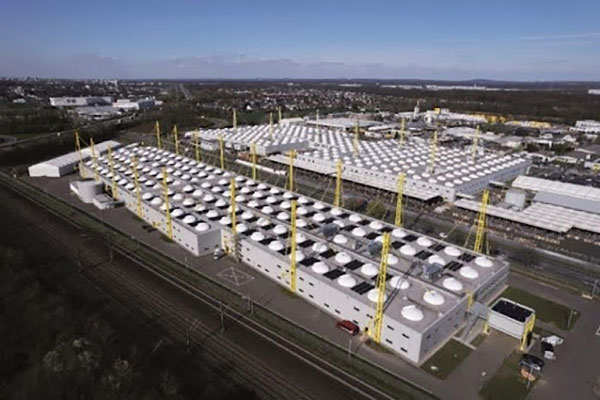
At its Cologne, Germany manufacturing facility, igus is investing in new automation systems to streamline processes and increase throughput times, including AGVs.
Get news, papers, media and research delivered. Sign up for our free newsletters.
Stay up-to-date with news and resources you need to do your job. Research industry trends, compare companies and get weekly market intelligence with Robotics 24/7.
igus GmbH
At its Cologne, Germany manufacturing facility, igus is investing in new automation systems to streamline processes and increase throughput times, including AGVs.
Motion plastics components provider igus recently announced it has achieved sales of €1.105 billion (about $1.256 billion). The company reported a comparatively moderate decline in turnover of 2.5%.
Despite the challenging geopolitical and economic situation in 2024, the motion plastics specialist was able to increase its number of active customers by 5% and maintain its billion-euro turnover.
Igus presented 277 new lubrication-free motion plastics products in 2025, including products made from PTFE-free materials, an energy chain series made of recycled materials, a new type of dry cleanroom certificate, and a humanoid robot.
"The changing political and economic conditions didn't leave us entirely unaffected," said Tobias Vogel, igus CEO of plain bearings and linear technology. "Like many of our customers, we are also focussing on savings and increased efficiency, e.g. through increased automation in our factory.”
This year, igus said it is continuing to invest in the R&D and production of new, innovative technical products.
"In the last five years, we have invested over 350 million euros in Cologne [Germany] alone - in land, buildings, state-of-the-art machines, software, new products, people and marketing," Vogel said. “The entire igus campus in Cologne, where we produce, test, and research, now covers around 218,000 square meters [2.3 million square feet].”
"The customer is at the center of all our activities," said Michael Blass, igus CEO of e-chain systems. "For this reason, our investments are deliberately close to our customers."
For example, igus is expanding its facility in Shanghai, China from around 269,000 to 753,000 square feet with a new building. In Bangalore, India, the manufacturing area has been tripled thanks to a new 172,000 square foot campus.
After introducing injection molding in the U.S., igus is now also setting up on-site lead screw production and has opened its own RBTX customer testing area for low-cost robotics. Ten countries now have their own customer test areas so users can quickly and easily find their individual low-cost automation system on site.
Read more about the new injection molding facility
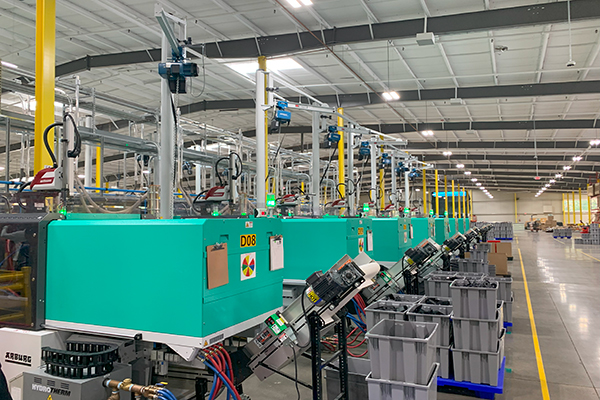
Three locations - U.S., China, and Brazil - will be expanded into regional hubs so production and development will also be increasingly localized. The company is also investing in the expansion of facilities in other countries such as Japan, Spain, Taiwan, and Poland.
However, igus said it is also clearly focussing on customer proximity in Germany. With the recent acquisition of elko Verbindungstechnik, igus is building up targeted assembly capacities in southern Germany.
Elko specializes in assembling cables and plug-in connectors into customer-specific systems that are used primarily in machine tools and the automotive industry.
At its Cologne site, igus is also continuing to invest in new automation systems to streamline processes and increase throughput times - such as specifically developed and patented crimp towers or the use of automated guided vehicles (AGVs) in factory buildings.
Igus said it has reached 92% of its target to be CO2-neutral with its buildings and production by the end of 2025.
"We need to become even better in this area and are working on numerous sustainability measures - from the new multi-story car park with complete façade greening to the modernization of our existing buildings, e.g. with photovoltaic systems, to the expansion of our MHRS [machine heat recovery system] for heating with waste heat from machines,” Blass said.
At Hannover Messe 2025, igus presented environmentally-friendly products such as PTFE-free versions of the iglidur standard plain bearing materials G, X and H, offering the same performance at almost the same price.
The company is also converting its entire E2.1 series energy chain cable carriers to recycled material consisting of post-consumer recyclate, such as old fishing nets and disused energy chains, which the company already recycles as part of its own "Chainge" program. Igus said using recycled materials for e-chains reduces its CO2 footprint by 80%.
Igus is also developing systems for dry cleanrooms, which is becoming increasingly important in battery production. Together with the Fraunhofer Institute, the company has developed a new type of certificate that confirms the cleanroom suitability of igus e-chains in long-term tests. They can withstand over 15 million double strokes with minimal and consistent particle emissions.
At a time when more and more companies are having to make cost savings, igus said it is also investing in the development of cost-effective products for its customers. This investment includes new energy chain glide-chain G4.42 for simple gliding applications, such as on indoor cranes, with travels of up to (about 100 feet). Thanks to its optimized design, it is not only 12 to 25% lighter, but also 30 to 40% more cost-effective than standard chains of the same dimensions from the E2 and E4 product range.
Igus said it is also performing low-cost automation development work. The company is currently developing its first humanoid mobile manipulation robot (MMR) made of high-performance plastic. It is based on the ReBeL Move autonomous mobile robot (AMR) and uses ReBeL cobots for its robot arms. The robot can be used flexibly and from any location at different workstations
Igus said the robot can provide an ROI of less than one year.
GENISOM AI makes ICRA debut at conference in Vienna
World's first omni-modal evaluation including tactile sensing for…
Ultrasonic sensing enhances robotics perception

North America’s largest automation and robotics event takes place June 22-25