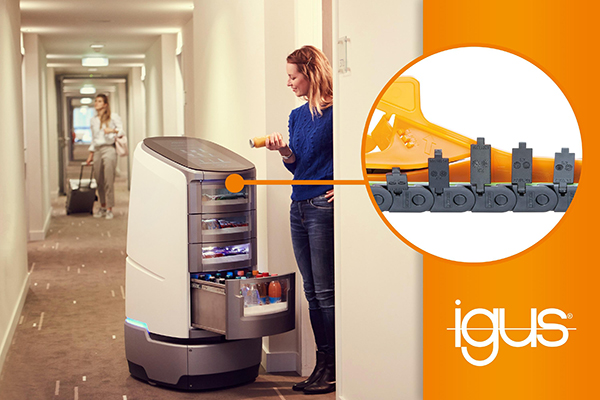
Robotise Technologies and igus
In JEEVES, igus E2.10 e-chain cable carriers are installed above the drawer guides and feature a tight bend radius of 28 millimeters.
Get news, papers, media and research delivered. Sign up for our free newsletters.
Stay up-to-date with news and resources you need to do your job. Research industry trends, compare companies and get weekly market intelligence with Robotics 24/7.
Robotise Technologies and igus
In JEEVES, igus E2.10 e-chain cable carriers are installed above the drawer guides and feature a tight bend radius of 28 millimeters.
German-based motion plastics company igus has supplied its E2.10 series of e-chain plastic cable carriers as part of JEEVES, an autonomous robot from Robotise Technologies, that can autonomously navigate its environment and replace up to 300 hotel room minibars.
JEEVES can be deployed at hotels, trade shows, canteens, offices, airports and more.
Constructed from high-performance plastics, the igus cable carriers are critical to the robot's performance, guiding the system's energy and data cables. Units can resist wear and abrasion and are suitable for a wide temperature range. The cables are installed above the guide rails of the drawers, saving valuable design space. Together these qualities improve the robot's efficiency and durability, minimize maintenance needs and save costs.
"A faulty robot waiter would immediately lead to resentment of the guests," said Clemens Beckmann, head of engineering at Robotise Technologies. "That's why we attached great importance to making JEEVES as reliable as possible."
When designing JEEVES, the cables - located inside the robot's extendable compartments - were at risk for excessive bending, breakage and freezing to the refrigerator's cooling plate. A damaged JEEVES would cause guest dissatisfaction, underscoring the robot's role in hospitality.
Standing at 124 centimeters tall and weighing 100 kilograms, JEEVES employs a laser system, 3D camera and sensors to autonomously navigate hotel rooms and use the elevator. Guests can request snacks or beverages by making a phone call or sending an app message. Upon arrival, JEEVES notifies the guest via a phone call or app alert. Once the robot arrives at the door, guests use its large touch display to select and pay for a product. JEEVES then dispenses the chosen item from one of its four drawers.
Want to learn more about mobile robots? This article was featured in the February 2025 Robotics 24/7 Special Focus Issue titled “Mobile robots of all shapes and sizes.”
GENISOM AI makes ICRA debut at conference in Vienna
World's first omni-modal evaluation including tactile sensing for…
Ultrasonic sensing enhances robotics perception

North America’s largest automation and robotics event takes place June 22-25