LUCID Vision Labs
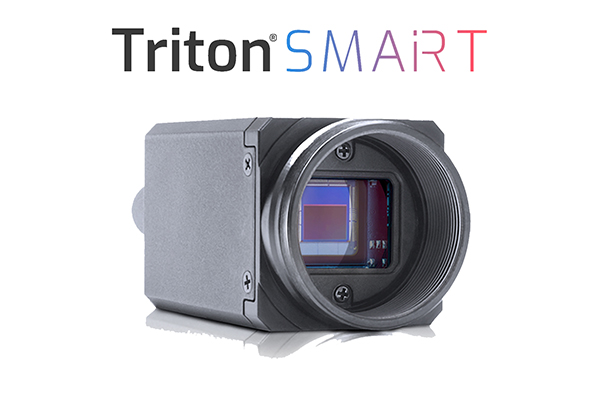
The new Triton Smart camera from LUCID Vision Labs features Sony’s IMX501 intelligent vision sensor with on-sensor AI processing.
Get news, papers, media and research delivered. Sign up for our free newsletters.
Stay up-to-date with news and resources you need to do your job. Research industry trends, compare companies and get weekly market intelligence with Robotics 24/7.

LUCID Vision Labs
The new Triton Smart camera from LUCID Vision Labs features Sony’s IMX501 intelligent vision sensor with on-sensor AI processing.
Canadian industrial camera designer and manufacturer LUCID Vision Labs announced the launch of the Triton Smart, a compact machine vision camera featuring Sony’s IMX501 intelligent vision sensor with on-sensor AI processing.
LUCID said the camera enables efficient, real-time inference directly on the device - no external processing or cloud connectivity required.
Built on LUCID’s Factory Tough platform, the Triton Smart combines AI and imaging in a rugged, lightweight 29 × 29 mm industrial housing. The Sony IMX501 is a 12.3 MP CMOS sensor with an integrated Image Signal Processor (ISP), Digital Signal Processor (DSP) and 8 MB of on-chip memory, allowing classification and object detection to be performed entirely offline. The company said this architecture delivers a power-efficient, self-contained offering that reduces system complexity and latency.
The Triton Smart’s dual-ISP design allows for simultaneous AI inference and image processing, outputting the original image and AI results in a single data stream. Users can also configure the camera to lower image resolution for privacy or bandwidth efficiency, achieving up to 30 FPS with inference or 8 FPS at full resolution (4056 × 3040 px).
“Integrating AI directly into the sensor opens up a new class of edge applications,” says Rod Barman, founder and president of LUCID. “The Triton Smart camera delivers fast, reliable inference without the need for host or cloud resources. This makes it easier, more secure and more cost-effective for customers to deploy AI in industrial and embedded environments.”
LUCID said the Triton Smart works seamlessly with AI models created in Neurala’s Brain Builder for AITRIOS, which enables users to train and deploy optimized AI models with as few as 50 images per class - no deep learning expertise required. Once a model is trained, LUCID’s ArenaView MP software uploads it to the IMX501 sensor in the Triton Smart, configures camera settings and streams real-time images with AI information overlays.
With M12 Ethernet and M8 GPIO connectors, an optional IP67 lens tube and a -20°C to 55°C operating temperature range, LUCID said the Triton Smart is ideal for factory automation, smart logistics, retail analytics and access control applications.
All LUCID cameras conform to the GigE Vision 2.0 and GenICam3 standards and are supported by the Arena SDK. The SDK is compatible with Windows, Linux 64-bit and Linux ARM platforms and supports C, C++, C#, and Python programming languages.

Ultrasonic sensing enhances robotics perception
World's first omni-modal evaluation including tactile sensing for…

Cybernetix Ventures’ event kicks off Robotics Tech Week 2026 slate of events

Preview the manufacturing and warehouse components that will be on the…