NEURA Robotics
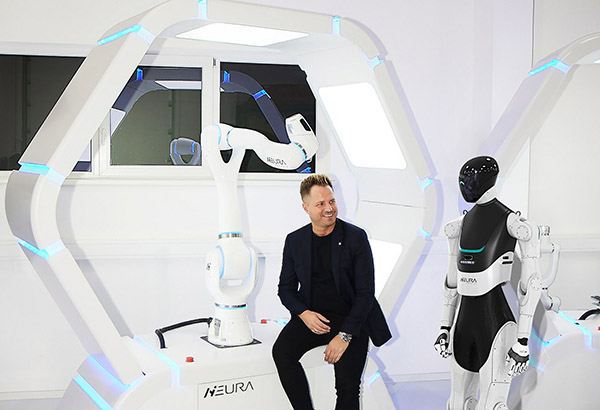
David Reger, CEO of NEURA, with cognitive robot MAiRA and humanoid robot 4NE-1.
Get news, papers, media and research delivered. Sign up for our free newsletters.
Stay up-to-date with news and resources you need to do your job. Research industry trends, compare companies and get weekly market intelligence with Robotics 24/7.
NEURA Robotics
David Reger, CEO of NEURA, with cognitive robot MAiRA and humanoid robot 4NE-1.
The combination of artificial intelligence and robotics promises to enable new capabilities. NEURA Robotics GmbH yesterday announced that it has closed a $55 million funding round. The Metzingen, Germany-based startup said it has "become a global pioneer in robotics in just three years."
"Since our genesis in 2019, NEURA Robotics has been working to push the boundaries of innovation in robotics by rethinking the subject with artificial intelligence and a platform approach, ushering in a new era in robotics," stated David Reger, founder and CEO of NEURA Robotics. "Today's funding round enables us to keep up the pace in delivering on our visionary promises."
Like a smartphone manufacturer, NEURA said it combines all components, sensors, and AI in one device, and it offers partners a platform for the joint development of a wide range of specialized apps. The company has developed collaborative robots and is working on the 4NE-1 multi-purpose humanoid robot.
The ability of robots to perceive, in combination with "reflective sensory processing," is necessary for safe, autonomous, and predictive action, asserted NEURA.
"In almost all industrial projects, we had to adapt the existing environment to the robot -- usually in a very complex and expensive way -- in order to meet the high safety requirements," Reger recalled. "But I was sure that in the long run, it would make more sense to modify the robots themselves so that they could be used safely in any environment alongside humans."
"Three important characteristics make up a cognitive robot," he said. "First, the ability to fully perceive its environment -- I mean seeing, hearing, and having tactile sense."
"Second, the ability to process these stimuli and react independently to new and unknown things -- without being programmed to do so beforehand," said Reger. "And third, to be able to 'remember' what they have learned for the future, in order to further develop existing skills."
Cognitive robots include features such as object recognition, natural language processing, and decision-making capabilites, he said.
The MAiRA cobot can help users address worker shortages, said NEURA. The company has also developed the MAV autonomous mobile robot (AMR) and the LARA high-end cobot.
NEURA added that its application development platform, or "NEURAverse," enables third-party automation developers to support sectors ranging from manufacturing to service with "unmatched flexibility and cost efficiency."
Reger noted that vendors such as Kawasaki are already selling their own cobots based on NEURA's platform.
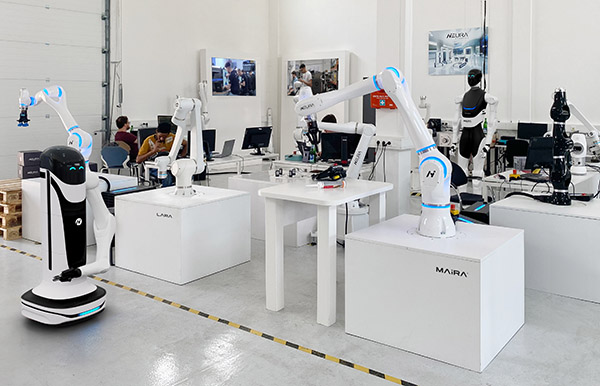
European investors Lingotto, Vsquared Ventures, Primepulse, and HV Capital, led NEURA Robotics' latest funding. GP Bullhound advised NEURA throughout the transaction. The company previously raised about $80 million from investors including Han's Group.
"NEURA operates at the confluence of AI and hardware development," said Nikhil Srinivasan, managing partner at Lingotto, an investment management company owned by Exor N.V. "Germany and Europe have a particular advantage here."
Dr Herbert Mangesius, general partner at Vsquared Ventures, added: "If you are serious about software, you need to embrace hardware. This is particularly true for robotic automation and has been a bottleneck in bringing cutting-edge machine learning and cognitive capabilities into the industrial and services world for many years."
"NEURA Robotics is the first company we met that combines this technological vision and leadership with an open partnership model and such driving progress globally at a never-seen pace within robotics," he said.
NEURA Robotics said it plans to use the capital to expand in the U.S. and Japan, as well as build out its production infrastructure in Germany to meet the demand of its order book, which exceeds $450 million.
"This involves cognitive industrial robots for applications such as welding, warehousing, gluing, sanding, and assembly," explained Reger. "However, this volume only describes the minimum delivery volume over the next five years. The actual demand of our customers is much higher, but currently still limited by our production capacities."
"For a better classification of the demand as a whole -- the order volume mentioned results from just one-time 14 contracts," he noted. "We currently have around 100 more contracts under negotiation. That is why the new capital is so important, because we need to expand our production capacities very quickly."
NEURA is developing industrial robots that will cost €5,000 to €40,000 ($5,570 to $44,600 to U.S.) and aiming its MiPA service robot for a price point below €10,000 ($11,140).
Startup NEURA Robotics recaps its experience at Automatica 2023.
Enjoyed this article? Add Robotics 24/7 as a preferred source in Google Search.
Edge computing gives AI agents the processing power to turn instructions into…
Daimon-TWM world model debuts for the public
Platform helps robots adapt to complex tasks
Look beyond the headlines for the latest in humanoid robots