Humanoid
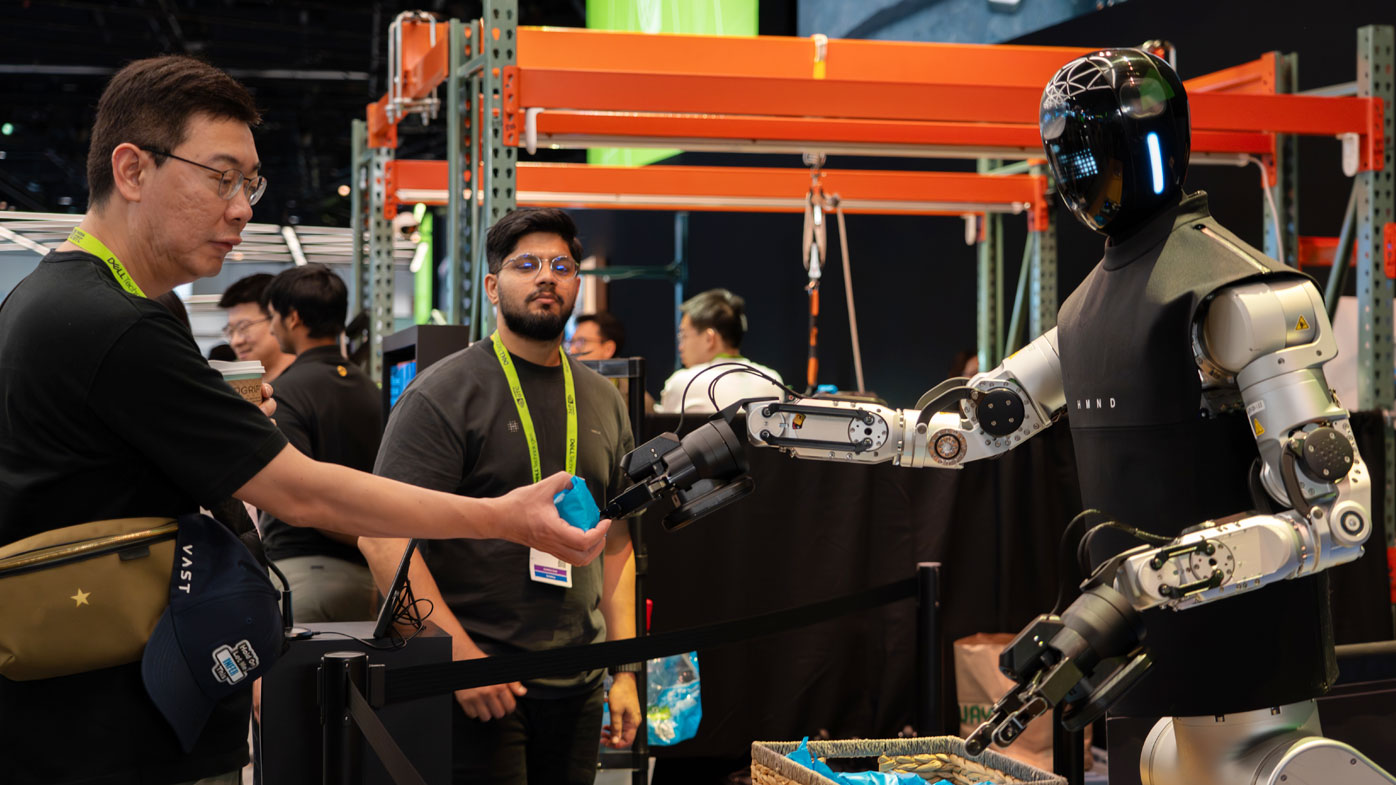
Humanoid showcased its fleet management platform, KinetIQ, at NVIDIA GTC 2026.
Get news, papers, media and research delivered. Sign up for our free newsletters.
Stay up-to-date with news and resources you need to do your job. Research industry trends, compare companies and get weekly market intelligence with Robotics 24/7.
Humanoid
Humanoid showcased its fleet management platform, KinetIQ, at NVIDIA GTC 2026.
At NVIDIA GTC 2026, UK-based AI and robotics Humanoid presented a live demonstration of its multi-robot coordination system.
Built on NVIDIA’s open robotics platform and powered by Humanoid’s KinetIQ AI brain, the company said that its system enables fleets of robots to interpret voice requests and coordinate physical actions in real time.
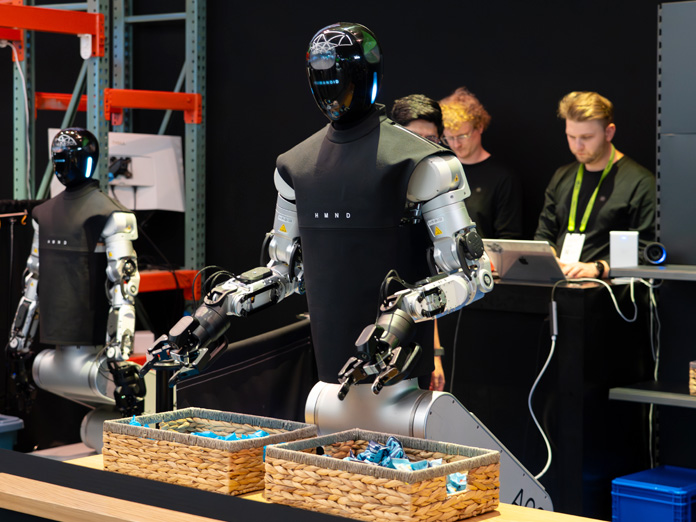
The demonstration (see below) featured two wheeled robots equipped with grippers operating in a simulated store environment. Using voice interaction at the booth, visitors could request the robots to handle items such as water bottles or popcorn. Once the request was made, KinetIQ’s Fleet Management system interpreted the command, dynamically assigned tasks between the robots and coordinated the physical handover of the items.
After completing each request, the robots returned to their default positions and waited for the next visitor. The system displayed real-time status updates, showing visitors how tasks were distributed and executed.
“At NVIDIA GTC, we demonstrated how our KinetIQ AI brain makes humanoid robots more practical, scalable, and ready for real-world use,” said Artem Sokolov, founder and CEO of Humanoid. “As one of Europe’s leading robotics companies, we are focused on moving beyond prototypes and preparing humanoid robots for real-world deployment as quickly as possible.”
Humanoid said that it is building autonomous general-purpose humanoid robotic systems using NVIDIA’s open robotics platform. Its KinetIQ AI brain utilizes NVIDIA GPUs for large-scale model training, the open NVIDIA Isaac Sim and Isaac Lab frameworks for simulation and digital twin development, and edge computing with NVIDIA Jetson to run real-time robotic behaviors on the robots.
Humanoid said that it is also adopting NVIDIA Isaac GR00T N1.7, an open reasoning vision language action (VLA) model to scale humanoid robot development. Together, the company said that these technologies enable fleets of robots to interpret human commands, coordinate tasks and execute physical actions autonomously, allowing Humanoid to move rapidly from simulation to real-world deployment of Physical AI systems.
“At Humanoid, we believe the next wave of robotics will come from general-purpose systems that can interact with humans and coordinate physical actions autonomously,” Sokolov said. “Our close collaboration with NVIDIA allows us to build on the world’s most advanced AI and robotics technologies to accelerate the development of Physical AI. The workflow illustrated how humanoid robots can interpret human commands, allocate tasks across a fleet and safely interact with people. It demonstrated key capabilities required for real-world deployment, including autonomous task allocation, efficient robot-to-robot collaboration and safe human-robot interaction.”
GENISOM AI makes ICRA debut at conference in Vienna
World's first omni-modal evaluation including tactile sensing for…
North America’s largest robotics and automation event winds down

Automate’s largest day ever draws huge crowds to McCormick Place