By
Brian Albright
December 18, 2018
Get news, papers, media and research delivered. Sign up for our free newsletters.
Stay up-to-date with news and resources you need to do your job. Research industry trends, compare companies and get weekly market intelligence with Robotics 24/7.
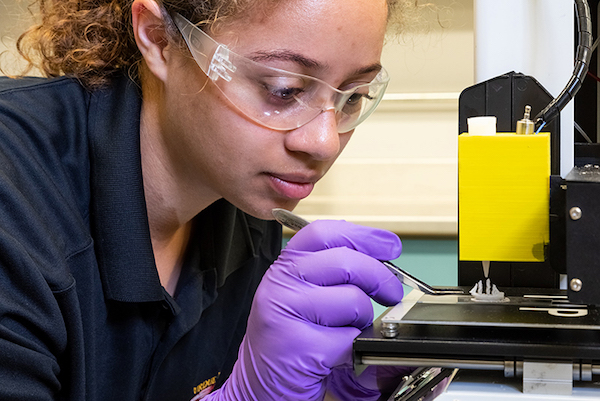
Researchers at Purdue University have come up with a method to more efficiently print with thick, viscous materials while also improving safety and reduce environmental damage. Jeffrey Rhoads, a professor in Purdue’s School of Mechanical Engineering, and Emre Gunduz, a former research assistant professor at the school have launched a new startup (Next Offset Solutions Inc.) to make printers and energetic materials based on the research. The energetic materials include solid rocket fuels, propellants and pyrotechnics.
The process allows for the printing of thick materials with high levels of precision by applying ultrasonic vibrations to the nozzle to reduce friction and allow for smooth materials flow. It also allows for more precise flow control. “It's like the Play-Doh press of the 21st century,” Rhoads said.
“We have shown that we can print these energetic materials without voids, which is key,” Rhoads said. “Voids are bad in energetic materials because they typically lead to inconsistent, sometimes catastrophic, burns.”
The team also used the method to print biomedical implants, personalized drugs and other products. Next Offset Solutions will focus on energetic materials, but is exploring other potential applications.
The process doesn’t rely on solvents, which makes the printers more environmentally friendly, and the printers can be operated remotely. When dealing with propellants and other materials, that can increase operator safety.
“You don't have to have a person there interfacing with the system. That's a big advantage from the safety standpoint,” Rhoads said.
Eliminating solvents also means that the process is less expensive and faster than traditional approaches.
Next Offset hopes to provide these printers and their products to the Department of Defense, Department of Energy, and contractors that serve both of them. Because the company already uses materials that are qualified by those government agencies, the resultant products can be more quickly adopted.
Source: Purdue University

Brian Albright is the editorial director of Digital Engineering and a contributor to Robotics 24/7.
Enjoyed this article? Add Robotics 24/7 as a preferred source in Google Search.

Edge computing gives AI agents the processing power to turn instructions into…
Daimon-TWM world model debuts for the public
Platform helps robots adapt to complex tasks

Look beyond the headlines for the latest in humanoid robots