Pusan National Univeristy
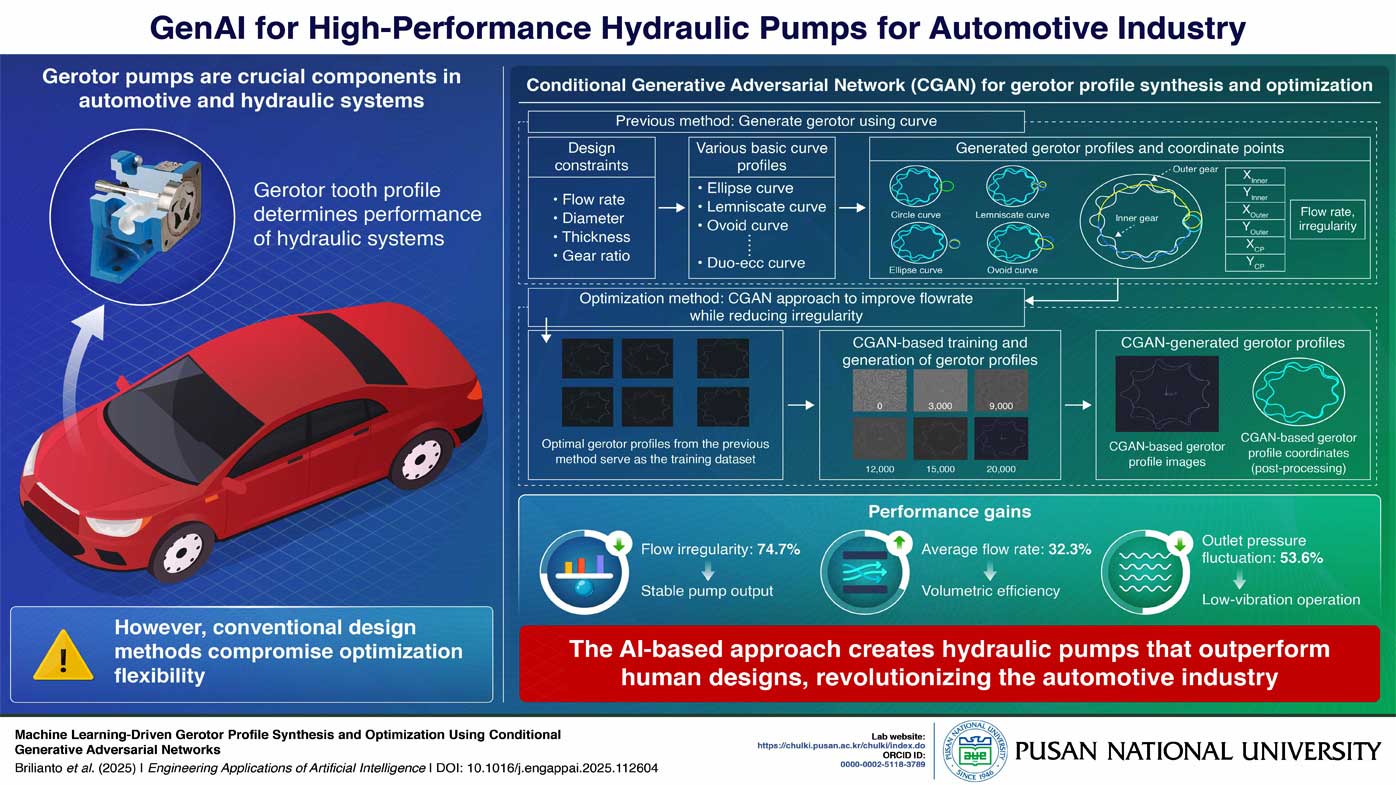
Researchers from Pusan National University utilized AI to generate gerotor designs that outperform humans.
Get news, papers, media and research delivered. Sign up for our free newsletters.
Stay up-to-date with news and resources you need to do your job. Research industry trends, compare companies and get weekly market intelligence with Robotics 24/7.
Pusan National Univeristy
Researchers from Pusan National University utilized AI to generate gerotor designs that outperform humans.
Generated rotor (gerotor) pumps for oil circulation and lubrication are crucial components in automotive and hydraulic systems. They possess a compact design, excellent flow rate per rotation and high suction capability.
The gerotor tooth profile plays a significant role in determining the overall performance of hydraulic systems for engine lubrication and automatic transmission. Unfortunately, conventional design methods utilize predefined mathematical curves and iterative adjustments, which compromise their optimization flexibility.
A team of researchers from the School of Mechanical Engineering at Pusan National University in South Korea, led by Professor Chul Kim, has proposed a new design methodology. Their findings, “Machine learning-driven gerotor profile synthesis and optimization using Conditional Generative Adversarial Networks,” were published in the December 2025 journal, Engineering Applications of Artificial Intelligence.
The key point of this study is the use of AI, specifically, a conditional generative adversarial network, as a design tool. Instead of relying on the traditional approach of using predefined mathematical curves, the researchers trained an AI to automatically generate new gerotor profiles. The AI learned from a dataset linking specific, high-performance profile geometries to their actual performance data. This innovation, according to the study, allowed it to understand why certain shapes perform better than others, and then generate new, highly optimized geometries that substantially outperform traditional, human designs.
“Crucially, for the public, the adoption of more optimal components can mean the machines we use daily become quieter and more reliable,” said Professor Kim. “In the automotive sector, this translates to vehicles with more efficient and durable hydraulic systems like transmissions and oil pumps.”
In the paper, the research team demonstrated that their novel AI-generated design exhibits substantial performance gains in simulation validation via computational fluid dynamics. Compared to a traditional ovoid profile, the proposed design achieved a 74.7% reduction in flow irregularity. This means the pump's output is significantly more stable and consistent. It also shows a 32.3% increase in average flow rate, which indicates better volumetric efficiency, as well as a 53.6% reduction in outlet pressure fluctuation, which directly contributes to quieter operation and reduced vibration.
The paper suggests that the most direct real-life applications of the present work are in the automotive industry. The reduction in pressure fluctuation and flow irregularity can lead to transmission systems that operate more quietly, and could potentially improve component reliability by reducing vibration and unstable hydraulic stress.
Furthermore, the 32.3% increase in average flow rate allows for more efficient oil circulation throughout the engine. This contributes to better lubrication and cooling of engine components, which is critical for engine durability.
“The same principles demonstrated in our study are applicable to various hydraulic pumps used in industrial machinery, where efficiency, low noise, and reliability are important factors, making our technology highly lucrative for real-life adoption,” Professor Kim said.
Enjoyed this article? Add Robotics 24/7 as a preferred source in Google Search.
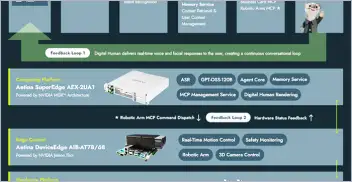
Edge computing gives AI agents the processing power to turn instructions into…
Daimon-TWM world model debuts for the public
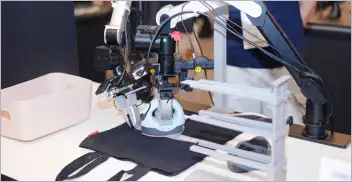
Platform helps robots adapt to complex tasks
Look beyond the headlines for the latest in humanoid robots