Sanctuary AI
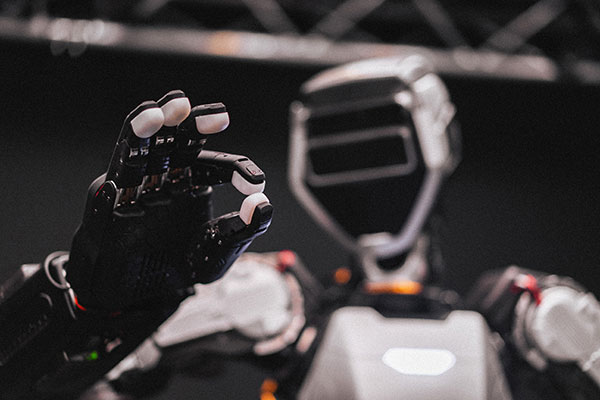
Sanctuary AI has equipped its seventh-generation Phoenix general purpose humanoids with its new touch sensors, improving tactile functionality, grasping, and force correction.
Get news, papers, media and research delivered. Sign up for our free newsletters.
Stay up-to-date with news and resources you need to do your job. Research industry trends, compare companies and get weekly market intelligence with Robotics 24/7.
Sanctuary AI
Sanctuary AI has equipped its seventh-generation Phoenix general purpose humanoids with its new touch sensors, improving tactile functionality, grasping, and force correction.
Physical AI for general purpose humanoid robots developer Sanctuary AI recently announced the integration of new tactile sensor technology into its Phoenix general purpose humanoids.
Sanctuary AI said the integration will enable teleoperation pilots to more effectively use the dexterity capabilities of general purpose robots to achieve complex, touch-driven tasks with precision and accuracy. Richer behavioral data collected from the new sensors will also allow for improvement of embodied physical AI models.
This announcement comes after the initial unveiling of Sanctuary AI’s tactile sensors, which the company said demonstrates progress along its path to creating dexterous intelligence for autonomous labor.
As global labor shortages continue to impact industries, many organizations are struggling to fill roles that sustain their operations.
Sanctuary AI’s technology is focused on addressing these growing labor challenges by developing dexterous hand technology that enables general purpose robots to fill gaps in the global workforce. The company said its robots have the potential to fulfill jobs across a variety of industries, including automotive manufacturing, telecommunications, distribution, logistics, retail, utilities, energy, and more.
“The sense of touch is a key enabler for creating human-level dexterity in robots and critical for physical AI to achieve its full potential,” said James Wells, Sanctuary AI CEO.
Wells said the company’s tactile sensors can enable reliable and confident fine manipulation when robot vision is occluded, which can enable capabilities such as blind picking and slippage detection, and also prevent excessive force application, all of which broadening the scope and range of tasks robots can accomplish.
Sanctuary AI said integrating touch sensors further differentiates its approach to dexterity from other vendors who rely on stereo camera feeds for their technology to interact with objects in the real world.
“Without tactile sensing, robots depend on video to interact with their environment,” said Jeremy Fishel, Sanctuary AI principal researcher. “With video alone you don't know you've touched something until well after the collision has physically caused the object to move. This reduces work efficiency and can require numerous attempts, grasping and re-grasping the same object for a secure hold.”
In May 2024, Sanctuary AI unveiled the latest iteration of its Phoenix humanoids. With Phoenix now equipped with advanced tactile sensors, the company said it remains committed to driving innovation in the AI and robotics industry.
GENISOM AI makes ICRA debut at conference in Vienna
World's first omni-modal evaluation including tactile sensing for…

Ultrasonic sensing enhances robotics perception
Cybernetix Ventures’ event kicks off Robotics Tech Week 2026 slate of events