Morton Plant Hospital
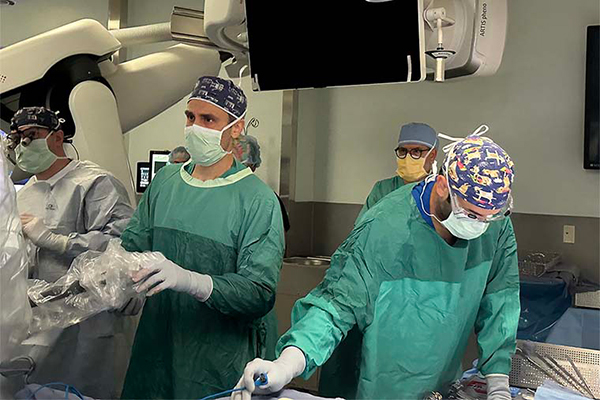
Members of the Morton Plant Hospital perform the first hospital's first robot-assisted coronary artery bypass surgery.
Get news, papers, media and research delivered. Sign up for our free newsletters.
Stay up-to-date with news and resources you need to do your job. Research industry trends, compare companies and get weekly market intelligence with Robotics 24/7.
Morton Plant Hospital
Members of the Morton Plant Hospital perform the first hospital's first robot-assisted coronary artery bypass surgery.
Morton Plant Hospital in Clearwater, Fla. recently completed its first robotic-assisted, minimally invasive coronary artery bypass surgery (CABG), making it one of only two hospitals in the Tampa Bay area to offer robotic-assisted CABG.
Cardiothoracic Surgeon Michael Kayatta, MD, and his partner, Cardiovascular Surgeon John Ofenloch, MD, performed the procedure earlier this week, with the assistance of their highly skilled surgical team.
CABG surgery is needed when plaque has built up in arteries carrying blood to the heart causing the arteries to be severely narrowed. The surgeon creates a new path for blood to flow by using a healthy artery or vein from another part of the body and connects it past the blockage on the heart.
In a traditional CABG, the surgeon cuts open the chest by dividing the breastbone and spreads the ribs to expose the heart. The heart is stilled, requiring the patient to be on a heart-lung machine during the surgery. Full recovery often takes about two months.
The robotic-assisted CABG only requires four small incisions between the ribs. A small camera and surgical tools are attached to the robotic arms and guided through the incisions. The heart continues to beat through the procedure, with special tools stabilizing a part of the heart.
“We are excited to bring this new technology to patients at Morton Plant Hospital,” Dr. Kayatta said. “Many people hear robot and think a machine will be doing the surgery. We have a highly skilled, experienced team performing each surgery. The robot is simply a tool that helps us to treat more patients and get them back to their life in weeks rather than months.”
The computer console, which shows images of the heart magnified up to 10 times normal vision, gives the surgeon the ability to guide the surgical instruments, attached to the robotic arms, with his fingers while watching the screen. The robotic arms that are controlled by the surgeon have greater range of motion and are more precise than human arms.
A major potential benefit of a robotic-assisted CABG is a quicker recovery for the patient. The smaller incisions should also result in less scarring.
Drs. Kayatta and Ofenloch are both with BayCare Medical Group’s Cardiovascular and Thoracic Surgery clinic in Clearwater.

Ultrasonic sensing enhances robotics perception

Cybernetix Ventures’ event kicks off Robotics Tech Week 2026 slate of events

Preview the manufacturing and warehouse components that will be on the…

Preview the manufacturing and warehouse robots and software that will be on…