Used with permission via Wikimedia Commons
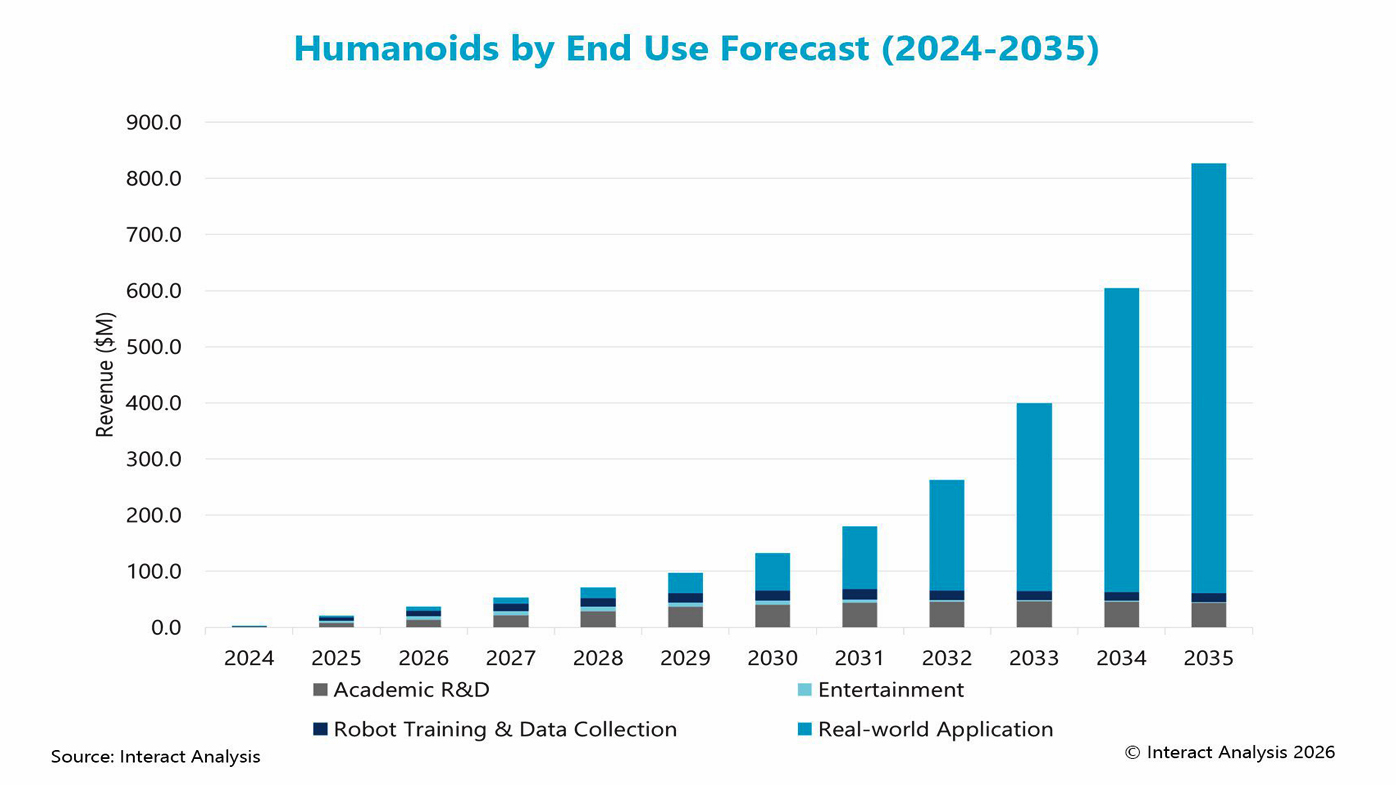
Real world application of humanoid robots are still in the minority, but Interact Analysis research said that they are set to grow strongly in the 2030s.
Get news, papers, media and research delivered. Sign up for our free newsletters.
Stay up-to-date with news and resources you need to do your job. Research industry trends, compare companies and get weekly market intelligence with Robotics 24/7.
Used with permission via Wikimedia Commons
Real world application of humanoid robots are still in the minority, but Interact Analysis research said that they are set to grow strongly in the 2030s.
A new report from market research firm Interact Analysis found that increased momentum and growth in humanoid robot development and deployment will result in major growth in the motion control market.
The report said that motion control demand tied to humanoid applications is forecast to grow at an average annual rate of 102% from 2023 through 2029.
Interact Analysis said that while this number is partially driven by a low-base effect, it also signals the early formation of a new demand channel within industrial automation.
Interact Analysis said that humanoid robots have become one of the most closely watched frontiers in automation, promising a fundamental shift in how machines interact with the physical world.
While IA said that the market remains small and largely confined to proof-of-concept deployments, momentum is building as companies move toward pilot programs and scalable production. At the same time, the market research firm said that AI advancements are accelerating progress, enabling these complex mechanical systems to perform increasingly dynamic, real-world tasks.
Despite all the attention on humanoid platforms, Interact Analysis said that motion control is a critical component of these machines that is often overlooked. Each humanoid robot integrates dozens of servo motors, drives, and control systems, making servo components one of the most direct beneficiaries of future market growth.
Although humanoids have yet to reach large-scale commercial deployment, Interact Analysis said that their evolution from prototype to profitable deployment has the potential to reshape motion control markets in the years ahead.
IA’s report found that 2025 marked a notable turning point for the humanoid robotics market, with shipments reaching 20,000 units, compared with 2,000 units in 2024. While more than 200 companies are now developing humanoid platforms, real-world deployments (defined as robots actively operating in the field) have only increased to approximately 2,500 units.
The primary challenge remains commercial deployment at scale. Currently, IA said that real-world applications account for a minority of total deployments, with many systems still concentrated in academic, R&D and pilot-stage environments.
The report said that real-world deployments will unlock a much larger wave of investment from warehouse operators, manufacturers and commercial users beyond niche research settings. The long-term humanoids forecast indicates that growth will accelerate sharply in the 2030s.
While AI captures much of the attention surrounding humanoid robotics, IA said that motion systems remain the foundation that makes them functional.
Because humanoids are designed to replicate human movement, they require a high number of actuated joints across the hands, arms, legs, torso, and neck. Interact Analysis estimates that a typical humanoid robot requires approximately 30 servo motors to achieve full-body actuation.
Beyond motors, IA said that motion controllers are essential for coordinating complex multi-axis movement while maintaining safe operation in environments shared with humans. Real-time feedback, synchronized motion and embedded safety functions are all critical requirements.
IA said that these systems must also deliver human-like movement through high torque density, precise speed control, smooth acceleration and deceleration, and efficient operation within a compact footprint. As a result, the report said that humanoid robotics will be a premium motion control application, aligning closely with two trends central to premium motion products: integrated motor-drive systems and advanced embedded safety technologies.
IA’s report said that integrated motor-drive products continue to gain market share across the motion control sector. This is particularly the case in robotics applications, where compact design, simplified wiring and system efficiency are critical. The report said that these advantages are especially relevant for humanoid robots, as space constraints, weight reduction and thermal efficiency directly impact overall performance.
By integrating the motor, drive electronics, encoder feedback and related functions into a compact architecture, IA said that these products are a natural fit within the joints of a humanoid robot.
To read Interact Analysis’ full insight, featuring more details on motion control and humanoids, including safety and the economic viability of humanoids, click here.
GENISOM AI makes ICRA debut at conference in Vienna
World's first omni-modal evaluation including tactile sensing for…
Ultrasonic sensing enhances robotics perception

North America’s largest automation and robotics event takes place June 22-25