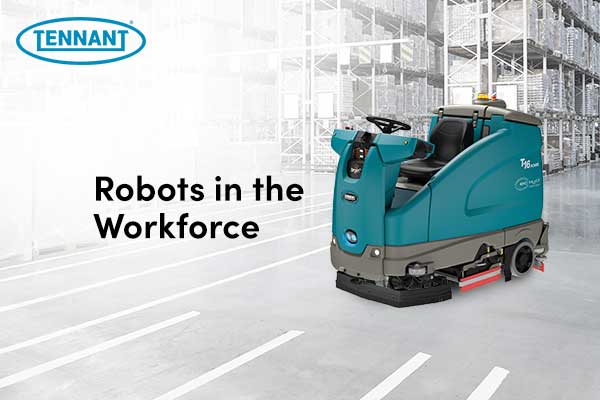
Image Source: Tennant
Get news, papers, media and research delivered. Sign up for our free newsletters.
Stay up-to-date with news and resources you need to do your job. Research industry trends, compare companies and get weekly market intelligence with Robotics 24/7.
Image Source: Tennant
The warehousing and logistics industry is booming. Volumes are up, warehouse capacity is tight, and labor is hard to find. But that doesn’t mean warehouse management should cut corners on floor cleaning. It’s essential to the health and hygiene of workers—as well as the overall health of the operation.
Robotic cleaning in warehousing and logistics has come at the right time as the industry needs to do more with fewer workers. Rather than replacing workers, robots assisting cleaning tasks can free up workers to perform other high-value, strategic tasks—something the warehouse workforce and operations alike would benefit from amid the ongoing labor crunch and the drive to boost productivity.
The use of robots in the industrial space has rapidly evolved in recent years. In 2022, the number of robots deployed in warehouses and manufacturing facilities is expected to reach 938,000—up from 194,000 in 2018, according to research and information services firm Informa.
Furthermore, the International Federation of Robotics reports that demand for professional robotic cleaning grew by 92% in terms of units sold from 2020 to 2021— an unprecedented spike was primarily driven by the global COVID-19 pandemic and advancements in autonomous cleaning technology. Sales of professional service robots rose an impressive 41% to 131,800 units in 2020 and are expected to grow by double-digit rates on average every year through 2024, the Federation reports.
There are many reasons for robots assisting cleaning tasks in industrial operations like warehouses and logistics operations.
As the volume of products in warehouses continues to climb, many warehouse and logistics operations are trying to improve productivity with the same or fewer staff. That puts pressure on employees to do more with less. Robotic cleaning that tackles routine cleaning tasks frees employees to be more efficient and productive in other higher-value work, boosting the operation's productivity. Because robots are more consistent in cleaning tasks than humans, it also decreases the chance for errors and reduces the risk of an employee getting injured or ill from performing repetitive tasks.
Warehouse and logistics employees might be surprised by how simple robotic cleaning can be integrated into their cleaning routines. That’s, in large part, because robotic cleaning machines look nearly identical to the typical ride-on floor scrubbing machine that crews already know and operate. The difference is robotic cleaning machines are integrated with technology that enables autonomous operation. Robotic scrubbing machines also have simple, easy and intuitive controls to ensure ease of use and efficiency for operators.
Robots assisting cleaning tasks are equipped with three types of sensors— LIDAR sensors, 3D cameras and 2D cameras—that allow the robot to navigate throughout the warehouse floor safely and efficiently. These cameras allow the robot to “see” the environment and avoid obstacles on the floor—whether that be an object or a person.
The robot is first taught a cleaning route to get it up to speed in its new environment. From thereon out, the operator simply drives the robot to the home marker, selects the cleaning route and presses the start button. Then, the employee moves on to other higher-value tasks.
Industrial robotic scrubbers are gaining ground for cleaning warehouses and other logistics operations. They help address the ongoing labor shortage and the need to increase productivity amid skyrocketing volumes. They can also be a cleaning crew’s best friend.
Robotic cleaning is not meant to replace human employees. They are meant to work alongside humans to increase efficiency, boost productivity and relieve workers of the more labor-intensive, repetitive tasks in their cleaning routine. Working with robots provides a pathway for warehouse employees to build a new skill set in training and managing autonomous cleaning equipment that can increase their value and stature within the warehouse facility. Furthermore, robotic cleaning machines look just like a typical ride-on scrubber and are incredibly easy to learn—the only difference being the built-in autonomous technology.
Enjoyed this article? Add Robotics 24/7 as a preferred source in Google Search.
Edge computing gives AI agents the processing power to turn instructions into…
Daimon-TWM world model debuts for the public
Platform helps robots adapt to complex tasks
Look beyond the headlines for the latest in humanoid robots