Toyota Research Institute
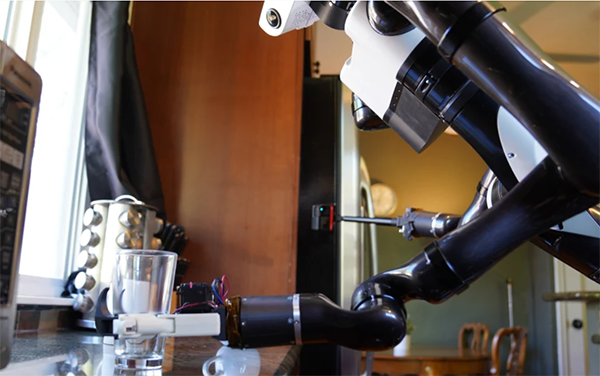
TRI said it has improved the adaptability of household robots.
Get news, papers, media and research delivered. Sign up for our free newsletters.
Stay up-to-date with news and resources you need to do your job. Research industry trends, compare companies and get weekly market intelligence with Robotics 24/7.
Toyota Research Institute
TRI said it has improved the adaptability of household robots.
Toyota Research Institute today said that it has successfully developed new capabilities for robots to conduct complex tasks in home environments. The Toyota Motor Corp. unit said its researchers were able to train robots to understand and operate in complicated situations that would confuse most other robots, including recognizing and responding to transparent and reflective surfaces in a variety of circumstances.
“Our goal is to build robotic capabilities that amplify, not replace, human abilities,” said Max Bajracharya, vice president of robotics at Toyota Research Institute (TRI). “Training robots to understand how to operate in home environments poses special challenges because of the diversity and complexity of our homes, where small tasks can add up to big challenges.”
Established in 2015, TRI said it aims to develop active vehicle safety and automated driving technologies, robotics, and other human amplification technologies. Led by Dr. Gill Pratt, the institute said it is working to apply artificial intelligence and mobility to benefit society. TRI has offices in Los Altos, Calif.; Cambridge, Mass.; and Ann Arbor, Mich.
While a human can easily differentiate between an object and its reflection, transparent or reflective items commonly found in the home befuddle today’s robots. Since most robots are programmed to react to the objects and geometry in front of them without considering the context of the situation, they are easily fooled by a glass table, a shiny toaster, or a transparent cup.
“To overcome this, TRI roboticists developed a novel training method to perceive the 3D geometry of the scene while also detecting objects and surfaces,” explained Bajracharya. “This combination enables researchers to use large amounts of synthetic data to train the system.”
Using synthetic data for training and simulation also alleviates the need for time-consuming, expensive, or impractical data collection and labeling, said TRI.
As TRI demonstrated in the video below, its system allows robots to make generalizations in a range of scenarios, including in different homes. The video, released on National Selfie Day, took a tongue-in-cheek approach to capturing these new capabilities on film, as the robot was shown recording itself as it proudly performed these new skills around the house.
"While no system is perfect, today’s announcement adds to the body of knowledge helping robots to reliably navigate and operate in home environments," said TRI. "This technical achievement enables a robot to quickly learn from 'programmable data' — synthetic data to recreate and learn from past failures and is a promising milestone for TRI and roboticists everywhere."
Today, Toyota Research Institute unveiled new robotics capabilities aimed at solving complex tasks in home environments. TRI roboticists were able to train robots to understand and operate in complicated situations, including recognizing and responding to transparent and reflective surfaces in a variety of circumstances.
Enjoyed this article? Add Robotics 24/7 as a preferred source in Google Search.
Edge computing gives AI agents the processing power to turn instructions into…
Daimon-TWM world model debuts for the public
Platform helps robots adapt to complex tasks
Look beyond the headlines for the latest in humanoid robots