Get news, papers, media and research delivered. Sign up for our free newsletters.
Stay up-to-date with news and resources you need to do your job. Research industry trends, compare companies and get weekly market intelligence with Robotics 24/7.

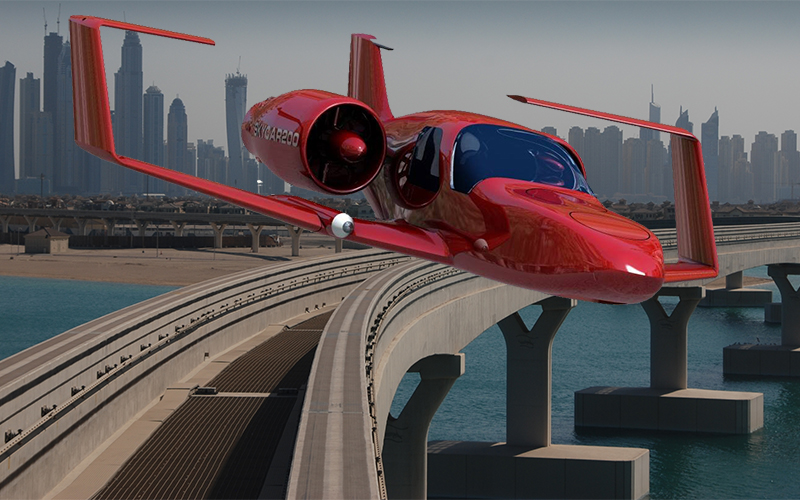
The San-Francisco based transportation network known as Uber announced that it is partnering with the cities of Dallas and Dubai to transform flying cars from science fiction to science fact.
The ride-sharing giant convened a three-day meet-up - called the Elevate Summit - featuring luminaries from aviation technology, venture capital, vehicle manufacturing and regulation, all with the express purpose of tackling flying cars.
Focusing on what it calls vertical takeoff and landing, or VTOL, Uber is working with a handful of startups on the futuristic tech with backing from some very big names, like Google founder Larry Page, aerospace firm Airbus and the government of Dubai.
As reported by Business Insider, by 2020, the company wants to have its first public demonstration of its network of electric planes that would ferry passengers at 150 m.p.h. through urban skies to their destinations.
To reach its ambitious goal in the next few years, Uber Elevate has partnered with Dallas-Forth Worth and Dubai to be its launch partners. Uber plans to announce on Tuesday that it's aiming to debut the Uber Elevate network when Dubai hosts the World's Fair in 2020.

"It’s push a button and get a flight," said Jeff Holden, Uber's Chief Product Officer, in his keynote at the Uber Elevate Summit.
The vision for Uber Elevate is to build a network of vertical take-off and landing (VTOL) aircraft that would make aviation on-demand.
The project will have "significant cost advantages" over other modes of solving transportation problems, like building new roads, bridges, or tunnels, Uber says.
Since the planes don't need to follow set routes, it would help avoid congestion and improve commute times, the company says.
"Just as skyscrapers allowed cities to use limited land more efficiently, urban air transportation will use three-dimensional airspace to alleviate transportation congestion on the ground," Uber wrote in its white-paper on Uber Elevate, which it unveiled in October 2016.
Based on Uber's calculations, a two-hour drive between San Francisco's Marina neighborhood to downtown San Jose would only take 15 minutes in a VTOL aircraft. In an app demonstration, Holden showed how "UberAir" could become an in-app option, just like choosing between UberPOOL and UberXL.
Uber says its key to unlocking this kind of urban air travel is being able to understand demand and pricing.
"We think we can start this for roughly the cost of UberX," said Holden.
To get there though requires an infrastructure build out. The company suggests parking garages and helipads could be repurposed to be used as "vertipods" and "vertistops." As part of its partnerships with Dubai and Dallas-Fort Worth, Uber will also be working with two real estate holding companies to work on building the infrastructure needed for it. The Dubai Road and Transport Authority will also be funding studies on pricing and demand for a VTOL network.

Uber is also working with NASA, the FAA, and the National Air Traffic Control Association to work on a different approach to air traffic control.
Flying Cars
Building out the infrastructure is just one part of the puzzle. The other roadblock is perfecting an all-electric VTOL plane that is quiet enough that it could be used to bring people from the cities to the suburbs, or even across cities, in a short amount of time.
Uber, for now, has decided not to build its own aircraft, but partner with other manufacturers who are designing planes to fit Uber's design needs. At the Uber Elevate summit in Dallas, Uber announced its first five VTOL vehicle partners will be Aurora Flight Sciences, Pipistrel Aircraft, Embraer, Mooney, and Bell Helicopter.
While these types of vertical take-off aircraft might sound similar to helicopters, Uber argues that the planes would have key advantages over helicopters: since they'll be electric, the planes would have zero emissions, and they'll be significantly less noisy than helicopters.
"The Uber Elevate mission is all about low noise, high reliability, and low cost," said Aurora CEO John Langford in a press release about the news. "We have already built and flown the first proof-of-concept aircraft and we’re excited to partner with Uber in accelerating the eVTOL initiative."
Launching a demonstration in a few years is ambitious for the $69 billion ride-hailing company that's currently saddled with enough problems across its other business units. But Uber seems to be aware of the challenges ahead in its path.
"We have a lot of work to do," Holden said. "This isn’t going to be easy."
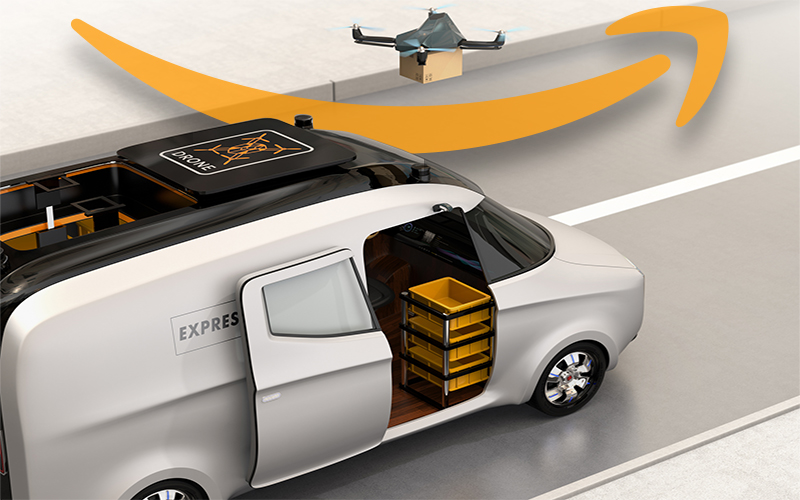
Related: Is Amazon Creating Self-Driving Cars for Delivery?
Related White Papers
The Future Isn’t What It Used To Be
According to predictions made a few decades ago, current travel should involve self-driving automobiles, jetpacks and flying cars, with space transport a common occurrence. Download Now!
Parcel Delivery: The Future of Last Mile
Currently subject to significant disruption, last-mile delivery, especially of parcels, is getting a great deal of attention in the media and from investors, and rightfully so. Download Now!
Drone Technology: Clarity from Above
According PwC's study on the commercial applications of drone technology, the emerging global market for business services using drones is valued at over $127 billion. Download Now!
Fast-Forwarding to a Future of On-Demand Urban Air Transportation
This white paper delves into these challenges for achieving a successful VTOL transportation market, with an eye to surmounting them as quickly as possible, as well as our view on rider experience requirements. Download Now!

Ultrasonic sensing enhances robotics perception

World's first omni-modal evaluation including tactile sensing for…
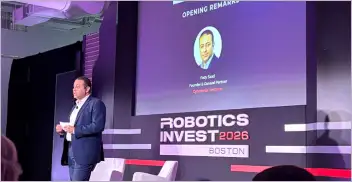
Cybernetix Ventures’ event kicks off Robotics Tech Week 2026 slate of events

Preview the manufacturing and warehouse components that will be on the…