By
DE Guest
February 1, 2020
Get news, papers, media and research delivered. Sign up for our free newsletters.
Stay up-to-date with news and resources you need to do your job. Research industry trends, compare companies and get weekly market intelligence with Robotics 24/7.
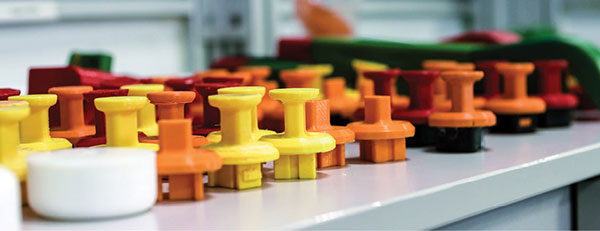
Not all products can be, nor should be, 3D printed. 3D printing will never rival the economies of scale found in mass-produced commodities, though the technology is becoming more capable and reliable.

According to Gartner, 47% of supply chain managers plan to use 3D printing in the next two years. This creates five unexpected benefits of bringing 3D printing into supply chain processes.
Businesses have outsourced to other companies for decades because it made economic sense. However, global logistics is becoming riskier and more expensive. Things only get more complex when you add the time required to negotiate with multiple suppliers, and navigate several time zones and different languages in the mix. More fragmented than ever, outsourced supply chains are losing their luster.
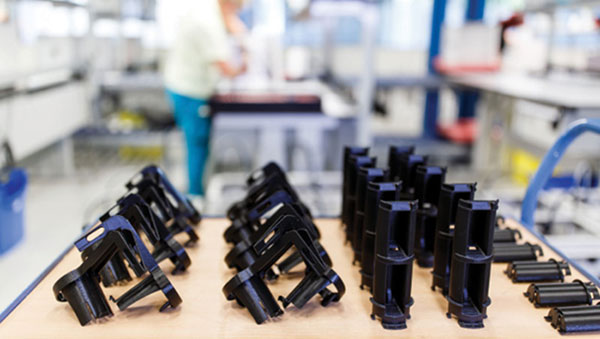
There is huge potential for 3D-printed spare part creation, which, according to one DHL report (bit.ly/35VK0Fu), can account for more than 20% of a company’s unused or excess stock. Many automotive manufacturers are required to stock spare parts for seven to 10 years for every vehicle they make. The end-to-end process that 3D printing offers serves as a fully fledged production method, cutting down on excess stock and wait times for parts.
Compared to outsourcing, 3D printing typically has a higher ROI, but supply chain simplification provides other savings as well. Three examples of how 3D printing can generate even more ROI include:
The logistical nightmare of producing and shipping spare parts from overseas offers an opportunity for easy savings. By simply installing a 3D printer to meet on-demand part manufacture, research suggests companies could save up to 85% on shipping costs.
Based on public data sets from the Bureau of Labor Statistics and manufacturing industry economic data, it can be estimated that cost of operating in the manufacturing industry in the United States is $4,258,341 per minute, with a profit margin of only $22,480 each minute.
3D printing can impact a large industry if it can save time in gained productivity. Although the cost savings for printing one prototype part in-house may not seem significant, each opportunity to save time or money adds up quickly, especially for large-scale manufacturing facilities.
Typically, overseas labor rates were cheaper than U.S. rates, so many manufacturers outsourced that cost. 3D printing reduces dependence on this variable because one trained worker can operate a small spare parts production facility at a workstation. This is due to increased printer uptime and reliability, with network-enabled machines controlled via intuitive printer management software.
Traditional supply chains are not known for their responsiveness and are only getting more complex. By reducing the manufacturing duration and cutting out overseas transportation, 3D printing almost negates lead times.
Depending on their complexity, most printed parts are produced in hours, not weeks; organizations can easily scale production output with multiple machines to meet demand.
3D printing offers small-batch manufacturing with a significant advantage: geometric freedom. Traditional production methods, like injection molding, can be restrictive and follow design-for-manufacturing rules.
With 3D printing, more exotic and efficient geometries can be printed with generative design—leading to improved structural performance, material savings and a shorter design-to-manufacturing cycle.
As digitization fuels the “demand economy,” 3D printing synergizes perfectly with connected manufacturing. This on-demand part production enables greater levels of personalization for finished or almost-finished goods. Parts can be individualized, such as manufacturing tools with ergonomics specific to the worker.
Essentially, 3D printers can replace your just-in-time inventory. Already a reality, virtual warehouses can send 3D model files digitally to the nearest 3D printer. Logistics companies like DHL and UPS are already using 3D printing to supplement their “end-of-runway” services when specific parts are needed in the fastest time possible.
Not everything should be 3D printed. But with its multiple benefits, 3D printing technology can improve the supply chain in ways that shouldn’t be overlooked.
Jamie Howard is president of Ultimaker Americas, where he is responsible for the company’s commercial strategy and business execution in the Americas region. He has more than 25 years of GM, engineering and technology management experience. He holds a B.A. from California State University, Long Beach, and M.A. from Fuller Theological Seminary.
Enjoyed this article? Add Robotics 24/7 as a preferred source in Google Search.
Edge computing gives AI agents the processing power to turn instructions into…
Daimon-TWM world model debuts for the public
Platform helps robots adapt to complex tasks

Look beyond the headlines for the latest in humanoid robots