Vecna Robotics
By
Tim Culverhouse
October 9, 2026
Vecna Robotics
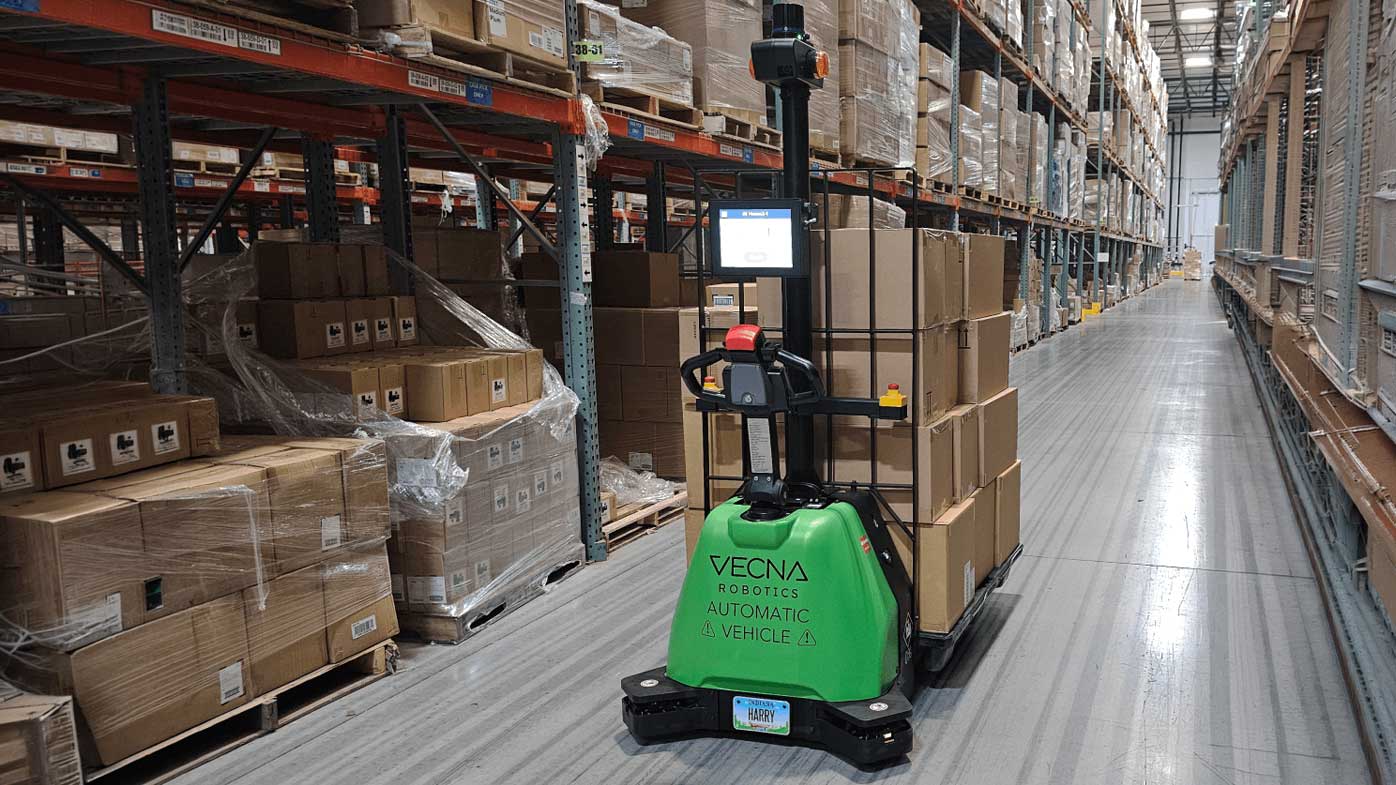
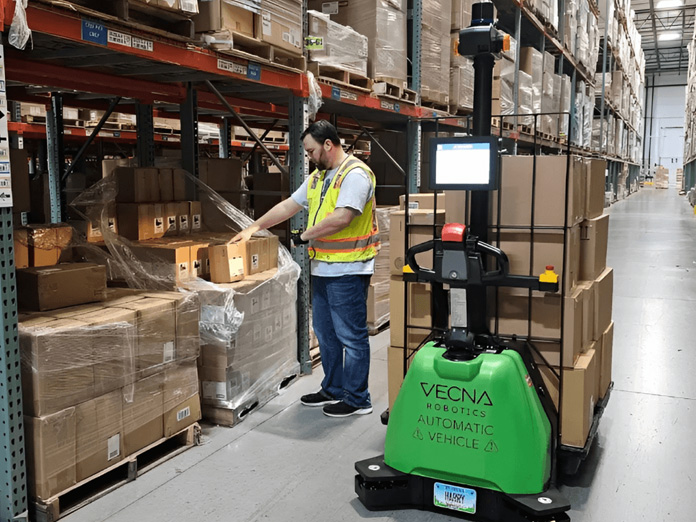
CaseFlow from Vecna Robotics includes multiple types of warehouse automation technologies that ease case picking applications.
Get news, papers, media and research delivered. Sign up for our free newsletters.
Stay up-to-date with news and resources you need to do your job. Research industry trends, compare companies and get weekly market intelligence with Robotics 24/7.
Vecna Robotics
CaseFlow from Vecna Robotics includes multiple types of warehouse automation technologies that ease case picking applications.
For warehouse operators, case picking remains a labor-intensive process, oftentimes requiring employees to spend as much time walking through a distribution center as they do selecting products.
Vecna Robotics is addressing that challenge with CaseFlow, an end-to-end automation platform that coordinates autonomous mobile robots (AMRs), workers and warehouse orders to reduce unnecessary travel and improve picking productivity.
CaseFlow combines wearable devices for worker guidance with Vecna’s Pivotal orchestration software, which coordinates the robot fleet and tracks order requirements.
“Workers in a case picking workflow spend too much time traveling and not enough time picking cases,” said Karl Iagnemma, CEO of Vecna Robotics. “The question we try to answer at Vecna is, how can we use robotics and how can we optimize the overall workflow so that we enable workers to spend more time picking and less time traveling?”
Rather than optimizing robot movement alone, the system considers the locations of both workers and robots. Pivotal positions robots near upcoming pick locations and assigns nearby workers to complete the next task, reducing travel throughout the workflow.
At a GEODIS deployment, Vecna reported a 2X improvement in picking throughput and reduced worker travel by up to 90%. The approach also changes warehouse employee requirements. Workers can focus on picking rather than operating powered material handling equipment, reducing the training needed to become productive.
GEODIS recorded seven powered-equipment incidents in 2022. During the phased CaseFlow deployment over the following two years, the company recorded two.
Vecna said that CaseFlow is designed to augment workers rather than fully automate the picking process. Robots handle pallet movement while employees remain responsible for selecting cases.
“This is a human-robot collaborative system,” Iagnemma said. “What we're really doing is introducing a fleet of robots to enhance picker productivity.”
That approach can deliver productivity gains without major facility modifications or a large upfront investment in fixed automation infrastructure. It also allows warehouses to build on existing processes and labor resources.
Vecna has continued to refine CaseFlow through software updates and customer feedback. Iagnemma said the company has exceeded its original productivity targets by improving navigation, routing and system performance.
“One thing, and I joke about sometimes, but the day we deploy a system, that's actually the least productive that system will be,” he said. “The productivity is only going to increase from there.”
Customer input has also led to practical hardware and software additions, including accessories such as label-printer mounts and shrink-wrap holders on robots. CaseFlow Voice is another example of adapting the system to existing warehouse workflows.
Introduced in March 2026, CaseFlow Voice integrates Lucas Systems' Jennifer voice technology into picking workflows. Workers can receive instructions and confirm tasks through voice commands, which helps reduce the reliance on handheld interfaces.
Iagnemma specifically mentioned CaseFlow Voice’s capabilities in cold-storage environments, where gloves, condensation and limited dexterity can make touchscreens difficult to use.
“We want to meet the customer where they are,” Iagnemma said. “Our goal as a business is not to ask the customer to change their process. We want to integrate with their processes as much as we can. I think CaseFlow and CaseFlow Voice are great examples of that”
Vecna announced a $31 million funding round in September 2026, bringing its total funding since inception to $221 million. The company said the investment will support expanded sales and go-to-market efforts, deployment and customer-support teams and the development of additional product capabilities. Vecna also reported that demand for CaseFlow had more than doubled year over year since its 2025 launch.
“What customers are looking for is, as much as possible, turnkey automation solutions,” Iagnemma said. “They want to find single systems that can do a lot of different complex automation tasks.”
The company said that the funding will also support additions to its autonomous forklift platform. Vecna said that it is developing capabilities for stacking and destacking large containers, as well as loading and unloading trailers. The company expects to release those capabilities in 2027, extending automation across more warehouse and distribution center workflows.
Vecna's broader strategy centers on coordinating different robot types through a unified software platform. Pivotal provides a common orchestration layer across the company's AMRs, enabling the system to manage different workflows and integrate with other automation technologies.
Iagnemma said the company is also focused on making interactions with automation simpler for warehouse employees as the underlying technology becomes more sophisticated.
“What we are very focused on avoiding is passing along the complexity of the system to the worker,” he said. “A worker should not need to understand how to operate a robot.”
Iagnemma said future interfaces could make it easier for customers to modify workflows, potentially using natural-language instructions rather than relying on technical resources.
“Everything in the industry is moving toward simpler interfaces,” he said. “And ultimately, that's going to be really good for the customers and for the workers.”

Tim is the Editorial Director of Robotics247.com. His mission is to provide valuable information and insights to robotics professionals and decision-makers, and to help them solve business challenges. He is a creative, deadline-driven, and detail-oriented storyteller. In addition, he is a sports broadcaster and public address announcer.
Artificial Intelligence Machine Learning Autonomy Lift Trucks Mobile Robots Wearables Components Sensors Cameras Lidar Software Cloud and Edge Data Management Fleet Management News Press Release Autonomous Mobile Robots Cold Storage Deployment Distribution Center Funding Picking Vecna Robotics Voice
Enjoyed this article? Add Robotics 24/7 as a preferred source in Google Search.
Edge computing gives AI agents the processing power to turn instructions into…
Daimon-TWM world model debuts for the public
Platform helps robots adapt to complex tasks
Look beyond the headlines for the latest in humanoid robots