By
Donald Halsing
January 30, 2025
Zebra Technologies
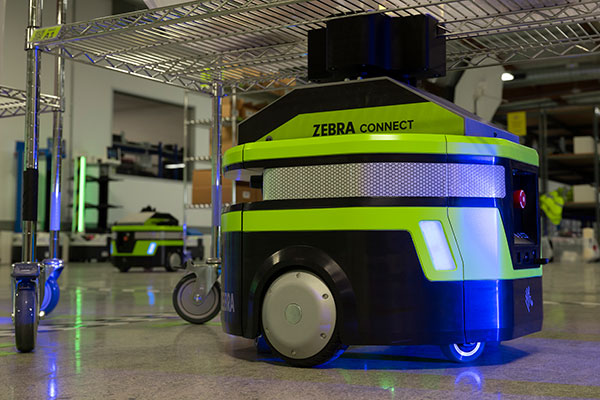
Expanding its Symmetry Fulfillment platform, Zebra Technologies’ Connect Fulfillment AMRs use a cart-based system coupled with wearable technologies to help reduce underutilization.
Get news, papers, media and research delivered. Sign up for our free newsletters.
Stay up-to-date with news and resources you need to do your job. Research industry trends, compare companies and get weekly market intelligence with Robotics 24/7.
Zebra Technologies
Expanding its Symmetry Fulfillment platform, Zebra Technologies’ Connect Fulfillment AMRs use a cart-based system coupled with wearable technologies to help reduce underutilization.
In 2021, Zebra Technologies announced its first new products built upon technology from Fetch Robotics, which it acquired in 2020. Zebra launched its FlexShelf, FlexShelf Guide, and RollerTop Guide autonomous mobile robots (AMRs) along with its FetchCore software. The AMRs integrate with Zebra’s Symmetry Fulfillment software and its other warehouse technologies.
“The legacy Fetch products themselves were built on this very, very strong foundation,” said Matthew Wicks, Zebra Technologies vice president and general manager of robotics automation. “What we've done at Zebra is taken that foundation and built solutions around that - specifically around fulfillment. So we took this awesome mobile robotic technology: we've expanded it, and grown it, and improved on it, as well as added a software on top.”
Since acquiring Fetch Robotics, Zebra has improved the battery chemistry, navigation, localization, and overall robustness of Fetch’s original design, Wicks said. The AMRs can now span multiple shifts on a single charge and carry larger, heavier products, helping end users reduce the number of robots needed and improve ROI.
Zebra most recently expanded its Symmetry Fulfillment software system to integrate its newest hardware product: Connect Fulfillment AMRs.
In person-to-goods (PTG) picking systems, loaded robots tend to queue when waiting for induction or pack-out stations, especially during order surges. Connect Fulfillment AMRs address bottlenecks by using detachable carts.
“Instead of having a high-value asset that's queuing up, we basically drop off a low-value cart and that can be processed. So now that robot can go back in and start supporting the picking operation and pick up another cart,” Wicks said. “You can drive down the overall cost to the end end user by decoupling those carts from the robot itself.”
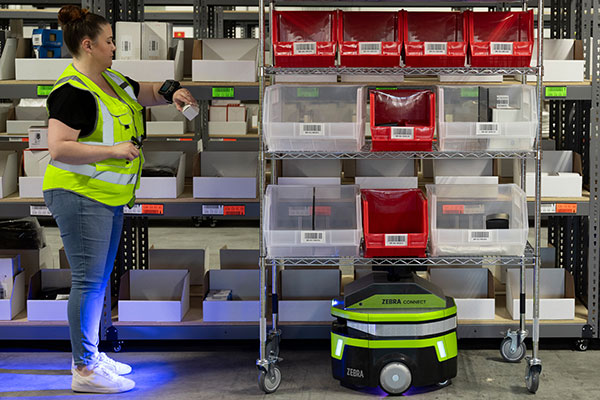
Adopting a cart-based system allowed Zebra to increase cubic capacity by up to 300% over PTG robots with built-in shelves. Wicks said the cart-based system requires up to 30% fewer robots compared to traditional PTG fulfillment systems, and it enables Symmetry to perform better pick route planning and utilization to help maximize efficiency.
“It really embraces the Zebra methodology and technology,” he said. “It has a Zebra look and feel to it. It works with our wearable devices. It works in the same environment in the warehouse with other Zebra devices.
“A lot of pack-out stations leverage Zebra handhelds and printing devices that are tied to the WMS,” Wicks added. “It is just an extension of where we are already very, very strong in the warehouse.”
Symmetry Fulfillment builds upon legacy software, including FulfillmentEdge and FetchCore. Symmetry performs both robot fleet management and manages fulfillment processes by interfacing with order fulfillment software, such as WMS, to process orders.
“We leverage AI to make the best decisions that we can to optimize those pick routes, and how those orders are to be best fulfilled,” Wicks said. “Our system looks at the orders holistically and looks across all of the waves or the orders that are given to us. And then we optimize the pickers’ routing and the robots required to support that,” he added.
Symmetry Fulfillment follows Zebra’s Team Intelligence methodology to coordinate teams of human pickers and robots precisely in a directed workflow. Workers interface with Symmetry through handheld and wearable scanning devices, which tell them where to go, what and how many items to pick, and where to place those items.
“It's very efficient and very fast and, quite frankly, a very simple product to use for fulfillment.”
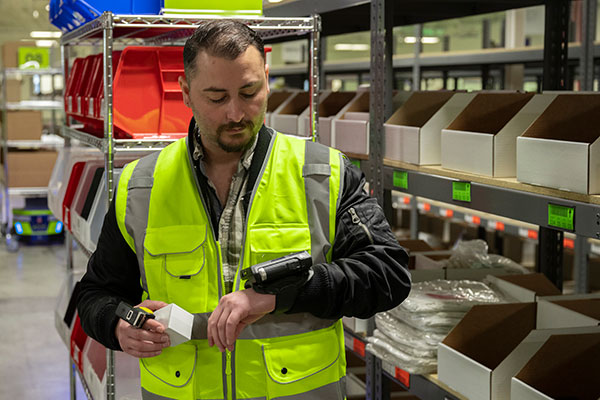
One challenge of automating with PTG cobots is underutilization. Empty robots might be spread across a facility, not engaged with pickers.
“Using our Team Intelligence, our robots are coordinated with the pickers so that we minimize the downtime and underutilization of the robots, and make that pick operation as efficient as we possibly can.”
Wicks said after about 15 minutes of working with the robots, employees will probably forget they are even there.
“That handheld tells me where to go, what to do, and the robots are just there,” he said. “They just show up, and they're there for me to put the items in. I'm not slowed down by anything but my ability to get to the next pick position and place those items into the next robots that are already there.”

Wicks said Symmetry can provide warehouse operators with insights absent from manual PTG operations that can help improve decision making.
“We're increasing the amount of analytics and visibility into what's happening out there in the fulfillment operations.”
Symmetry keeps track of pickers, showing operators which pickers are doing well along with those who might need assistance.
“We enable businesses of all different sizes to achieve their highest efficiency by intelligently connecting the data assets and workers, and so that falls right in line with our robotic solution and our robotics automation team,” Wicks said.
Symmetry Fulfillment can also support intralogistics transport systems for pick-to-cart and pick-to-tote arrangements.
“A lot of Zebra applications are leveraged in fulfillment operations for manual picking,” Wicks said. “Where we see other form factors being applied around fulfillment is to transport the items to and from those brownfield or legacy fulfillment operations to the pre- and post-pick transport area, like an induction area or a pack out area.”
Automating conveyance allows employees to focus on picking instead of shuttling carts, which can improve labor productivity.
“Our full turnkey Symmetry fulfillment solution has that post-pick transport, plus it does all of the picking operations inside the aisles inside of the warehouse.”
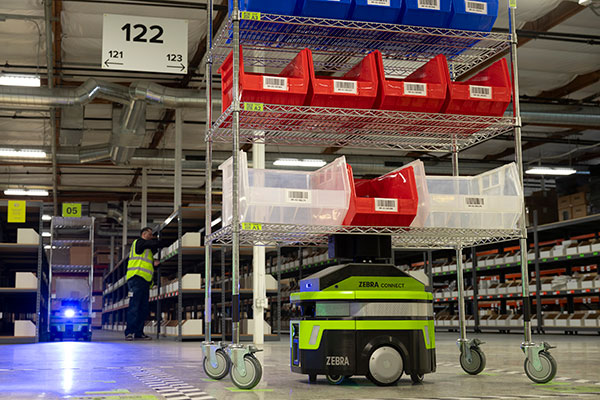
Wicks said Symmetry can also interface with other robotic systems, allowing Connect Fulfillment AMRs to transport items to and from goods-to-person (G2P) systems like automated storage and retrieval systems (AS/RS).
“We've had an opportunity to really rethink how to do fulfillment solutions. Person-to-goods fulfillment solutions have been pretty stagnant for quite some time, and so we've looked at the hardware and the software, and how to pull Zebra’s core products all together to make a really innovative solution that can drive down costs for our end customers.”
Wicks added Zebra Symmetry Fulfillment has helped wheeled AMRs realize the robotics productivity hype from many years ago.
“We've taken the opportunity to really build on the core products of Zebra, leverage the Zebra strengths, and then build on to a mobile robotics solution - a really innovative fulfillment solution - that we believe is game changing in the industry.”
Want to learn more about mobile robots? This article was featured in the February 2025 Robotics 24/7 Special Focus Issue titled “Mobile robots of all shapes and sizes.”

Donald Halsing is Associate editor of Robotics247.com. As an editor and journalist with a Bachelor of Arts in English from Framingham State University, he has a strong background in developing engaging and impactful stories for print and digital media. In addition to serving as Editor-in-Chief of Framingham State’s award-winning independent student newspaper, “The Gatepost,” Don spent over four years in operations at Mattress Firm, with his primary responsibilities including inventory control and inventory management. Don is currently pursuing his Master of Arts at FSU and is a professional photographer for Ashley Wall Photography
Artificial Intelligence Autonomy Mobile Robots Industrial Automation Collaborative Robots Wearables Components Batteries and Power Software Data Management Fleet Management News Features Editors Pick Analytics Autonomous Mobile Robots Carts Cobots Conveyance Decision making Fulfillment Intralogistics Labor Productivity Localization
Enjoyed this article? Add Robotics 24/7 as a preferred source in Google Search.
Edge computing gives AI agents the processing power to turn instructions into…
Daimon-TWM world model debuts for the public
Platform helps robots adapt to complex tasks

Look beyond the headlines for the latest in humanoid robots