By
Jeff Berman
January 9, 2020

Get news, papers, media and research delivered. Sign up for our free newsletters.
Stay up-to-date with news and resources you need to do your job. Research industry trends, compare companies and get weekly market intelligence with Robotics 24/7.
Looking at the calendar, I am mildly late with this type of column, which will endeavor to take a peek into 2020, as we are roughly one week into not only a new year, but also a new decade. But better late than never, is the working theme I will have to go with, in this case. And it stands to reason that it is not too late still.
Where to begin? There are many areas that could lead the list, but let’s go with the economic outlook. Taking a look back at 2019, it goes without saying that it came up short to 2018, which was a very strong year on myriad levels, including solid GDP, consumer confidence and retail sales, industrial production, and, of course, freight volumes and tonnage. Needless to say, that was not the case in 2019, with the economy bearing the brunt of tariff tensions, lower GDP output, a decline in manufacturing output, and reduced demand, not a good formula.
With 2020 in the early innings, there are signs of progress on the trade front for both U.S.-China, with the pending Phase One agreement to be signed on January 15 and the USMCA moving towards the finish line, too. But these developments come against the backdrop of impeachment proceedings and the U.S.-Iran conflict, with each of these things having the potential to change quickly.
Another thing to keep an eye on is the role of “disruptive” technology. I won’t lie, I used to cringe a little bit when I heard that term, at first, but I have now taken it for what it is. And what is happening with it is, no doubt, having an impact on how carriers, shippers, 3PL, and freight brokers approach doing business, or, perhaps more appropriately, the new way of doing business. In this case, it relates to things on the digital freight matching front i.e. securing capacity and matching loads, but there are other components, too, in a lengthy list. That list includes things like AI, IoT, Blockchain, robotics, delivery by drone, and (down the road) autonomous vehicles.
The state of parcel delivery and its last-mile logistics brethren will continue to get more and more specialization, one can assume, too. Given the heightened state of e-commerce and last-mile, how could it not? Amazon said it was on track to deliver 3.5 billion packages on its own in 2019, a staggering sum, considering where it was only a few years ago. And it is a number that is only going to grow as time goes on. Not to mention that UPS and FedEx continue to raise the stakes not only by their own internal standards but on a competitive level as well.
On an inside the Beltway level, the state of infrastructure remains muddled, in flux, or whatever you want to call it, but it is clear that with 2020 being an election year, the game of political football remains on the clock, with many stakeholders expecting another punt on a long-term bill until 2021.
This is only a sample of where things stand and have been last year and beyond and into this year, but one thing is clear: 2020 looks to be as interesting of a year in the freight transportation and logistics sectors as there has been in some time. Buckle up for what could be quite a ride.

Jeff Berman is Group News Editor for Logistics Management, Modern Materials Handling, and Supply Chain Management Review and is a contributor to Robotics 24/7. Jeff works and lives in Cape Elizabeth, Maine, where he covers all aspects of the supply chain, logistics, freight transportation, and materials handling sectors on a daily basis.
Enjoyed this article? Add Robotics 24/7 as a preferred source in Google Search.
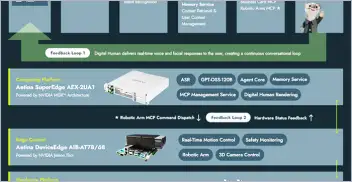
Edge computing gives AI agents the processing power to turn instructions into…

Daimon-TWM world model debuts for the public

Platform helps robots adapt to complex tasks

Look beyond the headlines for the latest in humanoid robots