Association for Advancing Automation (A3)
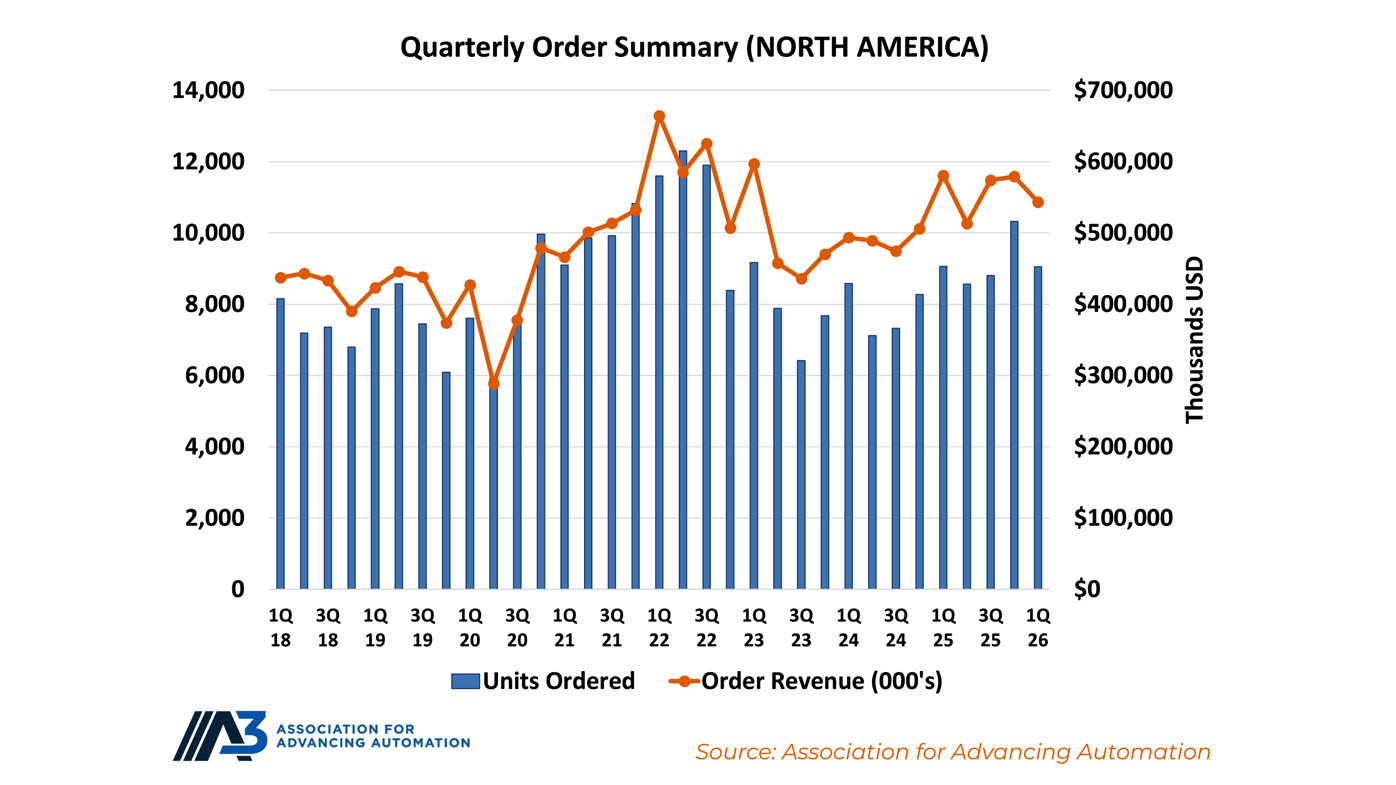
A3 released its Q1 2026 robot orders report, finding a 0.1% decrease in units ordered and a 6.4% decline in revenue compared to Q1 2025.
Get news, papers, media and research delivered. Sign up for our free newsletters.
Stay up-to-date with news and resources you need to do your job. Research industry trends, compare companies and get weekly market intelligence with Robotics 24/7.
Association for Advancing Automation (A3)
A3 released its Q1 2026 robot orders report, finding a 0.1% decrease in units ordered and a 6.4% decline in revenue compared to Q1 2025.
North American companies ordered 9,055 robots valued at $543 million in the first quarter of 2026, according to new data released by the Association for Advancing Automation (A3).
Compared to the first quarter of 2025, A3 said that this represents a 0.1% decrease in units ordered and a 6.4% decline in revenue.
A3’s report said that while unit orders were essentially flat, order revenue declined year over year, driven largely by a cyclical decline in automotive OEM orders, which fell 35.1% in units and 48.2% in revenue compared to the same quarter last year.
Given the size and timing of automotive programs, A3 said that decline had an outsized impact on the total market.
Outside of automotive OEMs, A3 said that demand across much of the robotics market remained healthy. Automotive component suppliers increased orders 28.1% in units and 15.5% in revenue compared to Q1 2025, reflecting the segment’s typical lag behind OEM ordering cycles.
Several non-automotive industries also posted strong year-over-year gains in robot orders, including:
A3 said that these results point to continued diversification in automation demand as companies across industries invest in robotics to improve productivity, address workforce challenges and strengthen operational resilience.
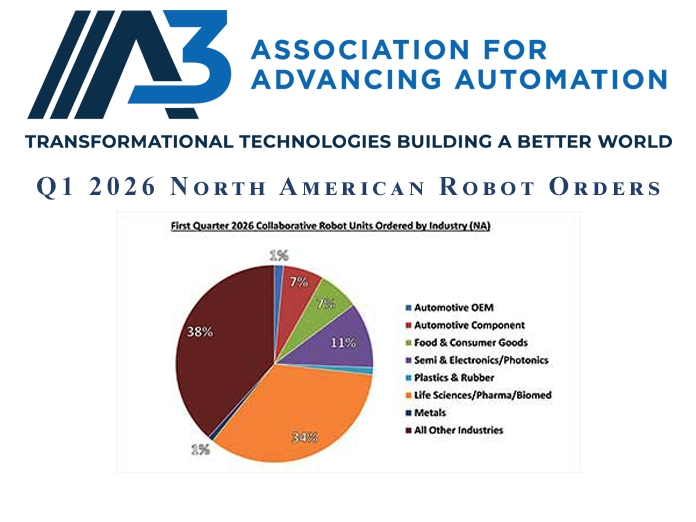
The report found that collaborative robots (cobots) remained one of the strongest-performing categories in the quarter. Companies ordered 1,637 collaborative robots valued at $69.8 million in Q1 2026, representing a 55.6% increase in units and a 78.2% increase in revenue compared to Q1 2025. Cobots accounted for 18.1% of all robot units ordered and 12.9% of total order revenue during the quarter.
Collaborative robot adoption was especially strong in life sciences/pharma/biomed, where they represented 60.7% of total robot orders in the sector, as well as semiconductors/electronics/photonics at 45.9% and all other industries at 29.0%.
“Collaborative robots are one example of how the robotics market continues to evolve,” said Alex Shikany, executive vice president at A3. “The broader takeaway from the first quarter is that automation demand is becoming more diverse in terms of industries, applications and deployment models. That is an important signal for the long-term health of the market, especially as companies continue to invest in productivity, flexibility, quality and competitiveness.”
A3 said that the Q1 data reinforces a broader trend that has emerged over the past several years: robotics adoption is expanding well beyond traditional automotive manufacturing.
Industries such as life sciences, electronics, food and consumer goods, and general manufacturing continue to increase investment in automation as they navigate labor shortages, supply chain pressures, quality requirements and global competition.

From geometry preparation to AI-assisted analysis, integrated CFD workflows…

Software-based GripperAI manages mixed picking through basic geometry
Safety, communication and motion control components enable smooth operation

North America’s largest robotics and automation event winds down