By
Clive Purchase
February 22, 2021
Get news, papers, media and research delivered. Sign up for our free newsletters.
Stay up-to-date with news and resources you need to do your job. Research industry trends, compare companies and get weekly market intelligence with Robotics 24/7.
Despite tremendous advances in route optimization over the past few decades, there remains an important gap between theoretical route planning and real-life route execution: in real-life operations, the quality of a route is not exclusively defined by its theoretical length, duration, or cost.
Experienced delivery drivers have tacit knowledge about the complex operational environment in which they serve customers on a daily basis.
To allow for safer, more efficient, and sustainable last-mile delivery, it is critical to leveraging this tacit information for improved route planning.
The primary goal of the Last Mile Routing Research Challenge is to encourage participants to develop innovative approaches leveraging artificial intelligence, machine learning, deep learning, computer vision, and other non-conventional methods to produce solutions to the route sequencing problem which outperform traditional, optimization-driven operations research methods in terms of solution quality and computational cost.
Despite tremendous advances in route optimization over the last decades, there remains an important gap between theoretical route planning and real-life route execution.
In real-life operations, the quality of a route is not exclusively defined by its theoretical length, duration, or cost.
Experienced delivery drivers have tacit knowledge about the complex operational environment in which they serve customers on a daily basis.
To allow for safer, more efficient, and sustainable last-mile delivery, it is critical to leveraging this tacit information for improved route planning.
The Amazon Last Mile Routing Research Challenge encourages participants to develop innovative approaches leveraging artificial intelligence, machine learning, deep learning, computer vision, and other non-conventional methods to produce solutions to the route sequencing problem which outperform traditional, optimization-driven operations research methods in terms of solution quality and computational cost.
The challenge site is live and registration opens on 22 February. Visit routingchallenge.mit.edu
Amazon is providing the training data for the models and will be evaluating submissions, with technical support from MIT CTL scientists. MIT CTL will publish and promote technical papers about the top-performing models. The winners’ prizes are $100,000 for first place, $50,000 for second, and $25,000 for third.
Top-performing teams may be interviewed by Amazon for research positions in the Last Mile organization and be invited to present their work at MIT CTL
The historical data provided by Amazon will include approximate delivery locations, package dimensions, and travel times and distances between locations - information used by existing route optimization algorithms.
But Amazon will also provide more than 4,000 traces of driver-determined routes, which encode the drivers’ know-how. Using both sources of information, contestants will be able to build models that identify and predict drivers’ deviations from routes computed in the traditional manner.
After the researchers have submitted their models, Amazon will release another 1,000 routes’ worth of historical data for evaluation purposes.
Visit routingchallenge.mit.edu for the most updated information on the challenge.
Related Article: MIT CTL’s Top Supply Chain Challenges in 2021
Enjoyed this article? Add Robotics 24/7 as a preferred source in Google Search.
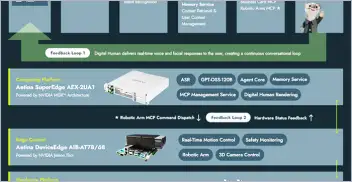
Edge computing gives AI agents the processing power to turn instructions into…

Daimon-TWM world model debuts for the public
Platform helps robots adapt to complex tasks

Look beyond the headlines for the latest in humanoid robots