Interact Analysis
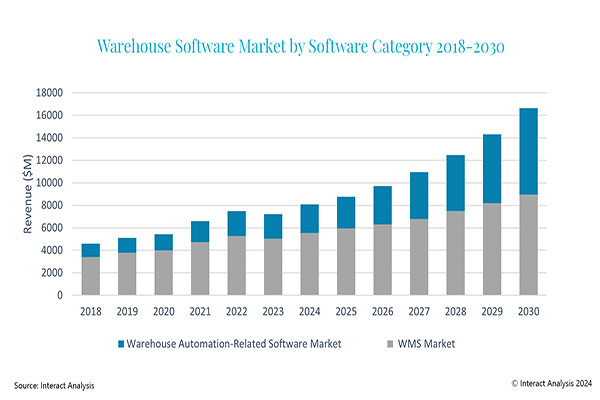
Based on recent data, market research firm Interact Analysis predicts a large portion of warehouse software market growth will be attributed to automation and robotics.
Get news, papers, media and research delivered. Sign up for our free newsletters.
Stay up-to-date with news and resources you need to do your job. Research industry trends, compare companies and get weekly market intelligence with Robotics 24/7.

Interact Analysis
Based on recent data, market research firm Interact Analysis predicts a large portion of warehouse software market growth will be attributed to automation and robotics.
According to recently-published research by market intelligence firm Interact Analysis, the warehouse software market is facing a rapid growth trajectory. In 2023, the market was valued at $7.2 billion, and this is expected to increase to $16.6 billion by 2030.
Overall, standalone warehouse management systems (WMS) remains the largest software category. The markets for other warehouse automation-related software, such as robotic picking software, multi-fleet orchestration platforms, and warehouse control systems (WCS), are expected to grow rapidly and at a higher growth rate than the total warehouse software market.
“The exponential growth of the warehouse automation-related software segment we have observed is the result of a few key drivers,” said Irene Zhang, Interact Analysis senior analyst.
Zhang listed three drivers, the first being that the growth of warehouse automation has created a need for software that can be used to control systems and execute tasks.
Additionally, modular and standardized automation sub-systems requiring orchestration have contributed to a need for optimization of overall throughput.
Finally, Zhang said widespread adoption of autonomous mobile robots (AMR), contributed to by the robotics as a service (RaaS) business model, has driven demand for fleet management systems.
Interact Analysis said it expects the automation-related software segment will expand at a compound annual growth rate (CAGR) of approximately 19.5% between 2023 and 2030, compared with 12.7% for the warehouse software market as a whole.
According to Interact Analysis’ latest study, the deployment of a warehouse execution system (WES) can be a strategic choice leading to increased operational warehouse efficiency. Not only do these systems provide visibility into warehouse asset operations, but they also have the capability to dynamically release orders and assign tasks based on the real-time operation status of assets.
As a result, bottlenecks can be avoided, and efficiency can be increased. WES data can also be used to predict future warehouse automation and capacity efficiency, while providing feedback to warehouse managers, Interact Analysis said.
However, the biggest question Interact Analysis posed surrounding the WES market isn’t the benefits of the software, but who will be providing it. Historically, automation vendors have been the main provider of WES solutions, given the amount of data they have on throughput rates and system constraints.
Interact Analysis said it has seen growth in standalone WES solutions independent of WCS and WMS, as well as WES embedded into WMS. Also, the boundaries between different types of warehouse software vendors have become blurred as vendors expand their software product offerings. Many traditional WMS vendors have started to offer WES and WCS solutions, for example.
Interact Analysis said it predicts the next few years will be highly dynamic, as different groups of companies compete to provide orchestration and execution capabilities.
Want to learn more about fleet management, orchestration and WES? Check out the June 2024 Robotics 24/7 Special Focus Issue titled "Orchestrating mobile robot fleets for success."
Enjoyed this article? Add Robotics 24/7 as a preferred source in Google Search.
Edge computing gives AI agents the processing power to turn instructions into…
Daimon-TWM world model debuts for the public
Platform helps robots adapt to complex tasks
Look beyond the headlines for the latest in humanoid robots