By
Donald Halsing
December 10, 2024
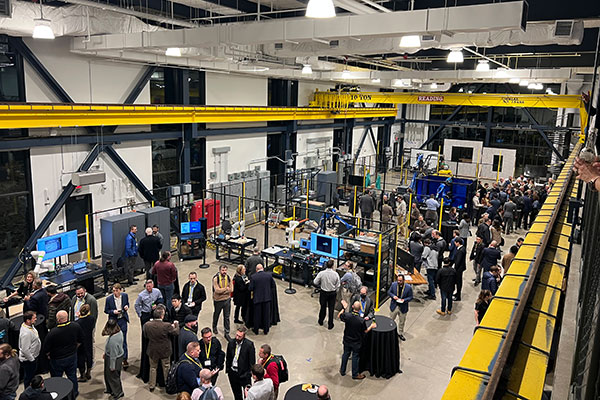
ARM Institute
ARM Institute members gather in Pittsburgh, Pa. at the Robotics Manufacturing Hub inside Mill 19 during the ARM Institute’s 2023 annual member meeting.
Get news, papers, media and research delivered. Sign up for our free newsletters.
Stay up-to-date with news and resources you need to do your job. Research industry trends, compare companies and get weekly market intelligence with Robotics 24/7.
ARM Institute
ARM Institute members gather in Pittsburgh, Pa. at the Robotics Manufacturing Hub inside Mill 19 during the ARM Institute’s 2023 annual member meeting.
Over the past several decades, Larry Sweet has led robotics development at several recognizable organizations.
Sweet has worked across the robotics ecosystem, from robot developers like ABB and FANUC to end users including Amazon and PepsiCo.
But it’s across his experiences in the latter category that Sweet noted an interesting commonality: robotics projects developed by end users, for end users, did not get stuck in a laboratory research and development phase.
“We were transferring the technology to ourselves. It was going directly into our own factories” he said.
Now serving as a member of the engineering team at the ARM (Advanced Robotics for Manufacturing) Institute, Sweet is helping robot developers research and prototype new systems with end-user deployments in mind.
In response to distribution challenges at C&S Wholesale Grocers, CEO Rick Cohen founded CasePick Solutions, now known as Symbotic, to develop sortation technology in-house that would be cheaper than European systems available at the time.
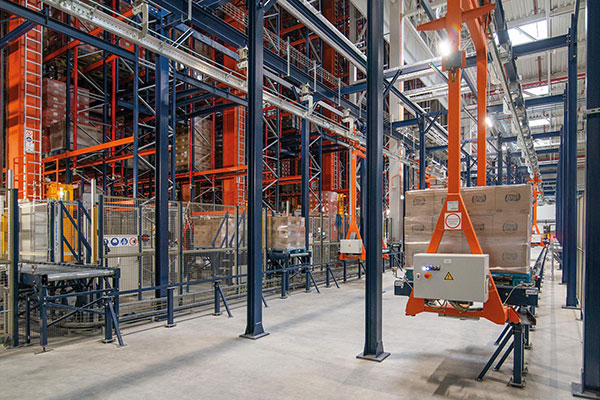
As CTO and SVP of R&D at Symbotic, Sweet helped develop an automated storage and retrieval system (AS/RS) for C&S, which automated picking and order fulfillment of around 80 million cases each night.
“I was involved from the beginning,” Sweet said. “It took us four years to build our first fully-operational warehouse in Newburgh, N.Y. I put 140,000 miles on my car driving between Boston and Newburgh.”

At the ARM Institute, members also gain opportunities to develop technologies that help address real-world challenges, focused on the manufacturing end of the supply chain.
It all starts with a project call.
A large portion of the ARM Institute’s funding comes from the U.S. Department of Defense (DoD) Manufacturing Technology (ManTech) program, which also provides technical oversight for project call creation. When putting together project calls, the ARM Institute provides its members with areas of interest developed in cooperation with its sponsors, but not explicitly what to deliver.
Sweet said when he joined the ARM Institute in 2023, he was chartered by institute leadership and the ARM Institute’s government sponsors.
“They said, ‘Larry, we want you to figure out a way to accelerate technology maturity from the lab to production readiness.’ It was important to the ARM Institute, and it was important to the Department of Defense, and it was also important to all of our members.”
Discussions with the ARM Institute’s DoD partners helped Sweet revise the ARM Institute’s project completion goals to help meet government sponsor expectations.
“One of things we talked about is when you're doing the demo, who's running the demo?” Sweet said. “The majority of the time I went in person or virtually to a final demo - I'm not kidding - you would stand around the robot, and there'd be three or four guys with open laptops. These are the developers. … They were doing some things, making adjustments, etc.
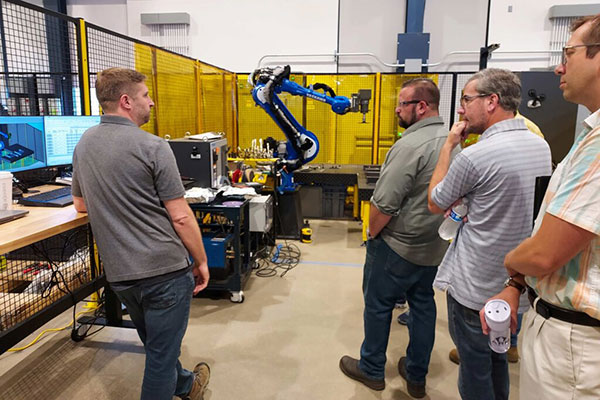
Building off feedback from sponsors and a ManTech document that defines R&D objectives, Sweet outlined three types of demonstrations the ARM Institute can now provide at the end of each project:
“We want the majority of the [manufacturing relevant] demo to be run by real operating people,” he said. “The difference is dramatic when you have to think about how you're going to do that. And in the [manufacturing] representative one, you're actually almost ready to go to pilot. So you basically tell the engineers, ‘Stay behind the line.’”
As group VP of transformational supply chain, engineering, & technology for the Frito-Lay division of PepsiCo, Sweet used simulation tools to help decide what parts of production lines needed attention and what technology was worth investigating. His team deployed three new technologies that improved asset utilization by 50%. Combined with other projects, these changes increased production output across the whole network by 800 million pounds per year.
To better achieve that goal, Sweet invited employees from the launch production facility to test-run automation equipment under development at a pilot site. The operators offered feedback for the development team, including changing the user interface.
“We had designed it as engineers. But having put it in the hands of operators, they really resolved a lot of the usability issues,” Sweet said. “In manufacturing, there's a lot of knowledge that isn't written down. … They taught us a lot of things that we needed to know, and without that we would not be successful.”
When the systems were integrated into production facilities, the test crew became ambassadors for the development team, contributing to a smooth startup.
“If you're just developing something in a research lab, you've missed all of that,” Sweet added. “How do you build a relationship with the end user, with the sites? In other words, what does it look like to the operators? What's it look like to their supervisors? What's it look like to the plant manager?”
One additional group robot developers need to consider is systems integrators.
“A lot of the hardware and the software that was being used in the laboratory setting was intentionally set up to make it easy for the engineers to develop. It wasn't necessarily commercial hardware,” Sweet said. “There's too much risk to an integrator to pick up something out of the laboratory. If you're an integrator, the margins that you're working on are very thin. You can't afford to have a big miss.”
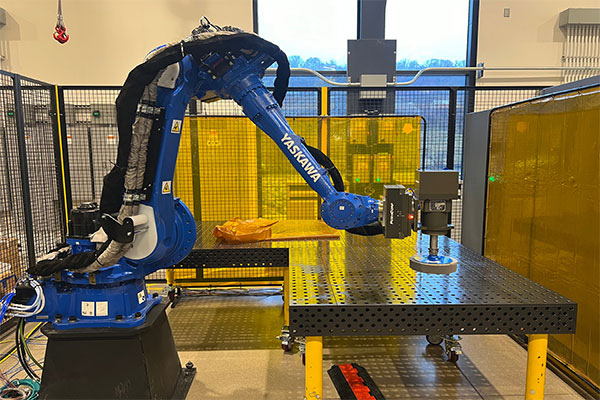
To help ARM Institute members develop robots on a path for deployment, projects with a manufacturing relevant or representative demonstration goal must predominantly use hardware and software that is commercially available, except for any proprietary technology being tested.
“When you think about a factory, they probably already have strategic supply agreements with the major vendors, and they tend to standardize,” Sweet said. “They don't want 13 different varieties of robot brands, because the training and the maintenance for their workforce is tough. They are not going to change just because you've got a favorite robot you like in your lab. You have to think about it from their side.”
The ARM Institute’s Robotics Manufacturing Hub in Pittsburgh, Pa. is intentionally aimed at small and medium-sized manufacturers to help them minimize the risks associated with deploying new technology. The ARM Institute connects U.S. manufacturers with robotics technologies, some of which are custom and some of which are off-the-shelf, to help improve their operations.
Most of the projects the ARM Institute wrapped up in 2023 concluded with laboratory demonstrations, but there were some exceptions, including manufacturing-scale demonstrations from GrayMatter and Titan Robotics, Inc. Those developers, although not as big as Amazon or PepsiCo, adopted the same process Sweet experienced at the larger companies: developing technology with integration as the end goal.
“They were created not just as an R&D shop, but they were created as a company that was also going to be able to integrate themselves. They were going to work directly with the end user from the very beginning,” Sweet said. “Here was a formula for potential success.”
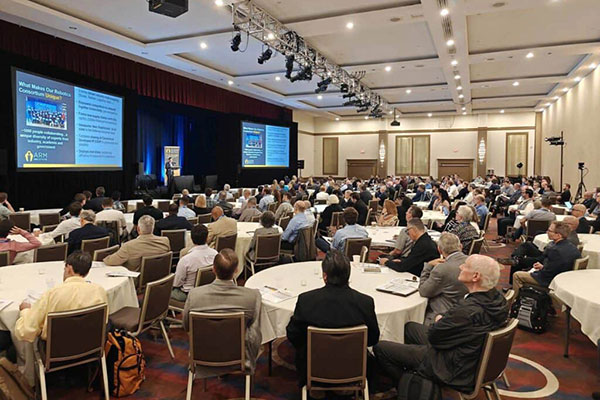
The ARM Institute hosted a Tech Day at Mill 19 in April 2024 to answer final questions before members submitted their proposals for its first project call of the year. Twelve proposals were selected for an in-person presentation.
“They were all production relevant or production representative,” Sweet said. “There were a couple of presentations where the manager from the factory where the product is being built came personally to say, ‘We want this. This is on our roadmap. It's on the company's roadmap. We're actually going to do things that are proving it out in a real manufacturing environment.’”
Following the selection process, the ARM Institute awarded $2.9 million to six projects that aimed to develop technologies with end users in mind, setting goals for manufacturing relevant or representative demonstrations.
“This is really the mindset for all the projects at the ARM Institute,” Sweet said. “The sponsors are very clear they want to do this kind of thing. This will be a model for how we do it.”
Want to learn more about robot and automation system integration? This article was featured in the December 2024 Robotics 24/7 Special Focus Issue titled “The process of robot integration.”

Donald Halsing is Associate editor of Robotics247.com. As an editor and journalist with a Bachelor of Arts in English from Framingham State University, he has a strong background in developing engaging and impactful stories for print and digital media. In addition to serving as Editor-in-Chief of Framingham State’s award-winning independent student newspaper, “The Gatepost,” Don spent over four years in operations at Mattress Firm, with his primary responsibilities including inventory control and inventory management. Don is currently pursuing his Master of Arts at FSU and is a professional photographer for Ashley Wall Photography
GENISOM AI makes ICRA debut at conference in Vienna
World's first omni-modal evaluation including tactile sensing for…

Ultrasonic sensing enhances robotics perception
Cybernetix Ventures’ event kicks off Robotics Tech Week 2026 slate of events