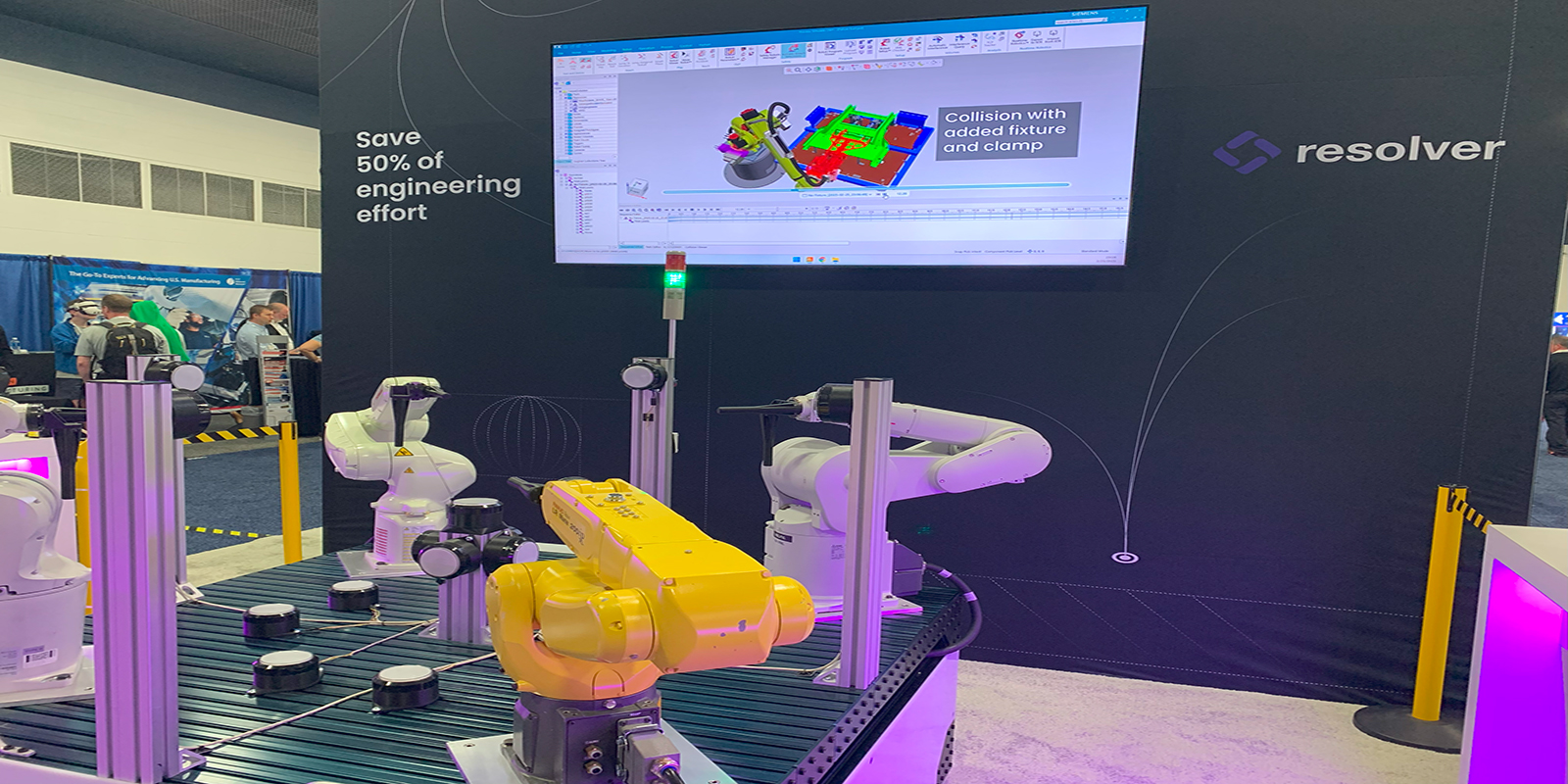
Tim Culverhouse | Peerless Media
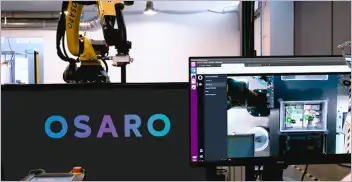
Realtime Robotics announced two new integrations for its Resolver program (seen here at Automate 2025). The integrations are for Visual Components and Mitsubishi Electric’s MELSOFT Gemini.
Get news, papers, media and research delivered. Sign up for our free newsletters.
Stay up-to-date with news and resources you need to do your job. Research industry trends, compare companies and get weekly market intelligence with Robotics 24/7.
Tim Culverhouse | Peerless Media
Realtime Robotics announced two new integrations for its Resolver program (seen here at Automate 2025). The integrations are for Visual Components and Mitsubishi Electric’s MELSOFT Gemini.
Realtime Robotics, a provider of automated collision-free motion planning, control and optimization, announced the release of two new direct integrations for Resolver, its cloud-based system that dramatically accelerates the design and deployment of robotic workcells.
Users of Visual Components or Mitsubishi Electric’s MELSOFT Gemini 3D manufacturing simulation software can now utilize Resolver’s industrial AI without having to leave their preferred environment. These new integrations join the existing integration with Siemens Process Simulate, which was available at launch.
The announcement came at Automatica 2025 in Munich.
Realtime Robotics said Resolver is a cloud-based optimization engine that automates the most time- and labor-intensive parts of robotic work cell design, namely path planning, task allocation, sequencing and layout validation. Whether engineering a new production line or upgrading a single robotic work cell, Realtime Robotics said Resolver empowers users to achieve superhuman cycle times - resulting in faster builds, fewer errors and validated designs in mere minutes.

The longer Resolver runs, the more options it provides, shortening the cycle time until the desired outcome is reached.
“Since launching Resolver commercially last month - following six months of intensive collaboration with automotive OEMs and their line builders and integrators across the U.S., EU, Japan, and China - we’ve seen momentum accelerate rapidly,” said Peter Howard, CEO, Realtime Robotics. “Two OEMs are already citing Resolver in their requests for proposal, while others are already using it as part of their internal standard workflows. This rapid acceptance is based on the consistent 15 to 40% cycle time improvements users are enjoying.”
The launch of the Visual Components integration with Resolver is part of Realtime Robotics’ larger partnership with Visual Components. Known as “the fastest way from concept to reality,” Visual Components has a reputation built on its intuitive, collaborative 3D simulation and robot offline-programming tools, backed by its library of over 3,500 components and 1,600 robot models.
On top of that strong foundation, the companies said there is growing traction for more complex use cases, such as large-scale automotive spot‑welding cells. The companies said that combined with Resolver, Visual Components can now be used to solve cells of any complexity and size, and at remarkable speed.
To support customers tackling these ambitious projects, Realtime Robotics is offering a joint trial: get one month free of Visual Components robot offline programming (OLP) software free when exploring the Resolver sandbox.
Enjoyed this article? Add Robotics 24/7 as a preferred source in Google Search.
Edge computing gives AI agents the processing power to turn instructions into…
Daimon-TWM world model debuts for the public
Platform helps robots adapt to complex tasks

Look beyond the headlines for the latest in humanoid robots