Realtime Robotics
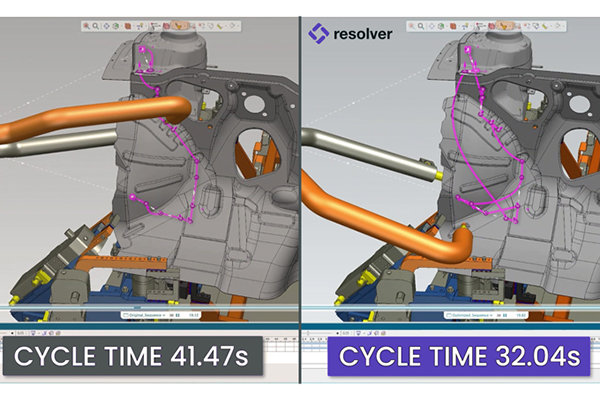
Resolver's cycle time is one of the program's advantages, according to Realtime Robotics. The platform officially launched at Automate 2025 in Detroit.
Get news, papers, media and research delivered. Sign up for our free newsletters.
Stay up-to-date with news and resources you need to do your job. Research industry trends, compare companies and get weekly market intelligence with Robotics 24/7.
Realtime Robotics
Resolver's cycle time is one of the program's advantages, according to Realtime Robotics. The platform officially launched at Automate 2025 in Detroit.
Realtime Robotics, a provider of automated collision-free motion planning, control and optimization, launched Resolver, a new cloud-based offering at Automate 2025 in Detroit.
The company said that Resolver dramatically accelerates the design and deployment of robotic workcells.
Automate 2025 is May 12-15 at Detroit’s Huntington Place. Realtime Robotics is showcasing Resolver in Booth 9101.
Robot path planning is traditionally a complex, time-consuming and brittle process. In most workcells, there are multiple robots in use, requiring tedious manual labor to create interference zones and interlock signals that ensure no collisions during the manufacturing process. Manually validating the mechanical design, planning robot paths, determining sequencing to hit optimal cycle time targets and defining those interlocks can take a team well over 100,000 hours for a single project. Due to its complex nature, Realtime Robotics said this often leads to failures in hitting cycle time targets and adds expensive rework to 10-15% of workcells.
Realtime Robotics said Resolver works by intelligently selecting and testing potential sequences tens to thousands of times faster than any human programmer, quickly generating optimal, collision-free motion paths and interlock signals.
“It is widely understood that the future of the manufacturing industry lies in robotics and automation,” said Peter Howard, CEO of Realtime Robotics. “However, that future is slow to materialize because of the outdated, time-consuming and inefficient processes commonplace in the industry. Few manufacturers have the time or resources needed to enact real change. We’ve engineered Resolver to help manufacturers improve their engineering, programming and production processes - and drive greater value from their current and future investments in robots.”
With Resolver, the company said organizations can automatically discover the fastest target order - accelerating workcell design from months to days - all while decreasing engineering effort by 50%. Workcell cycle times reduces, and overall throughput increases.
The company said Resolver gives users affordable, on-demand, infinitely scalable robotic simulation power that can be used to speed the process of:
Realtime Robotics’ Resolver supports path planning with any number of robots, at any phase of the workflow and generates results in minutes. The program requires minimal onboarding - and currently allows users to work directly within Siemens Process Simulate.
The company said support for other leading simulation platforms will be rolled out later in the year, enabling teams to work directly within their preferred simulation tool.
“Resolver has the computational power to generate better motion paths than human programmers in both simple and complex workcells,” Howard said. “This is because Resolver searches the possibilities open to robotic arms, while humans tend to stay within the possibilities of the human arm.”
Organizations will only need upload the workcell information into a new project, configure their sequencing and conditions and execute a run. Realtime Robotics said that in minutes, Resolver will generate motion paths - including interlocks - with a superhuman cycle time. The longer Resolver runs, the more options it provides, shortening the cycle time until the desired outcome is reached. The paths and interlocks can then be easily imported back into the simulation software for validation and operation.
“Resolver eliminates the most time-consuming aspects of industrial robotics - the programming and optimization of the robots. What used to take months to accomplish can now be measured in hours,” said Marco Bizjak, head of Competence Center Digital Factory and technical manager, digitalization, at FFT. “We believe this can be a real competitive advantage as we strive to help our customers establish the most efficient and effective manufacturing processes possible.”
Resolver also can be used at any point in the project lifecycle, from proposal to workcell design. Resolver can accelerate project timelines by generating collision-free motion paths and enable more accurate cycle time estimates. Realtime Robotics said this feature can allow organizations to outbid potential competition during the project proposal phase. It also shortens the design phase by streamlining manual path planning into simple steps, automatically defining interlock signals and minimizing mechanical design iterations.
Beyond its ability to determine optimal motion plans and interlocks, Resolver can help with fixture design, reachability validation, target sequencing and robot task allocation. It can also be used to design the paths and interlocks for an entire manufacturing line from the start, giving an organization a comprehensive view of its entire operation.
GENISOM AI makes ICRA debut at conference in Vienna

World's first omni-modal evaluation including tactile sensing for…
North America’s largest robotics and automation event winds down
Automate’s largest day ever draws huge crowds to McCormick Place