BeBop Sensors
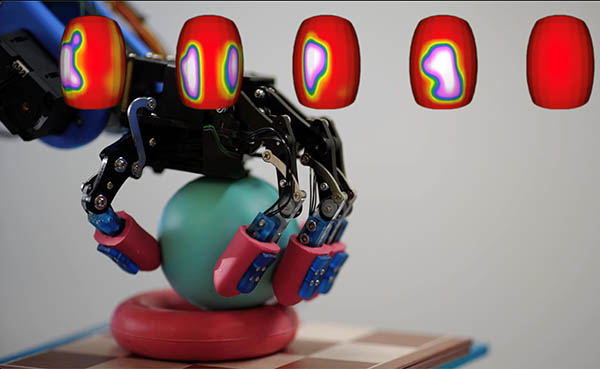
BeBop Sensors says its RoboSkin can help robots operate in environments designed by and for humans.
Get news, papers, media and research delivered. Sign up for our free newsletters.
Stay up-to-date with news and resources you need to do your job. Research industry trends, compare companies and get weekly market intelligence with Robotics 24/7.
BeBop Sensors
BeBop Sensors says its RoboSkin can help robots operate in environments designed by and for humans.
While most robots are vision-guided, other sensor modalities are progressing. BeBop Sensors Inc. today announced its RoboSkin line of skin-like coverings, which include sensors to provide tactile awareness for humanoid robots and prosthetics.
At less than 1 mm thick, RoboSkin fits robotic fingers, limbs, feet, heads, or torsos, to make robots “feel” better, said BeBop Sensors. RoboSkin’s advanced fabric-based sensor skin can be shaped to any surface, allowing quick tailoring to fit any robot, claimed the Berkeley, Calif.-based company. BeBob said its spatial resolution and sensitivity exceeds human abilities for collaborative applications.
“I have been working with roboticists refining our RoboSkin for 10 years," said Keith McMillen, founder and chief technology officer of BeBop Sensors. "We are pleased we can make this important contribution to the worldwide effort to bring humanoid robots into our lives to help people live longer, healthier, and more enjoyable lives.”
McMillen started and sold two companies in more than 40 years of innovating in the sensor and audio market. Zeta Music revolutionized stringed instruments and was sold to Gibson Guitars in 1992. Octiv, started in 2000, received funding from 3i and Intel Capital and was sold to Plantronics in 2005.
McMillen said he is the inventor on numerous patents, has released hundreds of profitable products, and published dozens of scholarly papers.
The U.S. Census Bureau predicts that for the first time ever, there will be more Americans over the age of 65 than under 18. Japan has the oldest population, with 30% over 65, noted BeBop Sensors. In addition, the so-called Great Resignation shows no sign of slowing down, with record numbers of people leaving the workforce, it said.
Human-like robots are stepping up to augment humans in the workplace, hospitals, and homes, according to BeBop Sensors. Mobile robots already play roles in manufacturing, distribution, and biohazardous materials handling. Humanoid robots are starting to be used in healthcare, domestic help, entertainment, and companionship, the company added.
A humanoid design ensures that a robot can fit through any door, use every manual tool, and peform tasks like humans would, said BeBop. Such robots do not need to have environments remade around their needs, and they can do jobs people want to avoid, it said.
Plart of human-like capabilties for robots and prosthetics is the ability to feel, BeBop Sensors said.
Advances in machine vision and audio sensing are incomplete, particularly for practical human-robot interaction, said BeBop Sensors. As robots quickly become part of people's daily lives, from restaurants to shopping malls, they need to interact and learn by sense of touch and feel, it said.
BeBop said its RoboSkin is "flexible, reliable, and highly proprietary." Technology based on the company 's fabric sensors is used in millions of sensors daily around the world. It has more than 30 U.S. and international patents.
BeBop uses smart fabrics to create sensor systems for OEMs. Where things or people interact, RoboSkin comprehends force, location, size, weight, shape, and presence across any size, resolution, and geometry.
RoboSkin is available immediately for a variety of applications in robotics and prosthetics, including biohazard, digital health, the Internet of Things (IoT), virtual and augmented reality (VR/AR), automotive, law enforcement, testing, and more, said BeBop.
BeBop is changing the way people interact with their devices. BeBop Sensors utilizes our patented smart sensors to receive rich real-time low noise, high signal data streams that can be optimized for targeted event information of human interactions.
From geometry preparation to AI-assisted analysis, integrated CFD workflows…
North America’s largest robotics and automation event winds down
Automate’s largest day ever draws huge crowds to McCormick Place

North America’s largest robotics and automation event kicks off