Interact Analysis
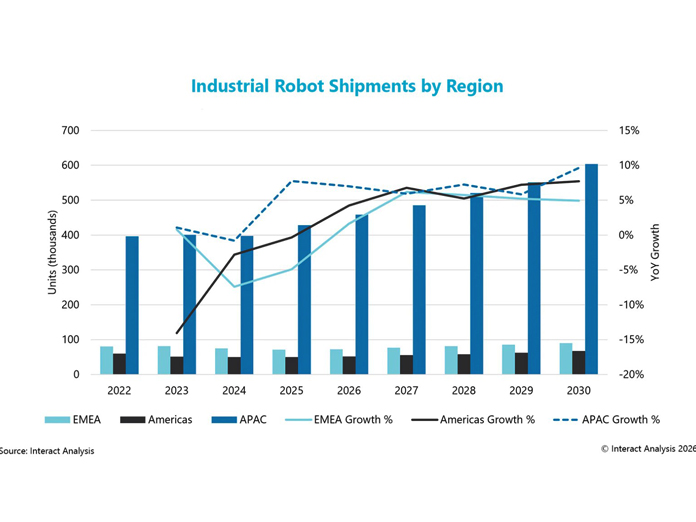
Industrial robot shipments saw weak performance in the Americas and EMEA markets between 2023 and 2025, and new safety standards are expected to affect the market further, according to Interact Analysis.
Get news, papers, media and research delivered. Sign up for our free newsletters.
Stay up-to-date with news and resources you need to do your job. Research industry trends, compare companies and get weekly market intelligence with Robotics 24/7.
Interact Analysis
Industrial robot shipments saw weak performance in the Americas and EMEA markets between 2023 and 2025, and new safety standards are expected to affect the market further, according to Interact Analysis.
Questions about the updated robot safety standard ISO 10218 are becoming increasingly common in the robotics industry.
A new report from market research firm Interact Analysis said that central to the discussion are CE certification requirements in Europe, as ISO 10218 is the key safety standard for industrial robots under the CE marking framework.
In the insight, Interact Analysis discussed the regulatory direction of the new standard, differences in manufacturer readiness and potential implications for the European and U.S. robotics markets.
ISO 10218:2025 is the updated industrial robot safety standard and will become mandatory for CE-marked products under the new European Machinery Regulation. The legal transition is expected around 2027, but IA said that weakness in European manufacturing demand and potential cost pressures on SMEs may push full implementation beyond this timeline. Unlike Europe’s binding CE framework, the equivalent U.S. standard update is voluntary, though effective compliance remains commercially necessary.
The report said that while established global vendors are largely prepared, mid-sized and emerging suppliers show notable gaps in their readiness. Once adopted, Interact Analysis said that the new standard is expected to strengthen established vendors’ competitive position and increase market access risks for those suppliers that are less well prepared.
The regulatory picture is shifting in a clear direction. In Europe, the current legislative instrument, Machinery Directive 2006/42/EC, will be superseded by Machinery Regulation EU 2023/1230 on 20 January 2027. However, the timing of one critical supporting step remains uncertain: the formal listing of ISO 10218:2025 in the Official Journal of the European Union (OJEU). This is a prerequisite for the standard to obtain full legal effect under the new regulation. Once this process is complete, ISO 10218:2025 will become a mandatory requirement for market access in Europe.
Historically, IA said that when the 2011 edition of ISO 10218 was introduced, the harmonization process and OJEU listing took more than a year to complete. If a similar timeline is followed, the 2025 revision sits close to the 2027 regulatory transition deadline, with the process still ongoing as of mid-2026.
In the U.S., the Association for the Advancing Automation (A3) and the American National Standards Institute (ANSI) jointly released the updated safety standard R15.06-2025 in September 2025, aligning it with the international ISO standards.
However, IA said that, unlike the European framework, ANSI standards are voluntary consensus standards and do not represent legally binding market access requirements.
Interact Analysis said that the European robotics market is currently operating in a relatively subdued demand environment. The market experienced contraction from 2023 to 2025, constrained by a slowdown in the overall manufacturing industry, particularly the automotive sector. Industrial end-users have adopted a cautious investment approach and face ongoing cost pressures, particularly among small and mid-sized enterprises (SMEs).
In the near-term, IA said that the safety standard update requires additional investment from robot vendors to achieve compliance. However, the report found that suppliers that absorb this transition effectively will be better positioned to serve an increasingly safety-conscious European customer base, particularly as demand recovers.
In the U.S. market, IA said that the new safety standard is comparatively more flexible as a voluntary industry framework. However, major customers and system integrators often require ANSI/RIA compliance in procurement specifications, and regulatory bodies such as OSHA may use it as a reference benchmark in enforcement.
Although the U.S. robotics market has shown signs of recovery since the second half of 2025, external pressures, particularly geopolitical tensions and high oil prices, continue to weigh on the pace of improvement. Within this environment, IA said that regulatory alignment and compliance efforts represent one of several operational considerations for market participants.
Interact Analysis said that its interviews with robot manufacturers reveal a clear divergence in readiness for the new safety standard:
If ISO 10218:2025 is formally adopted in Europe ahead of the 2027 deadline, IA said that the compliance dynamic is likely to reinforce the market position of established global players, which have the resources and institutional knowledge to manage the transition. For newer Asian entrants, the research firm said that it creates a meaningful headwind at a time when many are investing heavily in European market expansion.
That said, IA stated that broader weakness in European manufacturing demand and potential cost pressures on SMEs may push full legal transition beyond 2027.
In the U.S., the report said that the robotics market remains dominated by established suppliers. IA said that the new safety standard is likely to add incremental pressure for emerging players, alongside existing challenges such as tariffs and geopolitical uncertainty, but it is not the sole determining factor. Overall, the standard update is expected to favor better-prepared, established vendors and further strengthen their market positions.
IA said that the direction of travel is clear.
The firm said that ISO 10218:2025 reflects improved safety requirements that are in the long-term interest of the industry and robot end-users. In Europe, it remains uncertain whether full legal transition will be completed by 2027, given subdued market conditions.
However, once implementation occurs, Interact Analysis said suppliers that are well prepared will be positioned to benefit, while underprepared companies may face market access disruption. As a result, robot manufacturers and system integrators of all sizes should treat preparation as a strategic priority rather than a compliance afterthought.
GENISOM AI makes ICRA debut at conference in Vienna

World's first omni-modal evaluation including tactile sensing for…

North America’s largest robotics and automation event winds down

Automate’s largest day ever draws huge crowds to McCormick Place