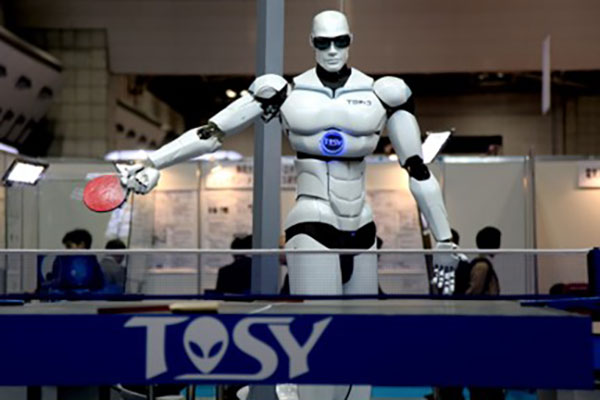
Chung-Ang University via Humanrobo from Wikimedia commons
Innovative piezoelectric and triboelectric manufacturing enhances tactile sensors, enabling sensitivity, flexibility, and efficiency for robotics, wearables, and interactive systems.
Get news, papers, media and research delivered. Sign up for our free newsletters.
Stay up-to-date with news and resources you need to do your job. Research industry trends, compare companies and get weekly market intelligence with Robotics 24/7.
Chung-Ang University via Humanrobo from Wikimedia commons
Innovative piezoelectric and triboelectric manufacturing enhances tactile sensors, enabling sensitivity, flexibility, and efficiency for robotics, wearables, and interactive systems.
Piezoelectric and triboelectric tactile sensors, crucial for applications in robotics and wearable devices, face challenges in flexibility and environmental resilience. In a new study, researchers from Chung-Ang University in South Korea have developed manufacturing strategies to enhance sensor performance by optimizing material properties and fabrication techniques.
According to the researchers, these advancements are set to drive the creation of highly sensitive, self-powered sensors for next-generation technologies, enabling breakthroughs in healthcare, robotics and human-machine interfaces.
Piezoelectric and triboelectric tactile sensors are designed to convert mechanical stimuli into electrical signals, making them critical components in intelligent systems. Piezoelectric sensors utilize voltage generation through mechanical stress in non-centrosymmetric materials, such as quartz and polyvinylidene fluoride (PVDF), while triboelectric sensors operate on contact-induced charge transfer. Both sensor types offer unique advantages, including self-powered functionality and high sensitivity but also face challenges, such as material brittleness and environmental limitations.
The Chung-Ang University research team, led by Professor Hanjun Ryu, has introduced novel manufacturing strategies to overcome these limitations. This paper was published in Volume 7 of the International Journal of Extreme Manufacturing.
“Our study explains the materials and device fabrication strategies for tactile sensors using piezoelectric and triboelectric effects, as well as the types of sensory recognition,” said Ryu.
The team conducted a comprehensive review of manufacturing strategies for piezoelectric and triboelectric tactile sensors, focusing on techniques to enhance sensitivity, flexibility and self-powering capabilities. The study examined various material properties, fabrication processes and device designs to overcome challenges, such as brittleness in piezoelectric materials and environmental sensitivity in triboelectric sensors.
“These strategies aimed to enable the development of high-performance sensors for applications in robotics, wearable devices, and healthcare systems,” Ryu added.
For piezoelectric sensors, the researchers highlighted the importance of increasing the piezoelectric constant through methods, such as doping, crystallinity control and composite material integration. Notable advancements include using lead-free ceramics and polymer blends to create flexible, environmentally friendly sensors suitable for dynamic applications.
The integration of 3D printing and solvent-based crystallization techniques was also found to significantly improve the sensitivity and adaptability of these sensors.
The triboelectric sensors were enhanced through surface modification techniques, such as plasma treatments, microstructuring and dielectric constant optimization. These strategies increased charge transfer efficiency and enabled the development of durable, high-output sensors. The researchers also demonstrated the effectiveness of hybrid materials and nanostructures in boosting triboelectric performance while maintaining flexibility and environmental resilience.
According to the researchers, this study is among the first to provide a holistic overview of manufacturing strategies for both piezoelectric and triboelectric tactile sensors, emphasizing their complementary strengths. The findings reveal that a combination of innovative material engineering and advanced fabrication techniques is essential for creating sensors capable of multi-modal sensing and real-time interaction. This interdisciplinary approach promises to expand the application scope of tactile sensors across industries.
The study also underscores the potential for integrating artificial intelligence with tactile sensors for advanced data processing and multi-stimuli detection. AI-driven analysis of tactile inputs, such as texture and pressure recognition, can significantly enhance the accuracy and functionality of these devices. Such integrations pave the way for next-generation sensors that mimic human sensory capabilities while achieving higher operational efficiency.
“It is anticipated that AI-based multi-sensory sensors will make innovative contributions to such advancements in various fields,” Ryu said.
GENISOM AI makes ICRA debut at conference in Vienna
World's first omni-modal evaluation including tactile sensing for…
Ultrasonic sensing enhances robotics perception

North America’s largest automation and robotics event takes place June 22-25