By
DE Editors
March 24, 2020
Get news, papers, media and research delivered. Sign up for our free newsletters.
Stay up-to-date with news and resources you need to do your job. Research industry trends, compare companies and get weekly market intelligence with Robotics 24/7.
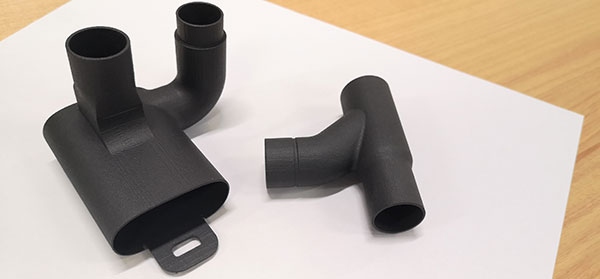
CRP Technology manufactures emergency valves for assisted ventilation using Additive Manufacturing and Windform P1 isotropic material.
To help defeat the COVID-19, in less than 24 hours, CRP Technology has manufactured in-house several functional prototypes of emergency valves for reanimation device and link-components for emergency respiratory masks for assisted ventilation.
For the manufacture of both types of components, the CRP Technology’s Rapid Prototyping Department has used the 3D printing technology called HSS (High Speed Sintering) and the Windform P1 isotropic material.
"Following the intensification of the emergency due to the lack of fundamental devices for the care of patients affected by COVID-19," says Franco Cevolini, vice president and technical director, CRP Technology, "we want to give a concrete sign of our support. We 3D printed emergency valves for ventilations and several 'Charlotte valves.'"
“Charlotte valves” are link components for emergency ventilator masks, realized by Isinnova on Dr. Renato Favero's idea and project, adjusting a snorkeling mask already available on the market (Easybreath mask by Decathlon).
“Isinnova has decided," Cevolini adds, "to urgently patent the link valve (Charlotte Valve), to prevent any speculation on the price of the component. They clarify that the patent will remain free to use, because it is in their intention that all hospitals in need could use it if necessary.”
It should be noted that neither the mask nor the link are certified and their use is subject to a situation of mandatory need.
Usage by the patient is subjected to the acceptance of use of an uncertified biomedical device, by providing a signed declaration.
Sources: Press materials received from the company and additional information gleaned from the company’s website.

DE's editors contribute news and new product announcements to Digital Engineering 24/7 and the Robotics 24/7 sites. Press releases may be sent to them via [email protected].
Enjoyed this article? Add Robotics 24/7 as a preferred source in Google Search.

Edge computing gives AI agents the processing power to turn instructions into…
Daimon-TWM world model debuts for the public
Platform helps robots adapt to complex tasks

Look beyond the headlines for the latest in humanoid robots