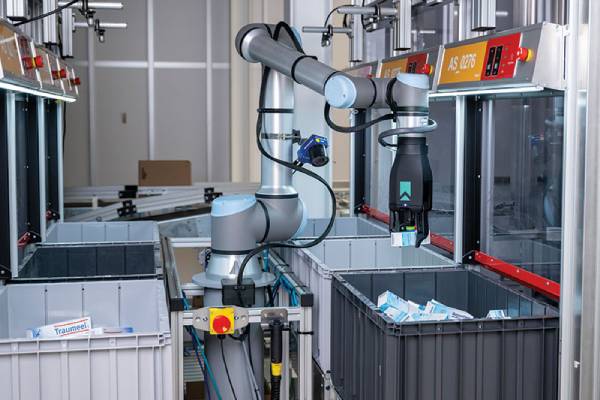
Robot density in factories has doubled since 2016, with Korea, Singapore, and China leading the charge.
Get news, papers, media and research delivered. Sign up for our free newsletters.
Stay up-to-date with news and resources you need to do your job. Research industry trends, compare companies and get weekly market intelligence with Robotics 24/7.
Robot density in factories has doubled since 2016, with Korea, Singapore, and China leading the charge.
The latest report from the International Federation of Robotics (IFR) reveals that the global average robot density in factories hit a record 162 robots per 10,000 employees in 2023. This marks a significant leap from 74 robots per 10,000 employees recorded just seven years ago.
“Robot density serves as a barometer to track the degree of automation adoption in the manufacturing industry around the world,” said Takayuki Ito, President of the IFR.
Europe: With an average of 219 robots per 10,000 employees, Europe remains a leader in automation. Countries like Germany, Sweden, Denmark, and Slovenia rank in the global top ten.
North America: The region reached 197 robots per 10,000 employees, with the U.S. ranking among the world’s top ten most automated countries.
Asia: Asia recorded 182 robots per 10,000 employees, driven by automation powerhouses like Korea, Singapore, China, and Japan.

Korea: A global leader, Korea boasts 1,012 robots per 10,000 employees, supported by its strong electronics and automotive industries.
Singapore: With 770 robots per 10,000 employees, Singapore's high density reflects its smaller manufacturing workforce.
China: Surpassing Germany and Japan, China ranked third with 470 robots per 10,000 employees, doubling its density in four years.
Germany and Japan: Germany ranks fourth with 429 units, while Japan follows closely with 419 robots per 10,000 employees.
United States: Ranking tenth globally, the U.S. reached 295 robots per 10,000 employees.
The rapid rise in robot density highlights the growing reliance on automation across industries worldwide.
Enjoyed this article? Add Robotics 24/7 as a preferred source in Google Search.
Edge computing gives AI agents the processing power to turn instructions into…
Daimon-TWM world model debuts for the public
Platform helps robots adapt to complex tasks
Look beyond the headlines for the latest in humanoid robots