Helm.ai
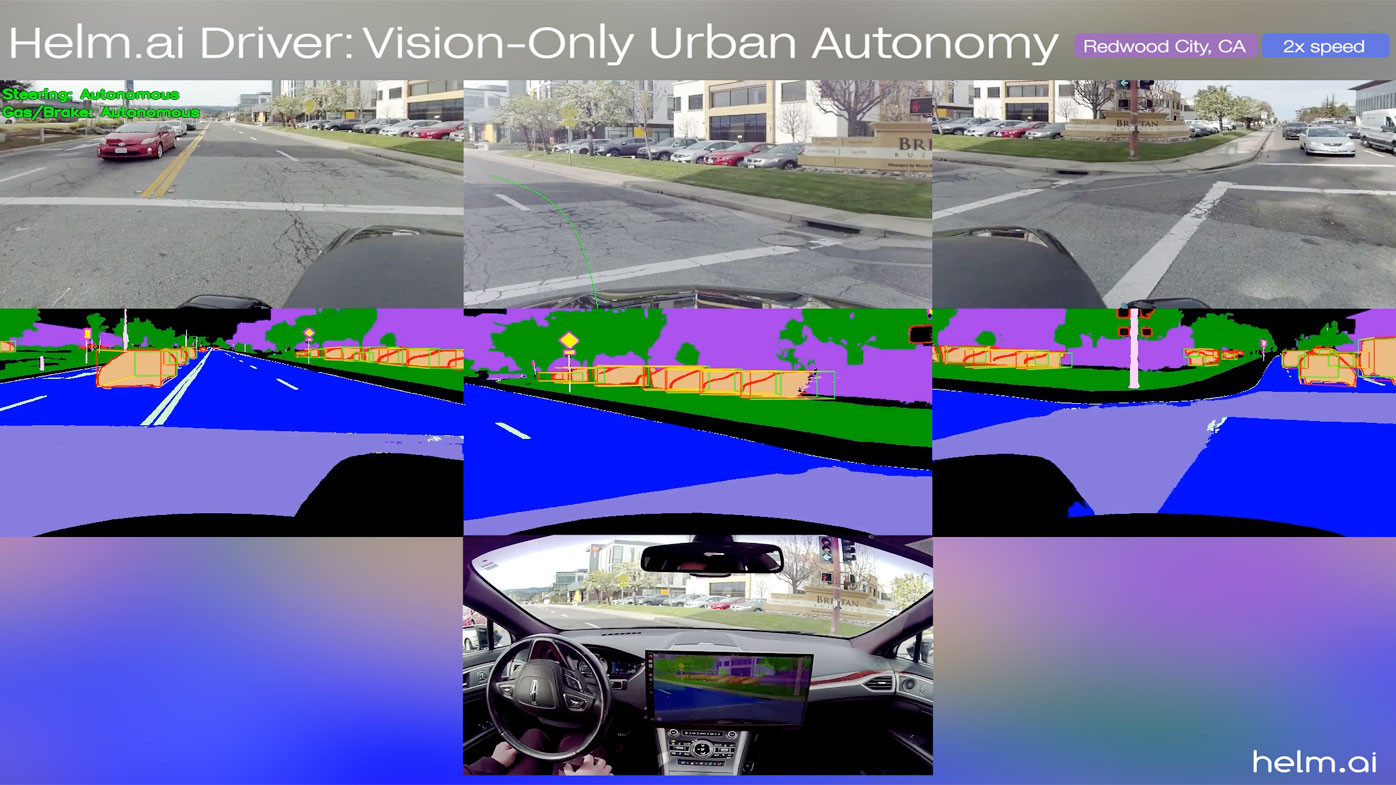
Helm.ai Driver navigated the urban environment of Redwood City, Calif.
Get news, papers, media and research delivered. Sign up for our free newsletters.
Stay up-to-date with news and resources you need to do your job. Research industry trends, compare companies and get weekly market intelligence with Robotics 24/7.
Helm.ai
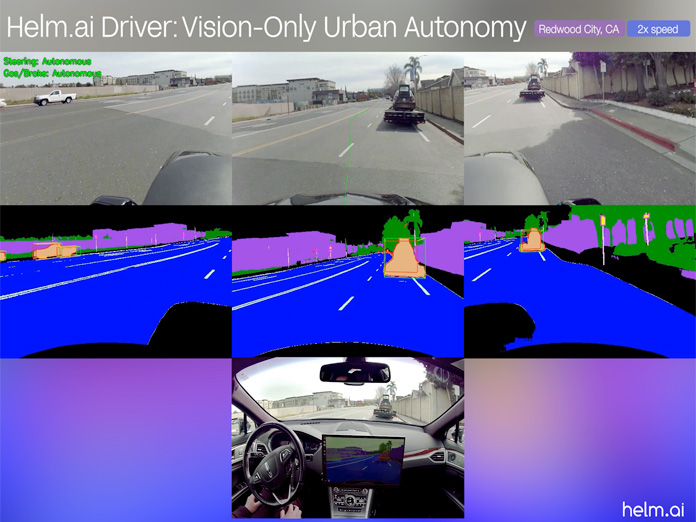
Helm.ai Driver navigated the urban environment of Redwood City, Calif.
Advanced AI software provider Helm.ai, which specializes in autonomous driving and robotics automation, announced a major expansion of Helm.ai Driver, a production-ready, vision-only software stack that the company said is designed to scale seamlessly from advanced Level 2+ systems to Level 4 urban autonomy.
Built on Helm.ai’s proprietary Factored Embodied AI architecture, the company said that the system delivers seamless, human-like driving in complex city traffic without reliance on high-definition (HD) maps or lidar sensors.
Because the core foundation model is level-agnostic, Helm.ai said that it enables automotive OEMs to deploy highly capable Level 2+ supervised systems immediately, while utilizing the same software architecture to unlock certified Level 3 "eyes-off" and Level 4 fully autonomous capabilities as their hardware and regulatory roadmaps evolve.
The video below showcases the system autonomously handling left and right turns at intersections, complex traffic light compliance and dynamic interactions with other road users - all safely supervised by a safety driver in accordance with standard testing and validation protocols for production-intent autonomous systems.
Helm.ai said that the automotive industry is currently hitting a "Data Wall," the point where traditional autonomous driving models require exponentially more rare and expensive data to improve performance in edge-case scenarios.
The company said that its Helm.ai Driver utilizes a Factored Embodied AI architecture. This approach splits the autonomy problem into two distinct, interpretable layers - Perception and Policy - allowing the system to "reason" about road geometry and traffic rules. This structure provides transparency critical for automotive OEMs, which Helm.ai said offers a clear, auditable software foundation capable of scaling from supervised Level 2+ to ISO 26262-certifiable Level 3 and Level 4 deployments.
"The industry has reached a tipping point where brute-force data collection is no longer commercially viable for high-end autonomy," said Vladislav Voroninski, founder and CEO of Helm.ai. "With Helm.ai Driver, we have fundamentally changed the unit economics of scalable autonomy. By delivering a vision-first system that powers advanced Level 2+ today, and serves as the software brain for the transition to Level 3 and Level 4 autonomy, we are providing OEMs with the only realistic path to deploying next-generation autonomy on mass-market compute platforms."
While traditional approaches typically require billions of dollars in capital expenditure and millions of miles of training data to achieve urban capability, the company said that its Helm.ai Driver’s planner reached this level of maturity using only 1,000 hours of real-world driving data.
The company said that this breakthrough is powered by Deep Teaching, its proprietary unsupervised learning technique that enables neural networks to learn directly from massive amounts of data, bypassing the need for costly human annotation.
Paired with semantic simulation, Helm.ai said that the system can train on practically infinite geometric scenarios without the computational overhead of rendering photorealistic pixels. By training the system on the "semantic geometry" of the world rather than raw pixels, Helm.ai bypasses the traditional cost and time barriers of autonomous development.
Helm.ai said that the true test of an autonomous system for mass-production vehicles is its ability to handle "unseen" environments without manual tuning or HD maps. To validate this, Helm.ai said that it recently demonstrated the system’s generalization capability by deploying the software in Torrance, Calif. (the Greater Los Angeles area).
Without any prior training on the area's specific streets, the company said that Helm.ai Driver was able to perform "zero-shot" autonomous steering. Helm.ai said that this ability to generalize across geographies ensures that its OEM partners can scale Level 2+ through Level 4 features globally without the prohibitive cost of city-by-city data collection or geofencing.
Enjoyed this article? Add Robotics 24/7 as a preferred source in Google Search.
Edge computing gives AI agents the processing power to turn instructions into…
Daimon-TWM world model debuts for the public
Platform helps robots adapt to complex tasks
Look beyond the headlines for the latest in humanoid robots