Honeywell
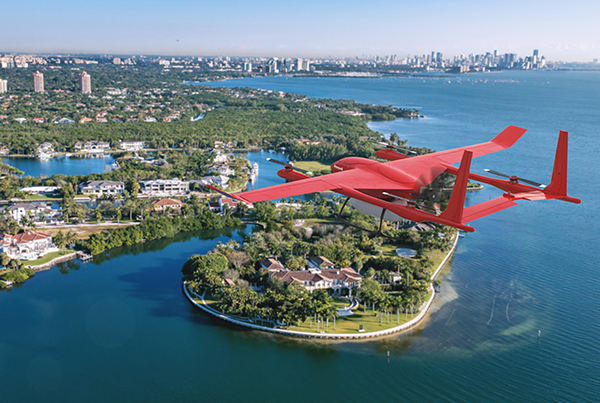
Honeywell's BVLOS suite is designed to increase autonomous drone range and capacity.
Get news, papers, media and research delivered. Sign up for our free newsletters.
Stay up-to-date with news and resources you need to do your job. Research industry trends, compare companies and get weekly market intelligence with Robotics 24/7.

Honeywell
Honeywell's BVLOS suite is designed to increase autonomous drone range and capacity.
Honeywell Aerospace announced today at AUVSI Xponential that it is developing a new technology suite for light drones that allows them to fly three times longer and with less human intervention. Traditional drones are limited by battery capacity and line-of-sight radio links, said the company.
In comparison, drones equipped with Honeywell’s Beyond Visual Line of Sight (BVLOS) technologies can fly farther, carry more weight, avoid hazards up to 3 km (1.86 mi.) away and stream video of their progress anywhere in the world, claimed Honeywell.
“These are technologies that businesses have been waiting for,” said Stéphane Fymat, vice president and general manager of Honeywell’s Unmanned Aerial Systems and Urban Air Mobility business unit. “They will help make drones profitable for a world of new applications.”
Honeywell said its BVLOS systems are ideal for missions where distance or terrain interfere with radio links or visual guidance. Applications include last-mile package delivery, military surveillance and reconnaissance, pipeline and power-line inspection, search and rescue, and use by first responders.
The technologies draw upon Honeywell’s decades of experience building and certifying avionics, engines, and auxiliary power units (APUs) for airplanes, helicopters, and military drones.
The company said BVLOS suite includes the following:
The fuel cells in the BVLOS suite can operate three times longer than batteries with equivalent output, claimed Honeywell. They work silently, unlike gasoline engines, and emit no greenhouse gases. Operators can refuel or swap hydrogen tanks in minutes, enabling more time in the air, it added.
Honeywell said its phased-array RDR-84K radar steers beams electronically, meaning it has no moving parts and requires minimal maintenance. It also does not need heavy cooling systems, said the company.
In addition to avoiding other aircraft, the radar can detect obstacles, map terrain, and identify landing zones, said Honeywell. It can act as a radar altimeter and provide mapping for alternate navigation if GPS guidance fails.
Honeywell said its BVLOS suite will allow drone designers to combine data in new ways to save weight and power. Its radar computes an avoidance path using built-in circuitry, rather than requiring a separate processor. Its satellite uplink can be used to download real-time weather and traffic reports from other drones.
Honeywell’s UAV Satcom and IMUs are available now, with some IMU models priced as low as $1,800. The RDR-84K and fuel cells are in late-stage development, and prototype fuel cells are available for purchase and evaluation now.
“These innovations give drone builders and operators a whole new range of options,” said Sapan Shah, product manager at Honeywell’s Unmanned Aerial Systems and Urban Air Mobility unit. “More time in the air, more awareness of surroundings and traffic, better connectivity -- these are the building blocks of safe, profitable drone operations of all kinds, and that’s what we’re delivering.”
Introducing Honeywell’s detect-and-avoid technology for drones and urban air mobility, featuring the IntuVue RDR-84K Radar System.
GENISOM AI makes ICRA debut at conference in Vienna

World's first omni-modal evaluation including tactile sensing for…
Ultrasonic sensing enhances robotics perception

Cybernetix Ventures’ event kicks off Robotics Tech Week 2026 slate of events