By
Tim Culverhouse
December 9, 2025
Bosch Rexroth
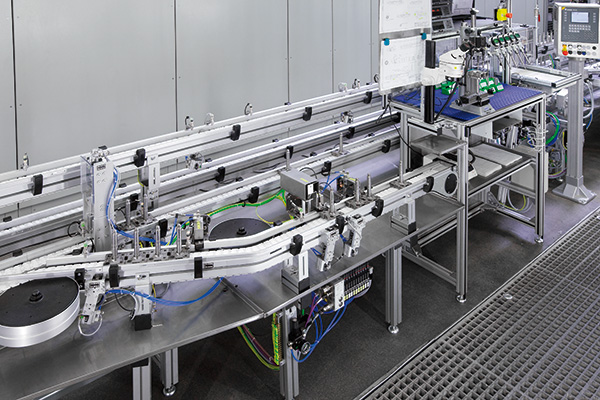
The VarioFlow conveyance system manages fulfillment with a myriad of technological innovations.
Get news, papers, media and research delivered. Sign up for our free newsletters.
Stay up-to-date with news and resources you need to do your job. Research industry trends, compare companies and get weekly market intelligence with Robotics 24/7.
Bosch Rexroth
The VarioFlow conveyance system manages fulfillment with a myriad of technological innovations.
Peak season represents only a small part of fulfillment.
While high demands require a ramping up of technology to keep orders moving into and out of warehouses and distribution centers, this condensed period of surging production is only a small part of the calendar year.
But from a technological point of view, it’s this segment, right around the end of each year, that requires extra attention to properly handle this influx of demand.
For Bosch Rexroth and its subsidiary Kassow Robots, this song and dance can be planned and managed through its conveyors, collaborative robots (cobots) and simulation.
There’s no such thing as too much data. Especially when it comes to peak season, data reigns supreme.
“The more data, the sooner we can get it, it's always better,” said TJ Tatum, senior design engineer at Bosch Rexroth. “But that being said, depending on what you've got, we can work with it. If you don't have enough data, we may be making some educated guesses based on the data that you do have. If you know you did 300 units last year, but 90% of it was in the last two months of the year, we can start looking at what that run rate is and do some line balancing on that.”

For Bosch Rexroth, this means utilizing the data from the consumer and incorporating it into advanced simulation software to generate prospective conveyor and robot layouts to maximize efficiency and optimize these processes at all times.
“You may need two robots to do those 300 units, but that doesn't mean you're going to need two robots year-round,” Tatum said. “Customers will need to start looking at, ‘If I'm only going to use this other robot for a certain portion of the year, where can I repurpose it to do something else?’ Because it doesn't make sense to buy two robots if I'm just going to run it for a month out of the year.”
But, Tatum did suggest there are times when the ROI equation makes sense for organizations to utilize multiple robots, even if they’re only used during peak season tasks. Or, if they can be repurposed for something else.
“There are instances where, when you look at it and the return on investment, even if you're only running it for a couple of months out of the year, it's worth having it and just letting it sit there for the other nine months out of the year.”
When Bosch Rexroth acquired a majority stake in Kassow Robots in early 2022, the company envisioned the “warehouse of the future.”
Kassow Robots’ flagship 7-axis cobots add more manipulation to the equation. The company’s cobot line, which includes the Edge edition and its multiple sizes and load-capacity options, enables flexibility in an area of the warehouse that desperately needs it.
“There are specific applications where it comes in handy,” Tatum said. “We've been able to take advantage of that extra axis and that extra freedom of motion, where in the past, we would have needed two robots. Now we can get away with one.”
At Automate 2025 in Detroit, Bosch Rexroth showcased an integration with Kassow Robots’ cobots and its smart conveyor system. The companies demonstrated how Kassow’s cobots maneuver goods for palletizing and packaging applications before moving them further down the pipeline on a Bosch Rexroth conveyor.
Also in Detroit, Germany-based CeiliX made its North American debut in partnership with Kassow Robots through the release of its Mobile-Ceiling Robot. The Mobile-Ceiling Cobot moves in all directions via an overhead ceiling rail system. CeiliX said that because of its location, the system can create up to 50 percent additional floor space.
Advancements in simulation programs have generated incredibly realistic opportunities for engineers like Tatum to plan out their conveyance operations.
“I've gotten now to where I will do a simulation of the application long before I ever actually look at actually doing it,” he said.
Regardless of the application, simulation offers vendors and their potential customers the opportunity to visualize, with accurate physics, how and where these robots and automation systems can best be deployed in their environments.
But there are elements of testing that can’t be addressed in the digital world.
“We have robots placed around the country strategically, and then most of that is for testing,” Tatum said. “Simulation gives us a pretty good idea of how fast we can do something. Nothing beats the real thing, though. We have robots available for testing, depending on the application and how accurate we need that data to be. Simulation will get us most of the way there, but then we're going to have to actually run it at some point.”

Tim is the Editorial Director of Robotics247.com. His mission is to provide valuable information and insights to robotics professionals and decision-makers, and to help them solve business challenges. He is a creative, deadline-driven, and detail-oriented storyteller. In addition, he is a sports broadcaster and public address announcer.
Artificial Intelligence Machine Learning Autonomy Mobile Robots Industrial Automation Collaborative Robots Robot Arm Software Cloud and Edge Simulation News Features Editors Pick Bosch Rexroth Cobots Conveyance Conveyors Distribution Center Fulfillment Kassow Robots Mobile Manipulation Packaging Palletizing
Enjoyed this article? Add Robotics 24/7 as a preferred source in Google Search.
Edge computing gives AI agents the processing power to turn instructions into…
Daimon-TWM world model debuts for the public
Platform helps robots adapt to complex tasks
Look beyond the headlines for the latest in humanoid robots