International Federation of Robotics (IFR)
A new report from IFR found that robot density is surging in Europe, Asia and the Americas.
Get news, papers, media and research delivered. Sign up for our free newsletters.
Stay up-to-date with news and resources you need to do your job. Research industry trends, compare companies and get weekly market intelligence with Robotics 24/7.
International Federation of Robotics (IFR)
A new report from IFR found that robot density is surging in Europe, Asia and the Americas.
New research from the ”World Robotics” 2025 report, presented by the International Federation of Robotics (IFR), found that economies worldwide are prioritizing the integration of factory robots, as automation becomes a critical tool for boosting productivity.
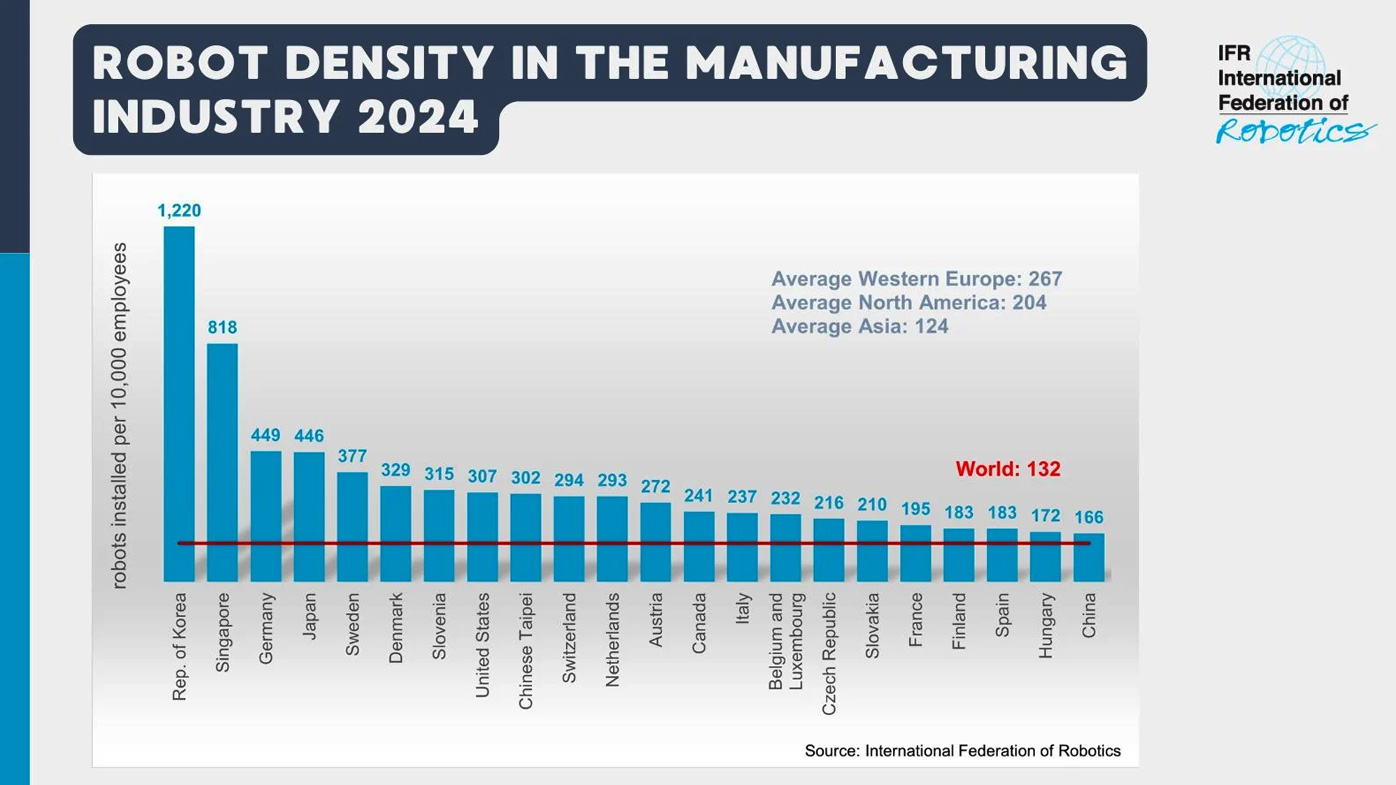
In the global automation race, Western European countries reached a record 267 robots per 10,000 employees in the manufacturing industry in 2024 - ahead of North America with 204 units and Asia with 131 units.
IFR said that robot density is the number of operational industrial robots relative to the number of employees. It can cover the whole manufacturing industry or just specific industrial branches.
“The robot density metric provides a uniform basis for comparison by relating the total number of robots used in a country to its economic size, as measured by its workforce,” said Takayuki Ito, President of the International Federation of Robotics.
The report found that Western European countries recorded a robot density increase of 3% year-over-year. Eight countries are within the global top 20, including
The European Union (EU-27) has a robot density of 231 units, which is above the global average of 132 units per 10,000 employees.
IFR’s report found that North America´s robot density rose by 4%. The United States ranks 8th worldwide with 307 units per 10,000 employees. Canada follows with 241 units and Mexico with 62 units.
Asia has an average robot density of 131 units per 10,000 persons employed in manufacturing - an increase of 11%. Asian economies among the top ten most automated worldwide include:
Based on updated labor market data issued by China's National Bureau of Statistics, China ranks 6th in Asia and 22nd worldwide. It has 166 robots for every 10,000 people employed, which is a year-on-year increase of 17%.
As a large country with a huge manufacturing workforce, IFR said that China requires a significant operational stock, with a presence not only in its manufacturing hubs but also in its rural regions, to achieve high robot density. The report found that China's outstanding position in the field of industrial robotics is demonstrated by its impressive operational stock, which is the largest in the world.
IFR data found that China counts around 2 million units - approximately 4.5 times more than Japan, which is in second place. The annual installation numbers found that 54% of all robots installed worldwide in 2024 were deployed in China (295,000 units).
The Republic of Korea records the world´s highest robot density with 1,220 robots per 10,000 employees, growing by 7% on average annually since 2019. With its globally recognized electronics industry and a distinct automotive industry, IFR said that the Korean economy benefits from these two largest customers for industrial robots.
Singapore is second with 818 units. As a small country with a low number of manufacturing employees, IFR said that Singapore can achieve a high robot density with a relatively small operational stock. The country's robot density had been growing by 13% annually since 2019.
Germany ranks third, with 449 units per 10,000 employees. The robot density of Europe´s largest economy has grown by 5% per year since 2019.
Japan is in fourth place with 446 units. IFR said that the robot density of the world´s predominant robot manufacturing country had been growing by 5% annually since 2019.
Sweden (377), Denmark (329), Slovenia (315), the United States (307), Chinese Taipei (302) and Switzerland (294) complete the top 10.
Enjoyed this article? Add Robotics 24/7 as a preferred source in Google Search.
Edge computing gives AI agents the processing power to turn instructions into…
Daimon-TWM world model debuts for the public
Platform helps robots adapt to complex tasks

Look beyond the headlines for the latest in humanoid robots