International Federation of Robotics (IFR)
New data from the International Federation of Robotics (IFR) found that the global average baseline for robot density has reached a record high.
Get news, papers, media and research delivered. Sign up for our free newsletters.
Stay up-to-date with news and resources you need to do your job. Research industry trends, compare companies and get weekly market intelligence with Robotics 24/7.
International Federation of Robotics (IFR)
New data from the International Federation of Robotics (IFR) found that the global average baseline for robot density has reached a record high.
New research from the International Federation of Robotics (IFR) shows that robot density in the global manufacturing sector has reached a new peak.
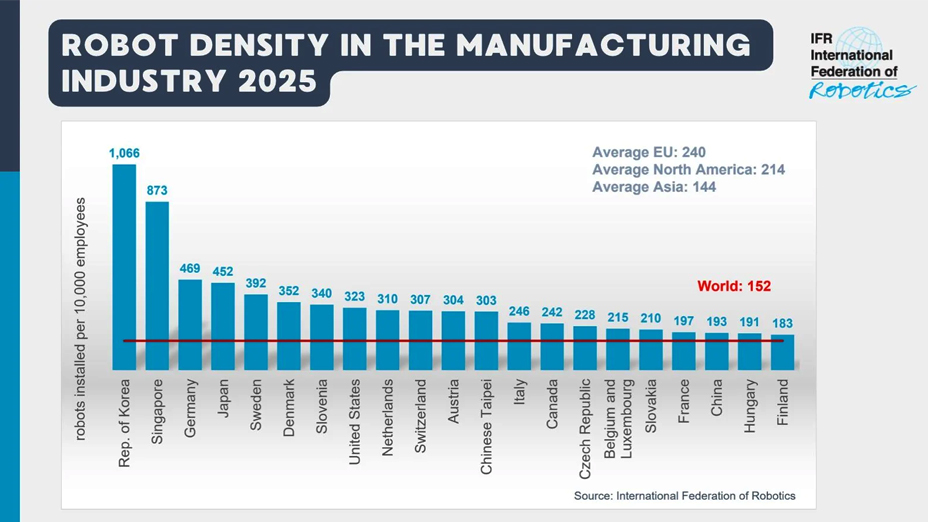
The new report found that, driven by accelerating automation, South Korea remains the world’s undisputed leader in robot density, with 1,066 industrial units per 10,000 employees.
Singapore follows in second place with 873 units, while Germany secures third place at 469 units. All three nations vastly outperformed the new global average baseline, which IFR said has risen to 152 units per 10,000 employees.
IFR’s previous robot density report was also led by South Korea, Singapore and Germany.
For this report, IFR said robot density represents the number of operational industrial robots relative to the number of employees. It can cover the whole manufacturing industry or just specific industrial branches. Because employee count measures economic size, the ratio of operational stock to employees puts it on a uniform basis.
"Tracking robot density creates a level playing field for global analysis by adjusting the number of operational industrial robots against every 10,000 employees in the manufacturing sector," said Jane Heffner, president of the International Federation of Robotics.
IFR said that robot density in the European Union increased by around 35 % within five years (2020-2025), reaching a new record of 240 units. Five of the top ten most automated economies are members of the European Union: Germany, Sweden, Denmark, Slovenia and the Netherlands.
The report found that North America´s robot density rose by around 24% over the same period (2020-2025), reaching 214 units. The United States remains 8th worldwide with 323 units per 10,000 employees. Canada follows with 242 units and Mexico with 64 units.
IFR’s report said that robot density in Asia increased by about 47 % within five years (2020-2025), reaching 144 units. Besides the region's front runners - South Korea and Singapore - Japan ranks 4th globally with 452 units.
IFR said that China, as the world´s largest market for industrial robots, now has a robot density of 193 units per 10,000 employees - ranking 19th globally. IFR said that this is based on employment data from the National Economic Census, conducted by China's National Bureau of Statistics. China’s robot density increased by 147 % from 2020 through 2025.
Enjoyed this article? Add Robotics 24/7 as a preferred source in Google Search.
The iWMC is a four-in-one integrated drive module for wheeled mobile robots,…

Comes 11 days after his resignation amidst multiple personal scandals
Automaker is developing its own robots at Kokomo, Ind. plant

Colette Kress, current EVP and CFO of NVIDIA named interim CEO