Interact Analysis
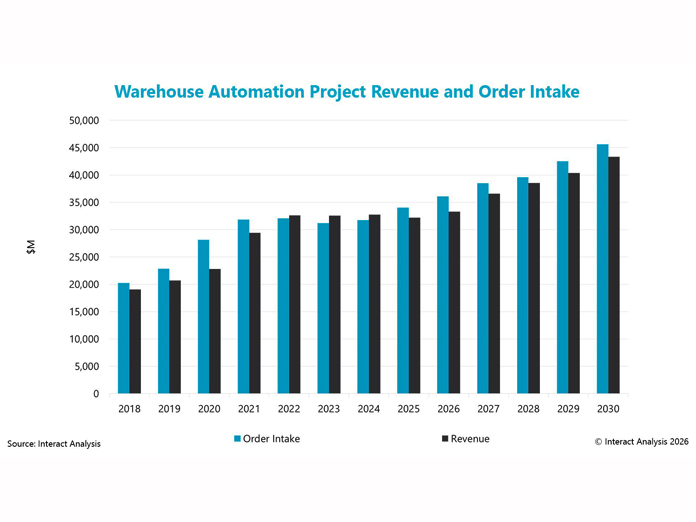
A new report from Interact Analysis found that warehouse automation order intake is up by 7% from 2025.
Get news, papers, media and research delivered. Sign up for our free newsletters.
Stay up-to-date with news and resources you need to do your job. Research industry trends, compare companies and get weekly market intelligence with Robotics 24/7.
Interact Analysis
A new report from Interact Analysis found that warehouse automation order intake is up by 7% from 2025.
A new report from market research firm Interact Analysis found that despite a weak overall macroeconomic backdrop, warehouse automation order intake rose by 7% in 2025, with multiple factors cushioning the market.
The latest market report reveals project values were inflated by rising steel and labor costs, causing order intakes to rise even without a boost in underlying demand. Slow momentum within the market was also offset by large-scale facility investments from retail giants such as Amazon, Walmart and Tesco, helping to fuel the increase in order intake during 2025.
Interact Analysis said that growth in warehouse automation over the coming years will be driven by shifting investment priorities and changing production strategies. The report found that strong industry sectors for growth are expected to be general merchandise, durable manufacturing and food and beverage.
However, grocery automation is expected to slow in the Americas as it gets closer to 2030, as major distribution center programs reach completion. Interact Analysis also predicts renewed growth for the parcel sector, with an average annual growth rate of approximately 6% forecast between 2025 and 2030, fueled by last-mile automation investment.
“Looking further ahead, growth is expected to slow slightly, particularly in North America as steel prices normalize and major CapEx cycles reach maturity,” said Rowan Scott, senior analyst at Interact Analysis. “Factors such as easing input costs and political uncertainty in the US ahead of the 2028 election are likely to weigh on longer-term growth in the warehouse automation market.”
Of the three key regions, Interact Analysis said that EMEA has the strongest forecast for warehouse automation, with projected annual growth of approximately 7% between 2025 and 2030. This is slightly ahead of the Americas (6%) and APAC (5%), in part because the EMEA region has been less heavily impacted by inflated steel and labor costs.
However, while EMEA forecasts as a whole look positive, Interact Analysis notes there is a level of nuance to the countries driving that progress. Although the Netherlands, Northern Europe and the UK are experiencing growth, many other countries, such as Germany, are experiencing lower demand as major customers shift operations towards lower cost regions.
In the APAC region, the overall slowdown in domestic Chinese demand is continuing to impact revenue growth and pulling forecasts down. The region experienced an estimated year-on-year decline in revenue of -8% in 2025, although some territories continued to perform strongly.
“Overall, the sector is defined by contrast: short-term order intake growth built on rising project prices and a handful of large-scale investments, set against persistent structural headwinds and cautious investment sentiment, resulting in an average annual growth rate of 6% between 2025 and 2030 globally,” Scott said.
Enjoyed this article? Add Robotics 24/7 as a preferred source in Google Search.
Edge computing gives AI agents the processing power to turn instructions into…

Daimon-TWM world model debuts for the public

Platform helps robots adapt to complex tasks

Look beyond the headlines for the latest in humanoid robots