Interact Analysis
As Chinese involvement grows and the current U.S. administration takes action, new inclusions in FCC's Covered List sparked debate regarding which robot and robot systems now fall under this guidance.
Get news, papers, media and research delivered. Sign up for our free newsletters.
Stay up-to-date with news and resources you need to do your job. Research industry trends, compare companies and get weekly market intelligence with Robotics 24/7.
Interact Analysis
As Chinese involvement grows and the current U.S. administration takes action, new inclusions in FCC's Covered List sparked debate regarding which robot and robot systems now fall under this guidance.
In Late July 2026, the Federal Communications Commission (FCC) added two further categories to its Covered List: foreign-produced advanced robotic devices and foreign-produced connected power inverters. The Covered List is the FCC’s register of equipment and services deemed to pose an unacceptable risk to U.S. national security or the safety and security of U.S. persons. Once a product category is added, new covered models are generally unable to receive FCC equipment authorization unless they secure a Conditional Approval.
An advanced robotic device, as defined by the FCC, is a mobile, ground-based device that can operate away from a human operator and weighs more than 4.4 lbs. - including any dock or ground station - and combines sensors, network connectivity of at least 200 kbps, and software that controls navigation, perception, data collection, or remote command. The FCC explicitly names quadrupeds, humanoids and wheeled or tracked ground vehicles as examples.
However, market research firm Interact Analysis points out that mobile robots used in logistics - including AMRs and AGVs for goods-to-person, sortation, and picking applications - appear to sit squarely within the scope. The determination even references the use case directly, noting that advanced robotic devices have applications in industrial manufacturing, from material handling to order fulfilment.
In recent years, Interact Analysis said that the mobile robot market has expanded rapidly, moving from a nascent and fragmented sector into a more mature market characterized by larger-scale deployments. Annual shipments increased from around 30,000 units in 2018 to more than 200,000 in 2025, equivalent to a compound annual growth rate of approximately 32%. By 2030, IA forecasts that annual shipments will rise to just under 500,000 units.
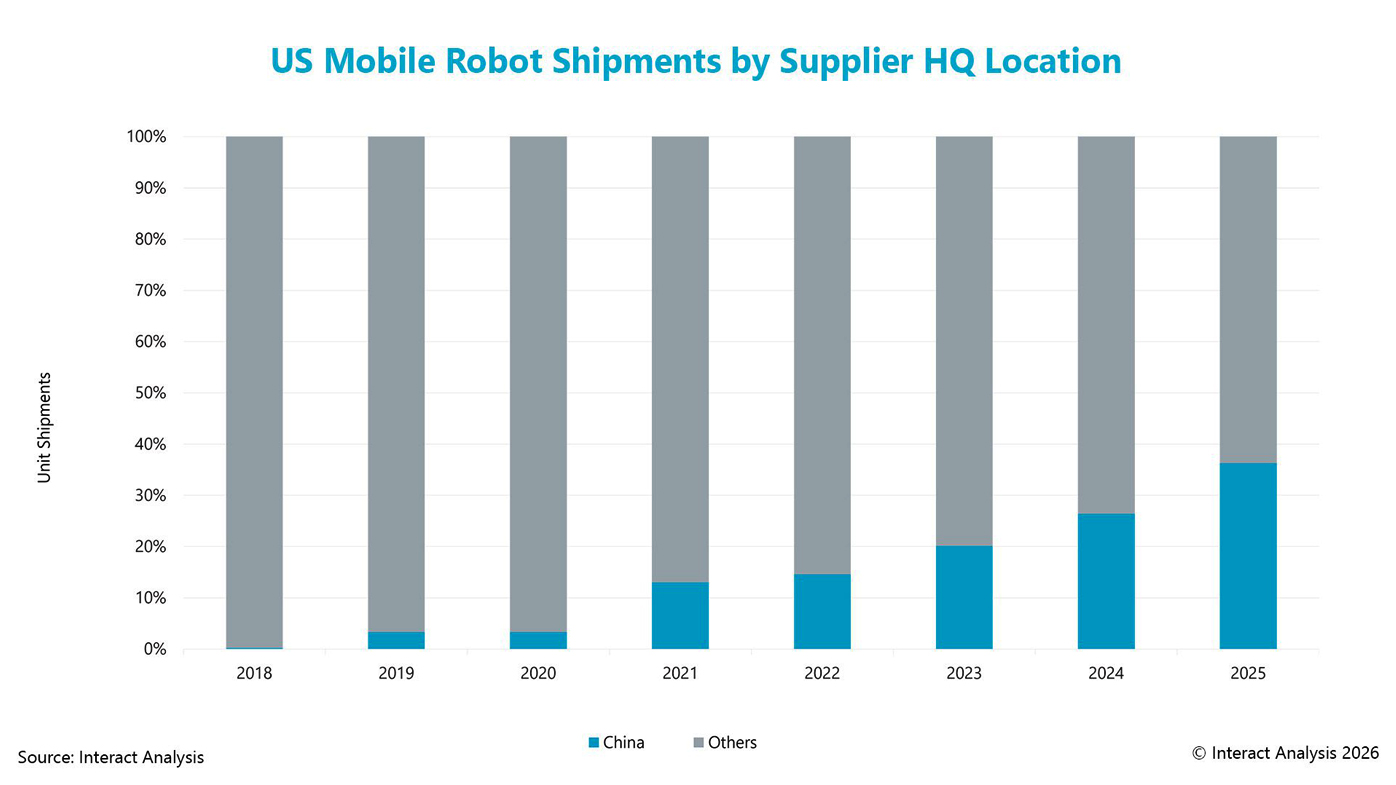
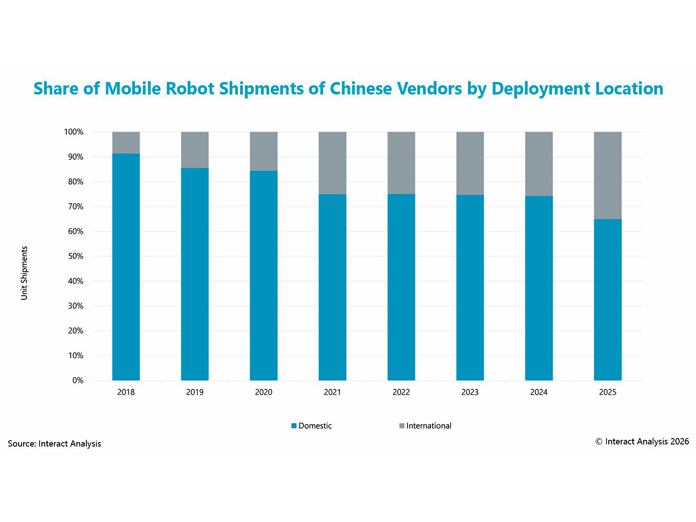
China remains the largest market for mobile robots. However, rising supplier competition and weaker post-pandemic growth conditions have compressed margins, prompting many Chinese mobile robot manufacturers to look overseas for growth. In 2018, Chinese mobile robot manufacturers shipped 91% of their units domestically; by 2025, this had fallen to 64%. As Chinese vendors have expanded internationally, their share of mobile robots deployed in the US has increased significantly, rising from 1% in 2018 to 36% in 2025.
At the same time, the current U.S. administration is using trade and security policy to strengthen domestic manufacturing and reduce reliance on foreign technology suppliers. The clearest precedent is the FCC’s December 2025 decision to add foreign-produced uncrewed aircraft systems and critical drone components to its Covered List, preventing new foreign-made drone models from receiving the equipment authorization required for import, marketing or sale in the U.S. Interact Analysis said that existing authorized drones were not grounded, but the action created a forward-looking barrier for new models.
Interact Analysis said that the new Covered List, if read literally, is country-neutral. It applies to devices “produced in a foreign country” and states that this applies “regardless of the nationality of origin” of the producer. IA said that, in other words, a robot manufactured in Germany or Japan is, on paper, subject to the same restrictions as one manufactured in China.
In practice, however, Interact Analysis’ report found that the evidentiary basis for the determination is drawn largely from Chinese examples: security vulnerabilities linked to Unitree quadrupeds, a reported backdoor attributed to a Chinese manufacturer, and broader commentary on Chinese dominance of the humanoid robot supply chain. Interact Analysis read this as a policy designed to survive scrutiny as country-neutral while functionally targeting the dependency that most concerns Washington: the concentration of robotics manufacturing, and critical components such as actuators, batteries and sensors, in China.
For allied-country vendors in Japan, South Korea, and the E.U., the compliance burden exists on paper. However, the enforcement focus and political attention are likely to fall most heavily on Chinese-built fleets and Chinese-headquartered vendors.
Interact Analysis highlighted the following unanswered questions from the latest additions to the FCC’s Covered List.
Interact Analysis said that this announcement may result in a short-term market disruption, as end customers pause investment while they wait for the dust to settle and for key questions to be answered. This would help them avoid committing to technologies that may ultimately not receive FCC approval.
Indeed, while IA said that the system integrators and automation vendors it has spoken to over the last few days have emphasized that this is a dynamic situation, with developments moving very quickly. One system integrator told Interact Analysis that they were urgently contacting all their international mobile robot suppliers to discuss the implications. Operators should expect existing authorized models to remain available, while new models from foreign-produced mobile robot vendors face a more complex path to market.
On the other side of the operation, Interact Analysis said that China-headquartered vendors are likely to respond by accelerating supply chain localization, shifting final assembly outside China, increasing the share of non-China components and preparing Conditional Approval applications for priority models. However, until the FCC and national security agencies clarify how they will treat component origin, final assembly and model changes, IA said that localization strategies will remain difficult to validate.
Click here to read Interact Analysis’ full report.
Enjoyed this article? Add Robotics 24/7 as a preferred source in Google Search.
Edge computing gives AI agents the processing power to turn instructions into…

President Trump orders a review of robotics imports over national security…
Platform helps robots adapt to complex tasks

Look beyond the headlines for the latest in humanoid robots