Halodi Robotics
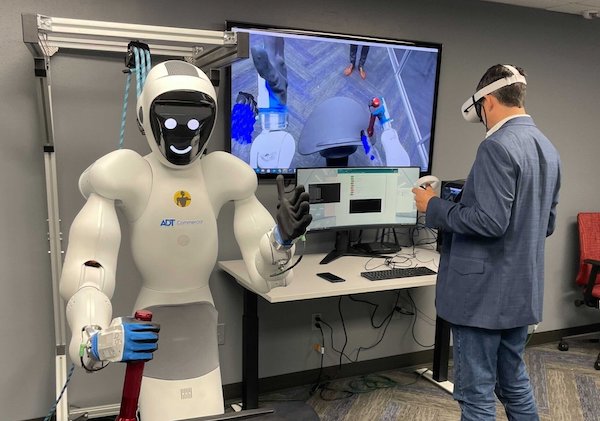
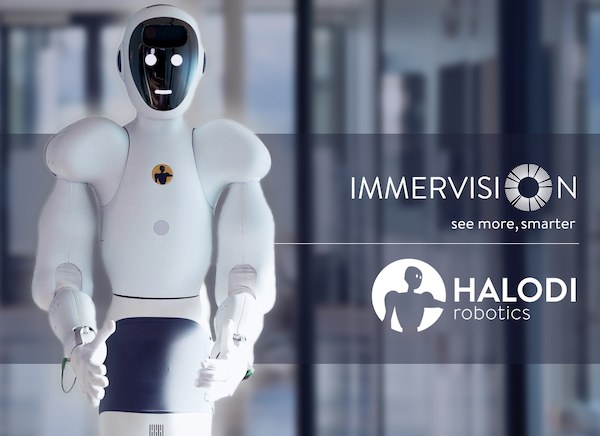
Halodi Robotics' EVE will use Immervision's technology for human-robot cooperation.
Get news, papers, media and research delivered. Sign up for our free newsletters.
Stay up-to-date with news and resources you need to do your job. Research industry trends, compare companies and get weekly market intelligence with Robotics 24/7.
Halodi Robotics
Halodi Robotics' EVE will use Immervision's technology for human-robot cooperation.
For robots to perform a wide variety of tasks and work autonomously or with human guidance, they need accurate perception. Immervision today announced that Halodi Robotics AS has chosen its next-generation vision system for Halodi's humanoid service robot.
Montreal-based Immervision's technologies combine optics, image processing, and sensor fusion. The company said its vision system will enable Halodi's robot to better perceive its environment, collect better-quality data for artificial intelligence pipelines, and provide an immersive virtual reality (VR) experience to remote operators.
“Halodi Robotics approached us when searching for a fast, responsive, and immersive visual system capable of delivering wide-angle visual data simultaneously to both machine and humans,” explained Patrice Roulet Fontani, vice president of technology at Immervision. “Increased responsive speed starts with a high-quality, wide-angle lens. With our patented technology and AI algorithms, we are the natural choice to optimize the performance and situational awareness across Halodi Robotics' entire vision pipeline.”
For robots to move and function within various environments, they need to understand them by obtaining data and processing it in a timely manner, said Immervision. Machine vision is sufficient for a robot to perform tasks independently, but to function with a human operator, a robot also needs an advanced vision system, it claimed.
Immervision said it invents, customises, and licenses wide-angle lenses and imaging software technology for AI, machine vision, and user applications, from capture to display. It added that it has more than 20 years of experience innovating "deep sensing" technology to enable high-quality visual and contextual data for smart devices.
"All the sensors are calibrated and synchronized so that the view is the same," Roulet Fontani told Robotics 24/7. "It reconciles all the data, which is what we do as humans."
The company has optimized hand-eye coordination to ensure that a robot is picking up an object. It said its system supports multiple sensors and wiring. A de-warping algorithm ensures that correct proportions are maintained for the entire image and real-time video for both human and machine vision.
Immervision said its technology can be customized to navigate environments such as hospitals or dangerous workplaces, as well as for specific tasks. Its vision systems are deployed in the robotics, automotive, drone, security, and consumer device markets.
Halodi Robotics designs and develops humanoid robots to operate in unstructured environments where people and machines must work safely together. The Moss, Norway-based company said its affordable systems can conduct everyday tasks in near silence with human levels of strength.
“Robots have incredible potential to expand human capabilities and performance in the real world,” said Nicholas Nadeau, chief technology officer of Halodi Robotics. “Immervision is able to help our EVE service robots create even greater value, by allowing human operators, via a virtual reality headset, to respond with human intuition capabilities to the anomalies that may arise as robots interact with their dynamic environment.”
"The humanoid form factor poses size constraints," noted Roulet Fontani. "Because we've designed custom electronics for smartphones, we're able to bring super-small sensors to the table for these projects. It's a true optical system to fit inside [a humanoid robot]."
With offices in Canada, Italy, and the U.S., Halodi said its service robots can augment workforces in healthcare and other industries. It already has multiple pilot programs under way with enterprise customers in Europe and the U.S. for security, retail, and logistics applications, with broader deployment planned for later this year.
A short video showing how a Halodi Robotics can be used in a commercial guarding application.
GENISOM AI makes ICRA debut at conference in Vienna
World's first omni-modal evaluation including tactile sensing for…
North America’s largest robotics and automation event winds down

Automate’s largest day ever draws huge crowds to McCormick Place