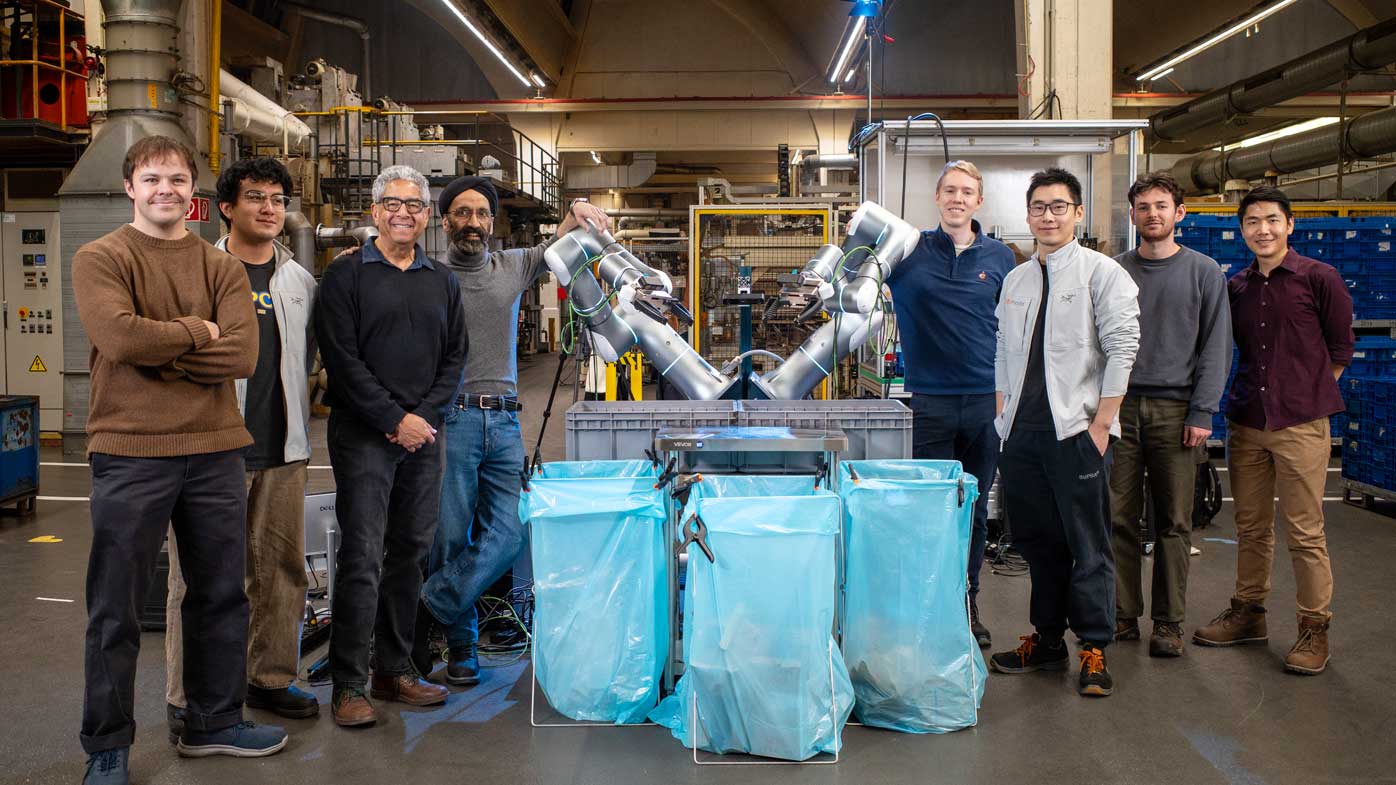
Rhoda AI
Rhoda AI emerged from stealth mode with a $450 million Series A.
Get news, papers, media and research delivered. Sign up for our free newsletters.
Stay up-to-date with news and resources you need to do your job. Research industry trends, compare companies and get weekly market intelligence with Robotics 24/7.
Rhoda AI
Rhoda AI emerged from stealth mode with a $450 million Series A.
Rhoda AI, which said it is building a new class of robot foundation model designed to bring general intelligence into the physical world, announced its public launch after 18 months in stealth with a $450 million in Series A funding to accelerate development and industrial deployment.
The company simultaneously unveiled FutureVision, which it described as a new approach to robotic intelligence based on video-predictive control, and designed to operate beyond controlled laboratory demonstrations and into real-world environments.
Rhoda AI said that traditional industrial robots perform well in structured environments, but remain largely limited to pre-programmed trajectories. More recent AI approaches - particularly vision-language-action (VLA) models - allow robots to learn from data and have demonstrated impressive results in laboratory settings. However, the company said that many still struggle to cope with the variability of the real world, including shifting layouts, previously unseen objects and unpredictable workflows.
Rather than relying primarily on teleoperated robot trajectories, Rhoda said it pre-trains its models on internet-scale video - hundreds of millions of videos - to build a strong prior on motion, physics and physical interaction. The company then post-trains the models on smaller amounts of robot data to learn embodiment-specific behaviors and the mapping from video predictions to robot actions.
The resulting system continuously observes its environment, predicts future states as video, converts those predictions into actions, executes them, and re-observes the world - repeating this process every few hundred milliseconds in a closed loop.
Rhoda calls this proprietary architecture a Direct Video Action (DVA) model, designed to bridge perception and control. Unlike open-loop approaches that generate plans without continuous feedback, Rhoda said that the DVA system updates its behavior dynamically as conditions change, enabling accurate physics-aware control in real time. The strong motion prior learned during Rhoda’s natively autoregressive video-based pretraining allows the model to learn new tasks efficiently, often requiring as little as 10 hours of teleoperation data.
Built on this architecture, Rhoda said that FutureVision serves as its intelligence layer, a foundation model that powers Rhoda systems today and is expected to be licensed to partners across different robotic hardware and software platforms over time.
“We believe the next era of robotics requires models that understand how the world moves - not just what it looks like or how it’s described in language,” said Jagdeep Singh, co-founder and CEO of Rhoda. “By learning from internet-scale video and operating in closed loop, our systems are designed to adapt to real-world variability in ways conventional approaches struggle to achieve. The goal is simple: robots that work in the real world, not just controlled lab settings.”
Rhoda said its technology has already demonstrated autonomous operation in production environments, where robots must handle continuously changing materials, layouts and workflows. In a recent high-volume manufacturing evaluation, the company said that it completed a component-processing workflow in under two minutes per cycle without human intervention, exceeding customer KPIs.
“In manufacturing, tasks with high variability have historically resisted automation. The real challenge isn’t solving it once, it’s delivering consistent, reliable output under real-world production conditions,” said Jens Wiese, managing partner at VC firm Leitmotif and former Volkswagen Group executive. “What impressed us about Rhoda’s approach is its ability to adapt to conditions that typically require human intervention. Technologies like this can dramatically expand the scope of what can be automated, playing a pivotal role in re-industrializing mature economies.”
Rhoda AI said that the $450 million Series A will support continued research and engineering investment, expansion of industrial deployments and customer pilots, and growth of Rhoda’s multidisciplinary team, spanning generative AI, computer vision and robotics.
Investors that participated in Rhoda AI’s Series A include Capricorn Investment Group, Khosla Ventures, Leitmotif, Matter Venture Partners, Mayfield, Premji Invest, Prelude Ventures, Temasek, Xora and more.
“We believe the first company to deploy intelligent, manipulation-capable robots at scale in real-world environments will kick start a powerful data flywheel, creating a compounding advantage in capturing the long tail of real-world edge cases,” said Sandesh Patnam, managing partner at Premji Invest. “At Premji Invest, we take a long-term view and are highly selective in where we partner. We invest only when we believe a company has the potential to build a truly large, enduring business. We believe Rhoda has assembled the technical foundation, ambition and execution capability required to achieve that goal, and we are excited to partner with this exceptional team to help bring the next generation of intelligent robots into the world.”
GENISOM AI makes ICRA debut at conference in Vienna
World's first omni-modal evaluation including tactile sensing for…
North America’s largest robotics and automation event winds down
Automate’s largest day ever draws huge crowds to McCormick Place