InOrbit
InOrbit provides Data Backfill and Time Capsule features for robot fleet optimization.
Get news, papers, media and research delivered. Sign up for our free newsletters.
Stay up-to-date with news and resources you need to do your job. Research industry trends, compare companies and get weekly market intelligence with Robotics 24/7.
InOrbit
InOrbit provides Data Backfill and Time Capsule features for robot fleet optimization.
As fleets of mobile robots grow, so does the challenge of managing them. Businesses deploying systems from multiple vendors across locations and in demanding conditions need a robot operations, or RobOps, infrastructure, according to InOrbit. The company today announced that it has released Data Backfill, a RobOps tool designed to eliminate gaps in a robot’s operating history with data saved offline.
"This is another piece of the puzzle for how to maintain end-to-end observability under even the most demanding conditions," wrote InOrbit in a blog post.
The Mountain View, Calif.-based company said its cloud-based, robot-agnostic data platform helps customers with “the four O’s” of RobOps: observability, operation, orchestration, and optimization. InOrbit said it provides secure, real-time analytics and data collection, robot performance monitoring (RPM), and incident response.
Engineers in development labs usually don't need to worry about how much data they can send from a robot to a laptop or when they can do it, noted InOrbit. Stable network or Ethernet connections, plus robots that are stationary or moving in controlled environments, can lead to assumptions about data generation and availability for analysis.
However, when robots need to be tested in the field or used in production, "network stability and resource allocation become incredibly important," InOrbit said.
Unstable, costly cellular networks and Wi-Fi "dead zones" are a common pain point for robot deployments. The observability portion of robot operations can be compromised if a robot is offline or enters an area with limited bandwidth, said the company.
In some use cases, robots can only connect to a network sporadically. These data gaps can adversely affect performance, InOrbit noted. For instance, an engineer performing root-cause analysis may miss critical details, which could mean the difference between a successful deployment and a failed pilot.
"There will be times when even the most stable network will be irregular or offline, just as there will be times when a robot will have a strong connection but may be performing resource-intensive tasks that require additional allocations, such as completing a mission," said InOrbit. "At other times, a robot will be idle and may have a better connection, such as when it is docked and recharging."
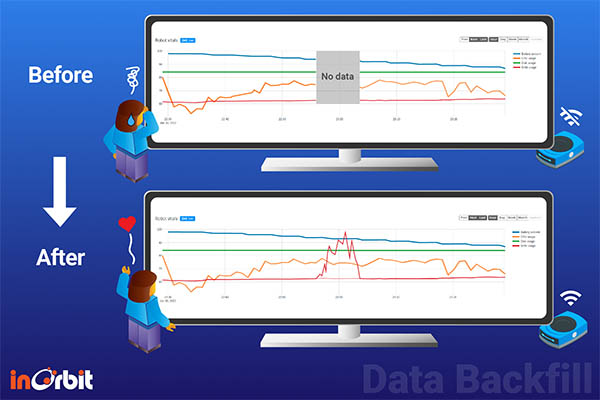
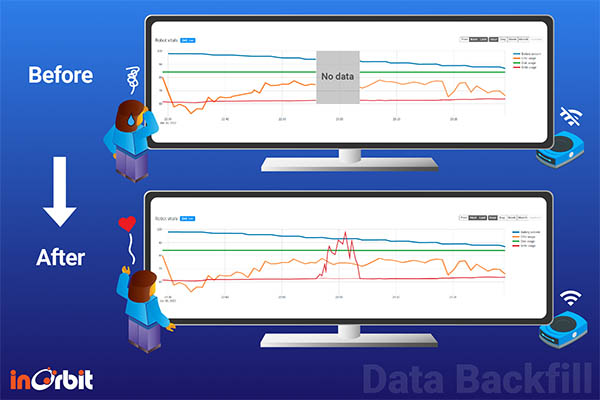
InOrbit Data Backfill collects and stores data locally via the InOrbit Agent. When network conditions improve, the system uploads the preserved data is to the cloud and merges it with existing data. This makes it possible to reconstruct the details of a robot’s operating history.
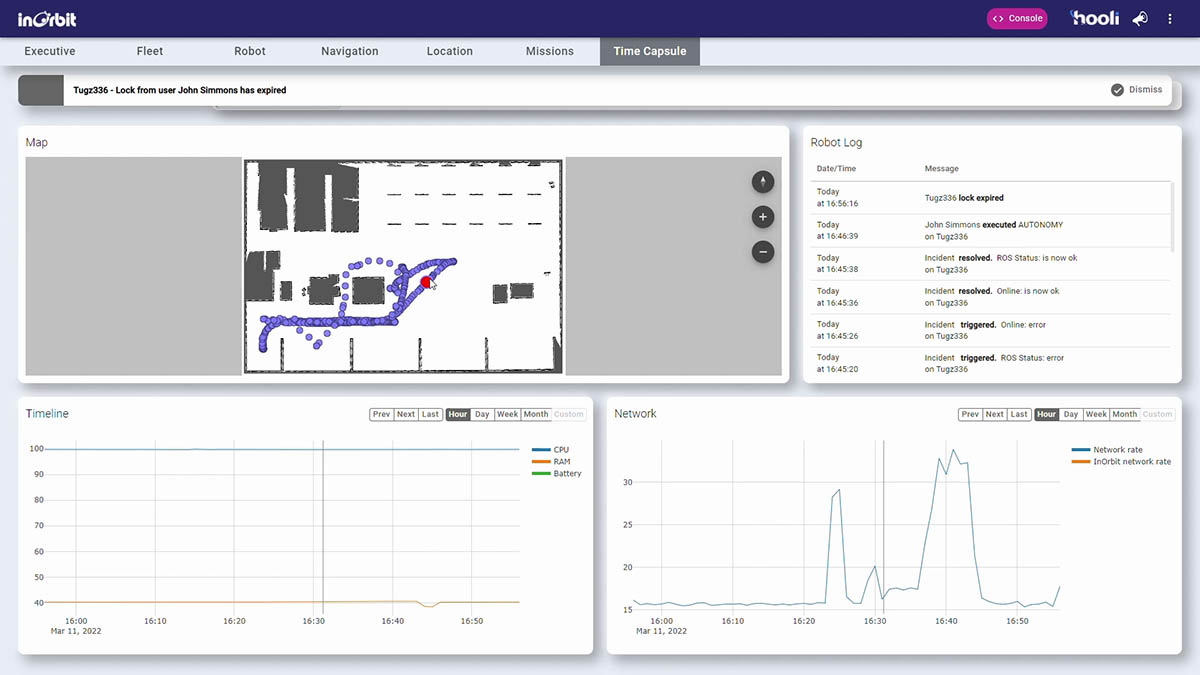
Data Backfill can be used in with InOrbit Time Capsule, launched last year, for analysis and continuous improvement, said InOrbit. The new feature is designed to support robots, incident analysis, and reporting under different network and operational conditions -- even if a robot is operating completely offline, said InOrbit.
As sensor platforms, robots can produce gigabytes per minute, including camera images, laser scans, maps, temperature readings, and wheel odometry. Whether engineers use a centralized cloud service or connect locally to robots for debugging, the amount of data they need to access may be prohibitive for the connection type available.
While a robot may be disconnected from the InOrbit Cloud and other applications with spotty LTE or even 5G coverage, the InOrbit Agent will continue to run on it, said the company. InOrbit claimed that Data Backfill can ensure data integrity and persistence, as well as enable operators to throttle data up and down to adapt to a situation.
"We practice aggressive data decimation for our users," said the company. "Keeping data management costs under control while maintaining data quality and integrity is an important part of our approach to effective data management. Adaptive Diagnostics collect and transmit only the minimum information necessary for useful insights, and change dynamically depending on a robot's specific circumstances."
In addition to filling data gaps and providing data integrity, InOrbit said it supports mobile robot operators with advanced fleet management capabilities.
Beyond just interoperability, the company now offers robot orchestration, which select InOrbit customers are already using. This includes enhanced navigation with heterogeneous multi-robot visualizations, defined single-occupancy areas used to trigger dynamic exclusion zones, and more.
InOrbit says that orchestration of robots is increasingly important as it releases the Data Backfill feature.
Enjoyed this article? Add Robotics 24/7 as a preferred source in Google Search.
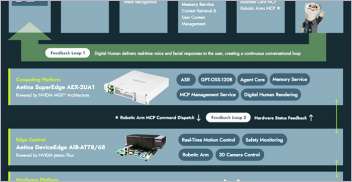
Edge computing gives AI agents the processing power to turn instructions into…
Daimon-TWM world model debuts for the public
Platform helps robots adapt to complex tasks
Look beyond the headlines for the latest in humanoid robots