Johns Hopkins University
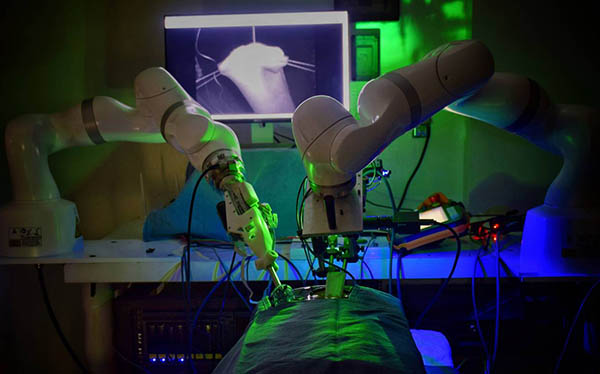
The STAR system has improved vision guidance and precision compared with its predecessor model.
Get news, papers, media and research delivered. Sign up for our free newsletters.
Stay up-to-date with news and resources you need to do your job. Research industry trends, compare companies and get weekly market intelligence with Robotics 24/7.
Johns Hopkins University
The STAR system has improved vision guidance and precision compared with its predecessor model.
While robot-assisted surgical procedures are typically supervised by physicians, fully automated surgery is progressing. A team of researchers at Johns Hopkins University yesterday announced that the Smart Tissue Autonomous Robot, or STAR, has performed laparoscopic surgery on the soft tissue of a pig without human guidance.
The researchers described their work in Science Robotics.
"Our findings show that we can automate one of the most intricate and delicate tasks in surgery: the reconnection of two ends of an intestine," said Axel Krieger, an assistant professor of mechanical engineering at Johns Hopkins' Whiting School of Engineering and senior author. "The STAR performed the procedure in four animals and it produced significantly better results than humans performing the same procedure."
The robot excelled at intestinal anastomosis, a procedure that requires a high level of repetitive motion and precision, according to the researchers. Connecting two ends of an intestine is arguably the most challenging step in gastrointestinal surgery, requiring a surgeon to suture with high accuracy and consistency. Even the slightest hand tremor or misplaced stitch can result in a leak that could have catastrophic complications for the patient.
Working with collaborators at the Children's National Hospital in Washington, D.C., and Jin Kang, a Johns Hopkins professor of electrical and computer engineering, Krieger helped create the robot, a vision-guided system designed specifically to suture soft tissue. Their current iteration advances a 2016 model that repaired a pig's intestines accurately, but required a large incision to access the intestine and more guidance from humans.
The team equipped the STAR with new features for enhanced autonomy and improved surgical precision, including specialized suturing tools and state-of-the art imaging systems that provide more accurate visualizations of the surgical field.
Soft-tissue surgery is especially hard for robots because of its unpredictability, forcing them to be able to adapt quickly to handle unexpected obstacles, Krieger said. The STAR has a novel control system that can adjust the surgical plan in real time, just as a human surgeon would.
"What makes the STAR special is that it is the first robotic system to plan, adapt, and execute a surgical plan in soft tissue with minimal human intervention," Krieger said.
A structural-light based three-dimensional endoscope and machine learning-based tracking algorithm developed by Kang and his students guides STAR. "We believe an advanced three-dimensional machine vision system is essential in making intelligent surgical robots smarter and safer," Kang said.
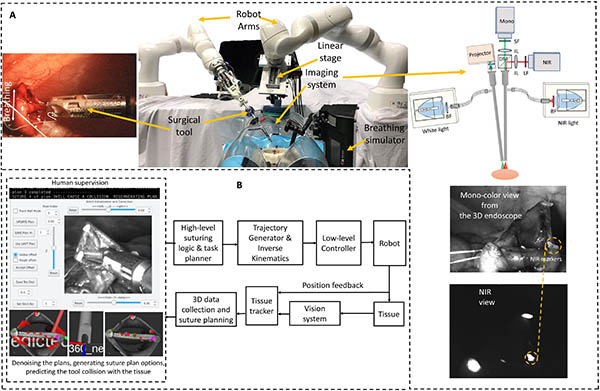
Enhanced autonomous laparoscopic soft tissue surgery. (A) The components of the STAR system, including medical robotic arms, actuated surgical tools, and dual-channel NIR and 3D structured light endoscopic imaging system. (B) Control architecture of the enhanced autonomous control strategy for STAR. Source: Johns Hopkins
As the medical field moves towards more laparoscopic approaches for surgeries, it will be important to have an automated robotic system designed for such procedures to assist, Krieger said.
"Robotic anastomosis is one way to ensure that surgical tasks that require high precision and repeatability can be performed with more accuracy and precision in every patient independent of surgeon skill," Krieger said. "We hypothesize that this will result in a democratized surgical approach to patient care with more predictable and consistent patient outcomes."
The team from Johns Hopkins also included Hamed Saeidi, Justin D. Opfermann, Michael Kam, Shuwen Wei, and Simon Leonard. Michael H. Hsieh, director of Transitional Urology at Children's National Hospital, also contributed to the research.
The work was supported by the National Institute of Biomedical Imaging and Bioengineering of the National Institutes of Health under award Nos. 1R01EB020610 and R21EB024707.
A robot has performed laparoscopic surgery on the soft tissue of a pig without human help. Actual surgery clip toward end of video.
Enjoyed this article? Add Robotics 24/7 as a preferred source in Google Search.
Edge computing gives AI agents the processing power to turn instructions into…
Daimon-TWM world model debuts for the public
Platform helps robots adapt to complex tasks
Look beyond the headlines for the latest in humanoid robots